- Published on
From First-floor Inbound to the External Finished-goods Warehouse: How Inventory Remains a Company Asset
Morning on the First Floor
8:15 a.m.
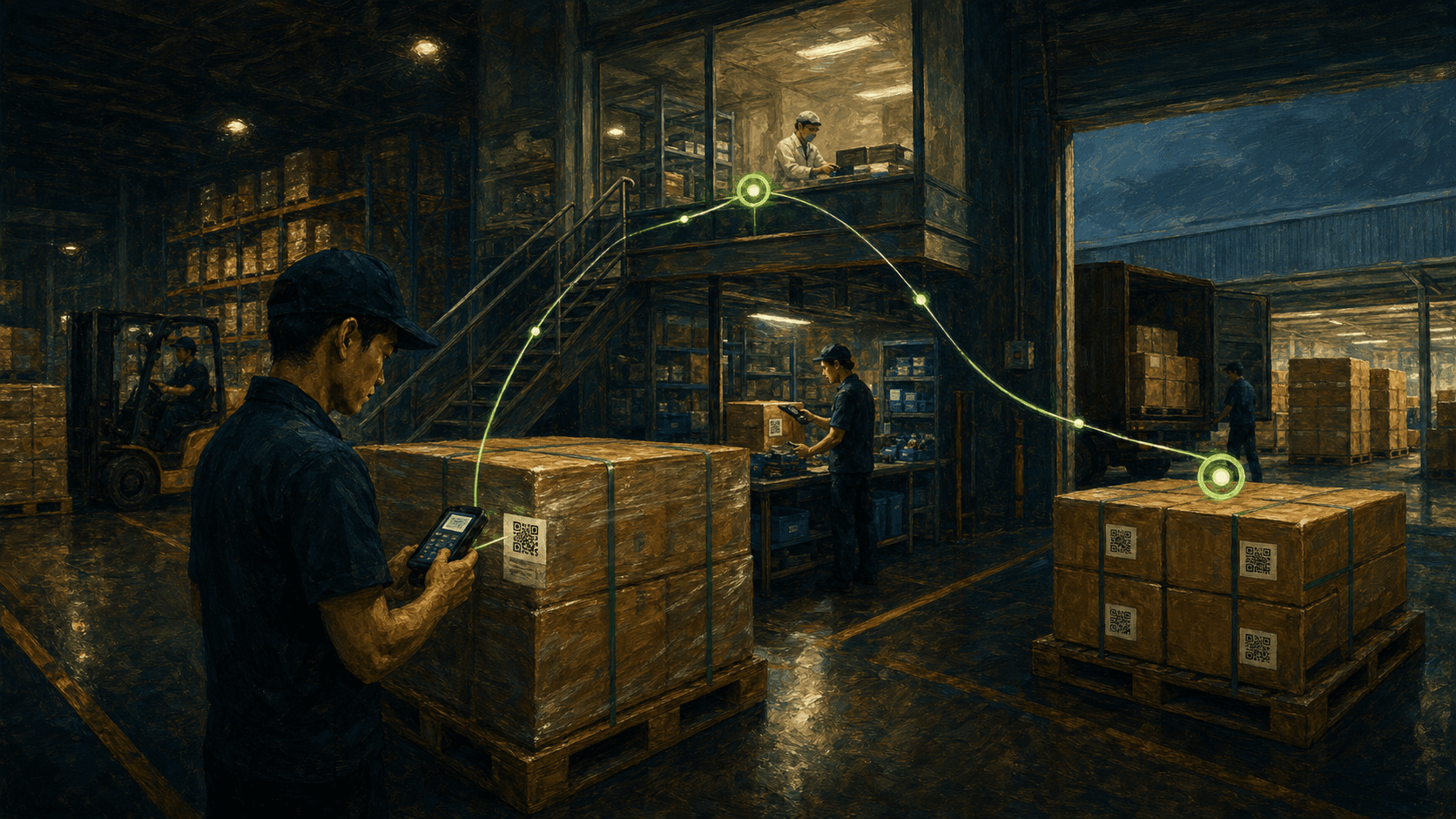
As the shutter of the first-floor inbound area opened upward, a large raw-material supply truck slowly reversed into the rear dock. Inside the loading bay, key materials for future process assembly, such as temperature-control controllers, connectors, and packing carton boxes, were loaded in orderly mixture together with general subsidiary materials used for manufacturing other item groups across the company. The flow managed by Exa Omni+ was not isolated to one specific primary item. Every item in the company was beating together inside one large integrated inventory transaction engine: inbound, inspection, storage, issue, process input, and external finished-goods shipment.
The warehouse person lifted a dedicated mobile terminal and compared the delivery note with the procurement PO information in the system.
In the past, when handwritten records and fragmented Excel management were used, even this simple inbound matching work caused numerous bottlenecks. Purchase PO numbers were trapped in individual Excel sheets owned by the procurement team. ETA information was buried in the email archive of practitioners. Actual inbound quantities were written with a pen on paper receiving slips and typed into ledgers much later. Sometimes, because the production line was urgent, field operators even took materials that had not passed inbound inspection and asked warehouse staff to "send them straight up to the upstairs line first." Physical assets that bypassed the system returned every month-end as a bill called large inventory variance of unknown cause.
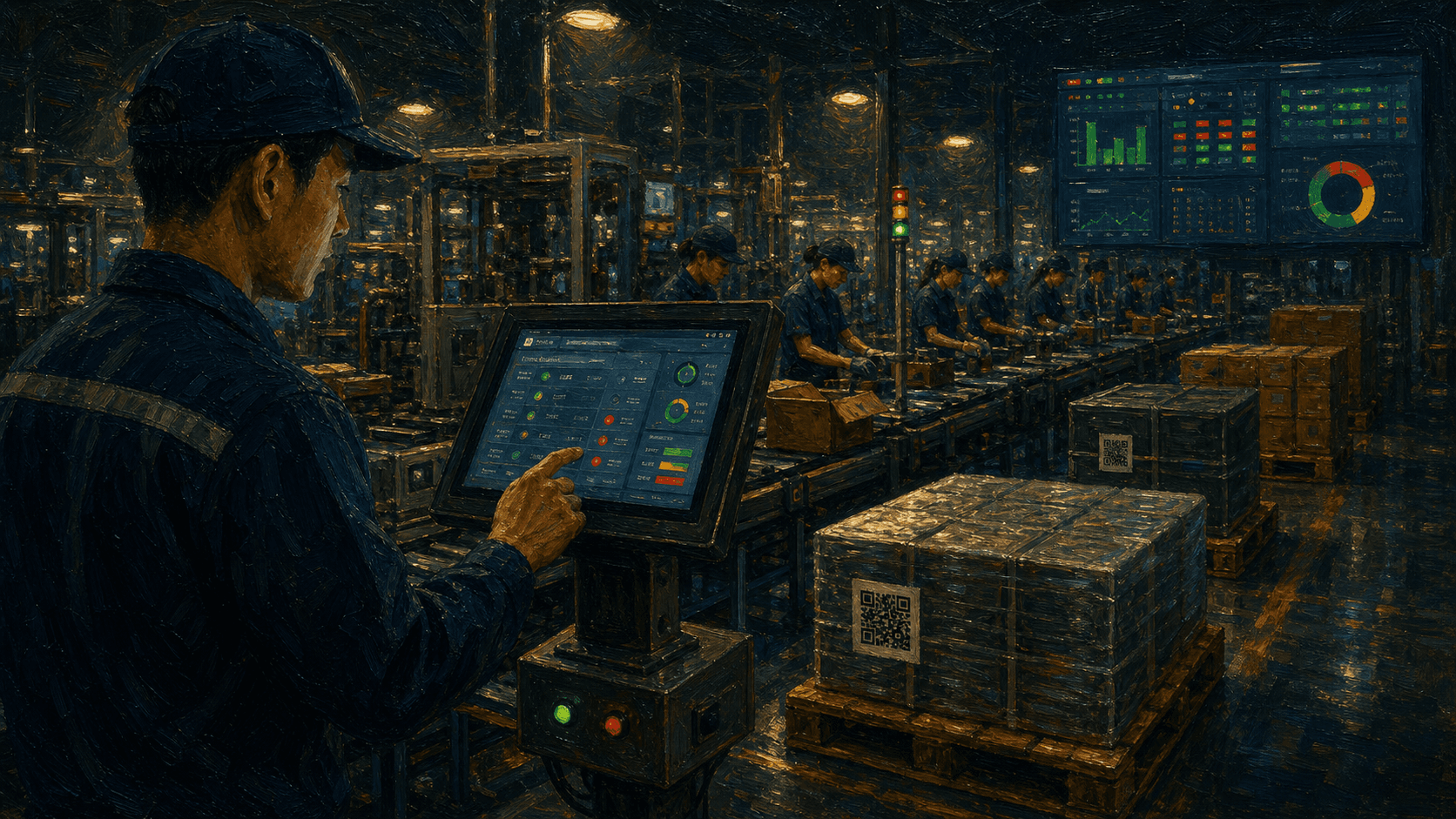
The monitor screen facing the warehouse person now was highly organized.
The inbound management interface of Exa Omni+ WMS displayed related PO matching status, ETA information, supplier delivery compliance risk indicators, expected inbound quantity, customs clearance status, and whether the item was subject to inbound quality inspection, IQC, through multidimensional mapping. Whenever a physical pallet was unloaded, the person immediately issued a unique pallet identification QR and precisely linked individual lower-level box QR codes and quantities to the system ledger.
Unique pallet QR: identifier for optimizing logistics movement routes and tracking storage location
Box-level QR: maintains physical balance inside the box and supply-chain LOT traceability
Supplier partner LOT: organic mapping between source supplier LOT number and internal inventory transaction LOT
PO/ETA dynamic comparison: automatic evaluation of physical supply timeliness against procurement scheduling
IQC real-time status: management of waiting for inspection, under inspection, final pass, conditional hold, and fail isolation
The person checked the unloaded quantities in order.
Temperature controllers 2,000 pieces, interface connectors 5,000 pieces, specification information labels 12,000 sheets, final packing boxes 1,500 pieces.
The system displayed a "delivery risk: Yellow (caution)" indicator for the imported controller PO. It had arrived about 24 hours later than the originally committed ETA due to variability during customs clearance. A simple static database would have left only an after-the-fact statistic saying "inbound delayed by one day." But Exa Omni+, organically synchronized with the finite-capacity production scheduling algorithm and the real-time procurement material requirements plan, MRP, immediately recalculated the potential bottleneck weight that this small one-day delay could have on this week's planned production LOT start timeline and final customer delivery, then fed it in real time to the working dashboard.
The Pallet Going Up to Second-floor IQC
Raw-material pallets that completed initial receiving inspection and labeling at the first-floor inbound area moved quietly to the second-floor IQC waiting area through the factory's dedicated freight elevator. When the warehouse person touched [Confirm Location Move] on the terminal screen and lightly scanned the pallet QR, the location value in the system inventory ledger changed immediately.
[First-floor inbound waiting] -> [Second-floor IQC waiting area]
In the old factory environment, a serious time gap would have occurred between physical material movement and system location update. Quality inspectors had to roam around the wide factory warehouse and search through physical boxes to find out whether materials were still left at the first-floor unloading area, already moved to the second floor, or temporarily stopped in another staging area.
Under the Exa Omni+ structure, the IQC quality person could dynamically check the list of available inspection targets that had arrived in the waiting area while remaining seated. Especially for imported controller materials, the supplier's historical delivery-delay record and the minor crack defect pattern found in a specific LOT during the previous quarter were recorded in the system, so the item had been pre-designated as a priority inspection and precision sampling target with a red flag.
The inspector opened raw-material boxes and performed physical inspection according to the defined standard sampling method.
Precise measurement of exterior damage and terminal pin fastening condition
Functional test of connector operation according to electrical signal input
Comparison of supplier LOT certificate specifications with physical specifications
Judgment of whether the packing carton had damage that allowed humidity intrusion
The inspection result showed that the overall yield of imported materials was stable, but one box corner was dented, apparently from impact during transport, and three internal controller terminals showed minor scratch deformation.
The inspector immediately scanned the QR code of the deformed box and independently changed its disposition status to [Hold: Move to isolation area]. The remaining boxes on the same pallet that were judged normal were immediately converted to [IQC Passed: Available Asset] and branched for movement to the storage location. The old, crude quality response of putting the whole pallet on inspection hold and stopping the operating line no longer existed. This high flexibility was possible because box-level QR and quantity information were controlled as fully independent nodes in the system.
Keeping Is Not Storage, but the Beginning of Responsibility
High-quality materials that safely passed the IQC gate and received normal approval began to be stored deep inside the warehouse according to the item- and LOT-based Keeping location instruction sequence.
On the WMS monitor, the optimal recommended storage location was calculated and displayed in real time based on the storage characteristics of each raw material. It considered usable period, issue frequency, weight limit of the storage space, and need for humidity control. The warehouse person moved the pallet along the recommended route, scanned the location QR attached to the storage rack, and closed the task.
[Second-floor A-03-02 Keeping completed]
At that moment, the individual box QR codes inside the pallet were also linked in real time with the upper storage location information. Even when stored by pallet, the quantity inside each box did not lose its consistency as an individual asset. Later, even if individual boxes were picked and issued according to operating-line requests, the ledger would record without error which box had how many units deducted. This was a precise inventory transaction structure.
This fine traceability becomes the most decisive defense line for protecting enterprise physical-inventory consistency in a production environment where large volumes of materials are input at high speed.
For example, due to the characteristics of the assembly line, the quantity of fine connector parts consumed each day reaches several thousand pieces. If a variance of only 20 pieces occurs and is not deducted from the ledger in real time, the variance disappears somewhere in the process line as invisible WIP congestion or material loss. Eventually it results in a wasteful stock-count war at the end of every month, where all employees walk through the warehouse at night opening boxes on racks and counting quantities, along with ledger variances whose causes cannot be found.
Under the Exa Omni+ WMS structure, inventory is not a static object merely sitting on a warehouse rack. It is a core financial asset of the company, organically alive through the sophisticated combination of item, LOT, pallet, box, storage cell location, quality status, and inventory transaction history.
Picking Instructions and Line Time
2:00 p.m.
The production control team of the Vietnam local factory finalized tomorrow's production operation plan and distributed it through the system. The confirmed plan expanded upward from MPS was cascaded downward into material requirements by line through MRP calculation, and the finite-capacity scheduling engine derived the optimal material picking sequence based on the physical operating sequence of the assembly lines.
At the same time, a precise Picking instruction sheet for warehouse staff was dynamically generated on the WMS screen.
Target production execution LOT ID and assigned assembly line number
Material item to be picked and real-time required quantity
Optimal FIFO material LOT number recommended by the system
Keeping rack location information where the material is located
Candidate substitute approved LOTs immediately available when available material is insufficient
Picking cut-off time required to comply with the process input timeline
The warehouse person immediately moved to the storage rack location, second-floor A-03-02, following the route guide arranged on the mobile screen. When the designated controller box QR was scanned with the terminal, a green message appeared: "FIFO LOT matched, picking approved." When the required quantity was issued from the box, Keeping inventory in the system ledger was deducted in real time and immediately transferred to [Line-side Buffer Inventory], which means the production line waiting area.
In the old factory environment, the outbound step would have ended vaguely with a verbal report such as "we placed the material next to the line first," or with an incomplete issue slip.
Now, however, it was woven perfectly as if threaded by a single digital string: which part from which partner LOT, imported through which customs-cleared PO, was picked at what hour and minute by which operator, and input into which finished-goods LOT production on which line. Even if an unexpected fine defect occurred during the process and traceability had to be activated, complete visibility was secured to track the inflow route and source inbound information of the defective part in one second.
Inventory was no longer isolated inside the boundary of the warehouse. Even while waiting for consumption at the line side, while transforming into WIP assets inside the process, and until being sealed in a final packing carton box and loaded onto the last dock heading outside, it pulsed under the inventory transaction control of the perfect single source of truth.
Exceptions Are Recorded, Not Hidden
4:10 p.m.
While the warehouse person was moving packing carton boxes from the lower rack with transport equipment, the equipment corner scratched the carton, severely tearing the outside and damaging part of the internal packing fabric material. A field exception incident occurred.
In the old factory environment, such small loss incidents were often hidden. To avoid criticism from managers, field workers might hide damaged materials in a warehouse corner or quietly pass them to production line operators and consume them as if they were normal quantity. These invisible micro-leaks accumulated and gnawed away at ledger reliability from the bottom.
In the Exa Omni+ environment, there was no need to hide exceptions, and they could not be hidden. The warehouse person immediately activated [Register Field Scrap] on the mobile terminal.
He selected the damaged quantity and physical location, photographed and uploaded field evidence using the terminal camera, then selected "damage during physical field transfer" as the scrap reason code and submitted it. The quantity was immediately excluded from available inventory in the enterprise system and transferred to the isolated scrap inventory flow. On the production control dashboard, tomorrow's packing-material buffer quantity for assembly was automatically tuned in real time and fed as an alert metric to prevent shortage risk.
Soon afterward, an urgent issue request for a small quantity of label material for a new training sample from the development team was received as miscellaneous issue. In the past, such irregular small-quantity issues were the main cause of inventory variance. Now, inventory transactions worked only when the requester clearly specified a detailed irregular issue reason code in the system and completed a digital signature.
Sample for R&D and performance testing
For operation verification when introducing new equipment, Machine Calibration
Imported raw-material inspection and customer sample submission, Customer Verification
For improving operator process proficiency, Training Asset
As soon as approval was completed, the relevant label quantity was deducted from the WMS inventory transaction ledger without any variance. This was not a system that suffocated the field by forcibly suppressing exception transactions themselves. It was a structure that completely absorbed all irregular exception movements occurring in the field into the transparent inventory synchronization architecture of the system and concluded them as controllable data.
Finished Goods Are Company Assets Even Outside
Two days later, in the afternoon.
After the operation of the primary lines was successfully completed, finished-goods boxes that had passed final inspection and carton packing received a sealed label printed with the final finished-goods barcode. Inside each finished-goods box's unique QR code, raw-material LOT traceability used in processing, the work team and equipment ID that executed production, and the digital consistency of the inspection certificate that passed final process PQC were organically mapped.
Some of the volume moved immediately to the shipping dock and waited for overseas shipment, while the remaining finished-goods volume began moving at once to the external 3PL finished-goods warehouse physically located outside the factory. The external warehouse was operated by an outsourced professional logistics operator, but ownership of the stored assets clearly belonged to head office.
In the past, from the moment physical goods crossed this physical boundary and entered the external warehouse, a massive blackout in asset visibility occurred. Until the static Excel report that the operator's employees recorded in their own system and sent once a day arrived, managers at head office or the factory had no way to know in real time how safely the actual finished-goods inventory was stored or exactly how many physical boxes were immediately available for shipment against orders.
Under the Exa Omni+ architecture, these external warehouse personnel were brought inside the single SSoT platform through [3PL External Finished-goods Dedicated Portal Accounts] designed with strict role-based access control, RBAC.
External operator staff logged in only within their authorized scope and performed scanning work while intuitively viewing only the screens permitted to them: inbound confirmation, storage loading, picking shipment, and stock-count screens.
QR scan to confirm storage quantity when the carton box transfer truck arrives
Registration of external storage rack location and synchronization of transfer status
Physical box picking verification based on head-office shipment instruction
Final departure scan approval at the physical shipment closing dock
The moment a finished-goods pallet left the factory dock and was scanned inbound at the external warehouse, the system location automatically changed from [KOKEN Factory] to [External Finished-goods 3PL Warehouse]. Only the storage location of the asset was dynamically updated. In the inventory transaction ledger of the enterprise ERP, the asset still maintained consistency as "real-time available finished-goods asset belonging to head office." The global quality manager at Japan head office and the shipping manager at the factory could look at the same physical inventory availability number, ATP, across physical distance with confidence.
Quantity Is the Language of the Company
In the evening, as the day's shift session ended peacefully, the warehouse manager opened the integrated control monitor dashboard.
A smooth inflow curve showed the total material quantity that had entered the first-floor dock this morning, completed second-floor IQC inspection verification normally, and finished inbound to the designated Keeping locations. Beneath it, the line-side safety balance indicator, after deducting the rough consumption of the assembly line through real-time backflushing, pulsed with a clear green badge. The physical damage scrap cases processed in real time at the field, the irregular miscellaneous issue history, and the final finished-goods carton quantity shipped through the agile scans of external 3PL logistics operator staff were achieving complete quantity consistency on a single dashboard canvas.
The warehouse manager clearly understood that each number was not merely an inventory figure, but quantitative evidence of the trust and promise the company had made with the global market and final customers.
Only when the real-time quantity of raw materials is accurate without the slightest variance can the reliability of production scheduling be maintained. Only when production flows exactly according to plan can shipment milestones be met stably. Only when perfectly reconciled finished-goods inventory transaction control is guaranteed can head-office management present accurate real-time ATP, available-to-promise, to external buyers and protect brand value.
The greatest innovative balance that Exa Omni+ WMS governance gave to the Vietnam manufacturing subsidiary was not merely a tool that shortened warehouse workers' scanning time. It was the most complete and powerful digital anchor: from a tiny raw-material box rolling on the floor of the first-floor factory dock to a finished-goods carton box stored in a corner of the external 3PL yard, it synchronized and fixed every exceptional movement and physical transaction trace in the field into the real-time quantitative database of the single source of truth that supports the massive backbone of the global enterprise supply chain.
Exa Omni+ Application Points
Closed-loop Connection from Raw-material Inbound to 3PL Outbound: The full lifecycle inventory transaction of raw materials and products, from first-floor inbound, second-floor IQC inspection, Keeping location assignment, production replenishment picking, process consumption, finished-goods inbound, and external 3PL consigned storage, is managed through a unique QR-based single data pipeline.
Internalizing Field Exception Variability Inside Inventory Accuracy: All irregular exception transactions, including field scrap damage, miscellaneous issue for irregular R&D or training purposes, imported raw-material nonconformance returns, and replacement flows for independent substitute material inbound to prevent PO distortion, are brought inside standardized system inventory transaction flows to protect ledger accuracy.
3PL External Asset Security Control Based on RBAC: For an external warehouse environment where ownership belongs to head office but operations are handled by an external logistics partner, dedicated RBAC portal interfaces are granted to external workers. Core sales secrets are strictly protected while real-time visibility of enterprise asset inventory transactions is perfectly maintained.
Bayesian EXAWin-Rate Forecaster
Precisely predict sales success by real-time Bayesian updates of subtle signals from every negotiation. With EXAWin, sales evolves from intuition into the ultimate data science.