Dynamic synchronization of complex operations, intelligent execution for enterprise-wide optimization.
From operational facts to sustainable enterprise performance.
Exa Omni+ ERP is an intelligent enterprise system that structures operational uncertainty through Business Science. It connects sales and planning, materials and production, inventory and logistics in one flow, using actual operational data to support clearer decisions and execution.
Strategic objectives and operational execution are synchronized through a single causal structure.
ONE ENTERPRISE. ONE SYNCHRONIZED FLOW.
Beyond local optimization, toward enterprise-wide performance
02SYNCHRONIZED VALUE CHAIN — FROM ORDER TO SHIPMENT
Close the gap between plan and production, synchronize operations to deliver planned shipments.
Orders change, materials arrive late, and equipment and quality fluctuate. When departments act on local metrics alone, delivery reliability and profitability across the supply chain break down. Omni+ traces the impact of small changes across the value chain through ontology, establishing a single, objective basis for the question: “What must the enterprise do first, right now?”
01
Demand and commitments
What must be supplied, and by when?
Sales intelligence, customer orders, and replenishment demand (MTA) are integrated and aligned as the starting point for feasible production scheduling.
Sales Intelligence · Dynamic MPS · MTO / MTA · MPS
02
Material supply
Can materials be available for input when required?
Supplier fingerprints are analyzed to calculate on-time risk probabilities through PO Risk Control, with coordinated intervention measures to secure on-time delivery for red-list items.
BOM · MRP / MTA · Purchasing
03
Production and flow
Where is the constraint, and what must happen first?
Actual capacity and constraints of operations, equipment, and work centers inform buffer management, connecting work orders, production actuals, and work in process to protect production against uncertainty.
Scheduling · MES / POP · WIP
04
Inventory and shipments
Where is stock, in what condition, and how much is available?
Physical location, quantity, and status are tracked from receipt, inspection, transfer, and picking through external warehouses and shipment, controlling customer delivery risk through to on-time fulfillment.
WMS / POI · Quality · Fulfillment
A sound structure for physical production and logistics flows is the foundation of sound strategic decisions.
03FACT · REASONING · EXECUTION · LEARNING
The system identifies causal relationships and provides clear alternatives and evidence.
Operational data is an organizational fingerprint: it records the factory’s efficiencies, inefficiencies, constraints, and variability. Omni Science Engine structures this data through ontology, learning and reasoning to derive solutions. Process Engine proposes those solutions in operational workflows and connects them to execution. People assess the evidence and decide; the system learns from actual outcomes, traces operational facts, and progressively converges on the organization’s underlying reality. This accumulated evidence and understanding support more precise decisions.
01
FACT → EVIDENCE
Capture operational facts as they occur
Transactions, production actuals, and material movements are collected in real time through POS and POP. Ontology structures linked to source data support reasoning, enabling the office and shop floor to share one factual basis as interpretable decision intelligence.
02
REASONING → POLICY
Trace relationships and compare alternatives
Ontology and reasoning trace relationships among orders, materials, operations, and quality. Bayesian analysis and simulation expose risks and alternatives, proposing what to change and why, with supporting evidence.
03
DECISION → EXECUTION
Connect decisions to execution
After the responsible person reviews operating conditions and downstream impacts and approves a decision, the selected policy and priorities are carried into operational workflows. Decision evidence and change histories remain traceable.
04
FEEDBACK → LEARNING
Learn from actual outcomes
The system analyzes differences between predictions and actuals and recalibrates lead times, buffers, and risk assessments. Bayesian inference—a major intellectual achievement—progressively reveals the reality underlying the organization’s operations as data accumulates. The organization uses that evidence to make more precise, strategic decisions.
A cascading crisis to prevent
A promised material delivery is a week late. Business plans across the global supply chain unravel.
Orders were placed early and time buffers secured to allow for supply delays. Yet a one-week material delay consumes even that allowance, making the committed production schedule unachievable.
The final buyer has already committed to supply, launch, sales, and marketing schedules across a worldwide distribution and dealer network. Production and shipment disruptions propagate through intermediaries into every one of those commitments. A single missed material delivery can devastate the business plans, revenue, and commercial trust of many enterprises.
Time and inventory held against delays also carry costs. As customers demand shorter lead times and buffers shrink, operations urgently need a basis for deciding which actions will prevent cascading damage.
Proactive on-time control · Protecting internal production
Manage risk from PO issuance and protect production when delays occur.
01 Predict delivery risk from the supplier’s fingerprint
A supplier’s delivery history is an organizational fingerprint of working practices, decision habits, management capability, and variability. Bayesian inference and MCMC Gibbs sampling analyze these patterns to calculate the probability of late delivery as soon as a PO is issued. Red, yellow, and green alerts identify management priorities.
02 Closely manage buffer events for at-risk POs
Red POs enter special management immediately. The PO Risk Hub shares and tracks buffer events with suppliers: securing and receiving materials, production start, progress and completion, packing, and shipment. Email and telephone histories are retained in a separate system and linked from the relevant PO.
03 Update probabilities and intervene before the due date
Risk probabilities are continuously updated from actual event progress, missing information, delay signals, and response actions. Suppliers, purchasing, production, and logistics coordinate shipment preparation, advance customs clearance, and transport, intervening before delays disrupt production to secure material input when required.
04 Protect production with alternative products and schedules
If material delays occur despite proactive control, ontology-based reasoning and simulation examine the relationships and constraints among materials, operations, equipment, and orders. The system proposes alternative products that can be produced with available materials and capacity, along with revised schedules, comparing their effects on customer delivery and Throughput. Changes selected and approved by the responsible person are carried into execution to limit cascading internal disruption.
Plans that account for real constraints, and can be completed.
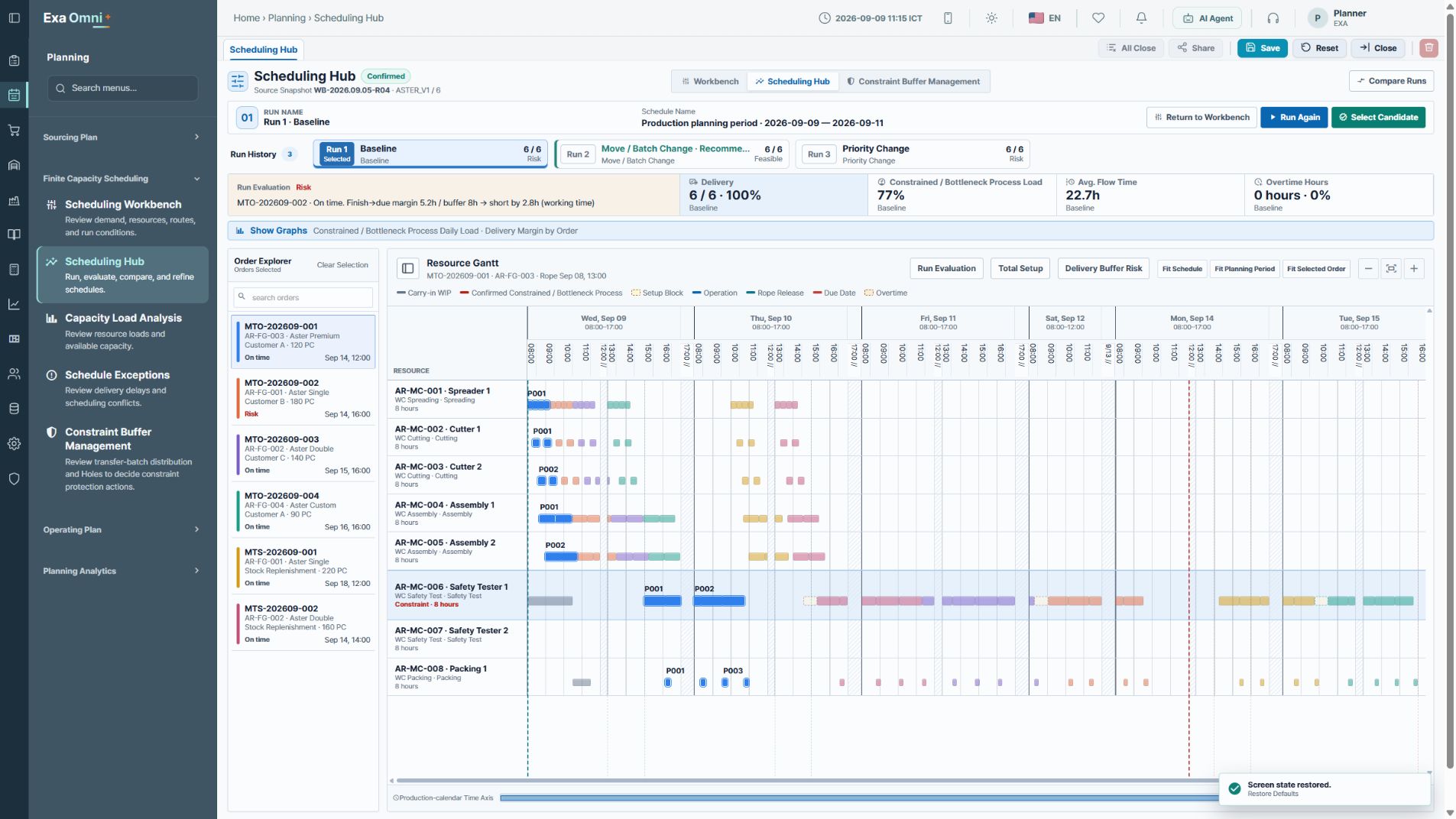
Customer-agreed due dates are requirements the production schedule must satisfy. Omni+ uses production-process and equipment-schedule data brought into the workbench as scheduling parameters. It analyzes material availability, actual capacity, constrained resources, and process variability to calculate and apply buffer sizes, then generates optimal finite-capacity production schedules against those parameters and given due dates. Buffer management tracks material and component locations and progress, identifies delay causes, and manages actions for timely arrival and input before production is disrupted. Proactive control and recovery come first; where recovery within the existing schedule is impossible, alternative products and schedules are evaluated to protect customer delivery and Throughput.
Scheduling Hub · Compare resource load and delivery margin by order, then inspect the selected operation’s schedule and delivery buffer.
Manual MPS
Manual MPS — production planning controlled by the user
Manual MPS is a way to run production by having users directly set what to produce, in what quantity, and by what completion date. Where production lead times per lot are as short as one or two days and the production flow is straightforward, production proceeds according to the plan established in Manual MPS without running a separate scheduling process.
The system proposes production candidates, including intermediate products, from customer orders, internal production demand, and replenishment demand (MTA), and calculates net requirements against available inventory. The user selects orders against customer-agreed due dates and internal required dates, then determines production quantities and schedules.
As the operation requires, users can continue with Manual MPS while piloting scheduling in selected plants, adjust the scope of scheduling, or return to manual planning.
Scheduling & Buffer Management
Omni+ generates optimal production schedules from process and equipment data brought into the workbench
Omni+ uses production-process and equipment-schedule data brought into the workbench as parameters to generate optimal production schedules. It analyzes actual capacity, constrained resources, and process variability to derive and apply buffer sizes, and calculates production sequences and material input times that satisfy given due dates.
The system evaluates each scheduling run against KPIs. The user reviews the evaluation, readjusts relevant parameters such as overtime and transfer batch size, and reruns the simulation. With each run, the user records the changed parameters and the intent behind the changes in a comment, repeats this process, and compares the scheduling results and evaluations across runs to confirm the optimal schedule. The parameters applied to the confirmed schedule become the basis for production policy. Buffer management proactively addresses uncertainty during production and controls execution so that production proceeds according to the confirmed schedule.
Buffer management based on finite-capacity production scheduling prevents disruption so the established plan can be fulfilled. Buffer consumption reveals early signs of deviation; the system tracks the current location and progress of materials and components due to arrive. It identifies causes of supply, transfer, and process delays and manages timely arrival and input actions, supporting recovery before delays propagate downstream.
Where proactive intervention and recovery cannot preserve the existing schedule, ontology-based reasoning and simulation derive alternative products and scheduling options. The responsible person compares delivery, Throughput, and buffer impacts and approves the change; production sequences and schedules are then adjusted, and proactive management continues against the revised plan.
The test of a solution is whether its schedule is executable under actual operating conditions—and sufficient to achieve On-Time & Throughput.
05THE WHOLE ENTERPRISE
Put the production plan at the center of execution, synchronize every function toward one objective.
Exa Omni+ ERP connects the timing and conditions purchasing, quality, production, and logistics must fulfill against the production plan. Each function manages its obligations for material input, process progress, and customer delivery, tracing deviations to prevent disruption. In parallel, internal accounting reflects actual transactions and physical movements in real-time costing and financial statements. Production-plan fulfillment and current financial position together inform enterprise decisions based on on-time delivery, Throughput, and cash flow.
Cross-functional fulfillment of the production plan
Production plans are based on confirmed customer orders, user-defined internal production demand, and replenishment demand (MTA). Purchasing manages receipt by material input dates; quality completes inspection before input; production meets operation schedules; logistics ships against customer due dates. Early signs of material and component delay trigger location and cause tracing and action management. Where recovery is impossible, the enterprise-wide impact of alternative products and schedules is analyzed.
Real-time costing and statements through internal accounting
Omni+ reflects operational transactions and physical production and logistics movements in internal accounting in real time to calculate costs and generate financial statements. Management immediately identifies costs, profit and loss, and asset and liability movements from transactions to date. The current financial position supports profitability and cash-flow analysis, funding decisions, and enterprise management.
Integrated head-office, production-site and shop-floor operations
Head-office operating policies and production-site and shop-floor plans, work orders, and actuals are integrated into one operational data structure. Multilingual working environments, role-based access, and approval procedures support traceability of execution and changes, ensuring consistent cross-organizational handovers and operational control.
06REAL-TIME FINANCE · INFORMATION WHEN DECISIONS MATTER
From real-time financial statements to free cash flow and enterprise valuation.
Information has value when it arrives in time for a decision. Exa Omni+ Finance connects transactions, financial statements, free cash flow, and decision intelligence in real time, providing current financial information while there is still time to decide and act.
Built on Free Cash Flow (FCF) in corporate finance, head-office and branch accounting enables real-time analysis of financial position and cash-generating capacity by business unit and responsibility center. Management uses current performance and funding requirements to determine investment, resource allocation, and operational improvements.
01 · TRANSACTIONS
Transactions and real-time journal entries
As soon as a transaction is recorded, internal AP invoices and journal entries are posted to the ledger. Reclassification entries based on subsequent supporting documents are also reflected in real time, updating the current financial position.
02 · FINANCIAL STATEMENTS
Costing and real-time statements
Costs calculated after the close of business are supplemented with costs from the current day’s transactions up to the query time, producing current profit and loss, assets, and liabilities.
03 · FREE CASH FLOW & VALUE
Real-time free cash flow
Operating Cash Flow (OCF), EBITDA, Free Cash Flow (FCF), EVA, and Economic Profit (EP) are calculated in real time. The enterprise’s current cash value, its components, and reconciliation results are immediately available for decisions.
04 · FINANCIAL DECISIONS
Valuation and financial decisions
Real-time financial analysis and DCF-based enterprise valuation feed an integrated decision dashboard, providing evidence when funding and investment decisions are needed.
Head-office and branch accounting master data automatically produces real-time FCF by business unit and center.
On transaction entry, amounts are allocated according to the head-office and branch accounting master data, and accounting vouchers are generated immediately. This feeds business-unit and center-level financial statements and FCF in real time, consistently extending divisional management accounting from transactions through financial analysis.
Identify which business units and centers are generating free cash now, and where funds are being deployed, to prioritize investment, resource allocation, and operational improvement. Real-time divisional FCF based on head-office and branch accounting is a core pillar of enterprise operations and management decisions, alongside logistics and production.
Free Cash FlowReal-time free cash flow · FCF
FCFFFree cash flow to the firm
=
FCFCAttributable to creditors
+
FCFEAttributable to equity holders
Transaction entry → Master-data allocation → Automatic accounting vouchers → Business-unit and center statements and FCF
EXA’s proprietary CBF model calculates and manages the cash the enterprise earns and accumulates.
EXA’s Cash Buffer of Firm (CBF) is a proprietary integrated calculation framework interwoven with the generation and attribution of FCF. It combines cash generated by operations, movements in working capital and capital investment, and cash attributable to creditors and equity holders with minimum required operating cash and internal cash accumulation, identifying what the enterprise itself has earned.
FCF and CBF components follow one calculation logic from generation and attribution through actual payment and cumulative changes. The framework cross-checks different calculation paths and attribution among the firm, creditors, and equity holders, tracking in real time the formation and accumulation of CBE—the enterprise’s cash reserve. This reconciliation supports calculation and management of the enterprise’s own cash-generating capacity and informs financial decisions.
Cash Buffer of FirmEXA’s proprietary enterprise surplus-cash framework · CBF
CBFEnterprise surplus cash
=
CBCAttributable to creditors
+
CBEAttributable to equity holders The enterprise’s cash reserve
FCF: cash generation, investment and attribution ⇄ CBF: retained cash and accumulation An integrated self-verification framework reconciling calculation paths and attribution
Cross-checking calculation paths
Calculations starting from financial statements and profit measures are reconciled on the same transaction and period basis. FCF and CBF attribution is verified, and component amounts are traced back to confirm consistency with cash balances.
Evaluating the enterprise’s own cash-generating capacity
The framework evaluates CBE—the enterprise’s cash reserve calculated through CBF—alongside cash generated by operations and actual invested capital. Bayesian updates revise estimates of cash-generating capacity as actual data accumulates, incorporating the enterprise’s own cash-generation performance into financial decisions.
Month-end close and official statements
A closing wizard supports cost closing and financial close. The results consistently feed official monthly financial statements, FCF, and financial analysis, connecting real-time management with finalized monthly results.
Align the timing of financial information with the decision. Real-time statements and divisional FCF support the decisions and actions needed now.
07THE REASON BEHIND THE SYSTEM
We publish the theory behind our solutions and the evidence behind decisions.
EXA publishes the theory and application logic of probabilistic material on-time risk assessment, finite-capacity production scheduling, and buffer management. Operational cases and technical documents explain source data, model assumptions and constraints, alternative generation, and the grounds for execution decisions. They enable examination of a solution’s validity and applicability to actual operations.
Enterprise synchronization around the production plan, integrated execution for business continuity.
We analyze demand variability, material delivery risk, capacity constraints, execution deviations, and cash flow in the context of each enterprise’s operating conditions. We design and implement enterprise processes, data structures, and decision systems to achieve On-Time & Throughput and financial soundness.