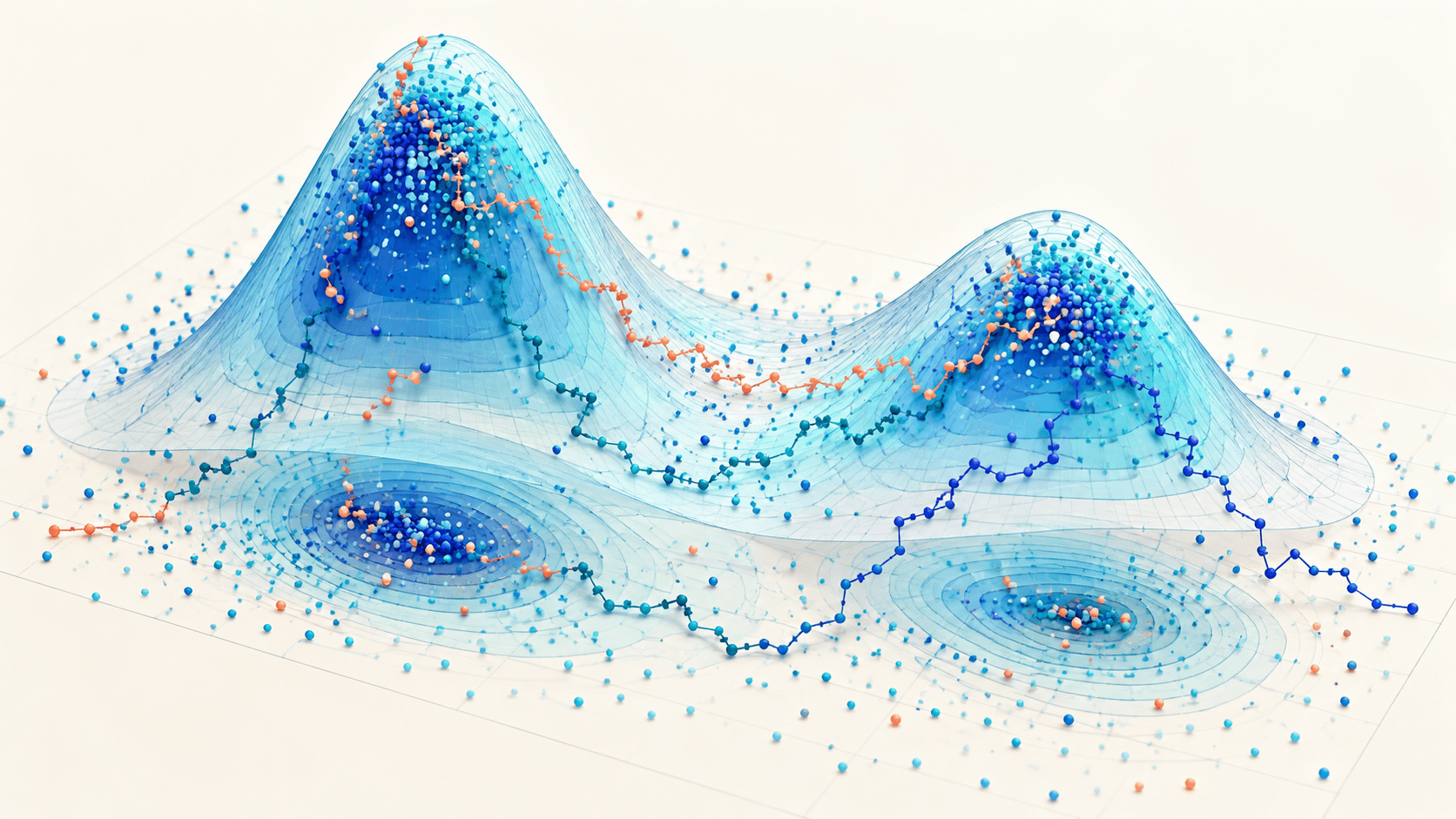
An ExaWin+ decision case that updates field observations and customer responses as Bayesian evidence, tracks win probability over 60 days, and allocates limited sales resources to better customers and actions.
11 min read
Bayesian
BayesFactor
BayesianUpdate
SERIESSeries: 60-Day Gamble: Part 2Theory & Methods
This article explains the mathematical principles and effectiveness of the Bayesian engine covered in the [BA02 Episode]. The goal is to precisely predict sales success probabilities in an uncertain business environment. At its core, it addresses the process of deriving optimal decision-making indicators by combining the Beta distribution, which quantifies past experiences, and the Binomial distribution, which captures real-time signals from the field. In particular, it emphasizes maximizing the system’s real-time performance and computational efficiency by utilizing Conjugate Prior distributions, which allow for immediate updates without complex calculations. Furthermore, this model adopts a Recursive Estimation method that makes immediate judgments whenever data occurs, securing technical validity optimized for modern business. Consequently, this document clearly demonstrates how sophisticated mathematical modeling transforms vague intuition into reliable, data-driven insights.
10 min read
Bayesian
Bayes Factor
Bayesian Update
SERIESSeries: 60-Day Gamble: Part 3Theory & Methods
In the previous Parts 1 and 2 of the [BA02. Exa Bayesian Inference: The Invisible Hand of Sales—A 60-Day Gamble] episode, we explored how the Bayesian engine establishes 'prior beliefs' and tracks the trajectory of probabilities through 'signals' and 'silence.' Now, we hold in our hands the pure posterior probability $ P_{raw} $, precisely calculated by the Bayesian parameters α and β. However, it is not over yet. The final decision-making process remains. Even with a 60% probability, the weight of the decision can vary completely depending on whether it was derived from a single meeting or dozens of negotiations.
14 min read
Bayesian
likelihood
bayesian
SERIESSeries: 60-Day Gamble: Part 5Sales & Customers
The EXA Bayesian Engine calculated win probabilities, but its precision depended on manually configured initial parameters. When 100 historical deals accumulated, the engine was ready to evolve on its own. Grid Search, MCMC Ensemble Sampling, and Cross-Validation — three mathematical pillars working in concert to find optimal parameters. Told as a story.
13 min read
Bayesian
Auto-Tuner
Grid Search
SERIESSeries: 60-Day Gamble: Part 6Theory & Methods
How do you find the 'optimal' among 3,240 parameter combinations? Grid Search performs an exhaustive scan, and Youden's J Index finds the balance point between Sensitivity and Specificity. The mathematical principles behind data-driven tuning of sales stage weights (T) and signal sensitivity (k) — the first pillar of Auto-Tuner — explained with business context.
11 min read
Bayesian
Auto-Tuner
Grid Search
SERIESSeries: 60-Day Gamble: Part 7Theory & Methods
If Grid Search found the 'tallest hill,' the MCMC Ensemble Sampler is the process by which 256 explorers reach consensus that 'the height is correct.' The mathematical principles behind Emcee's affine-invariant walkers, R̂ convergence diagnostics, HDI 95% credible intervals, 5-Fold cross-validation, and Signal Lift analysis — explained with business context.
15 min read
Bayesian
Auto-Tuner
MCMC
60-Day Gamble — All articles | EXA Business Science Lab