

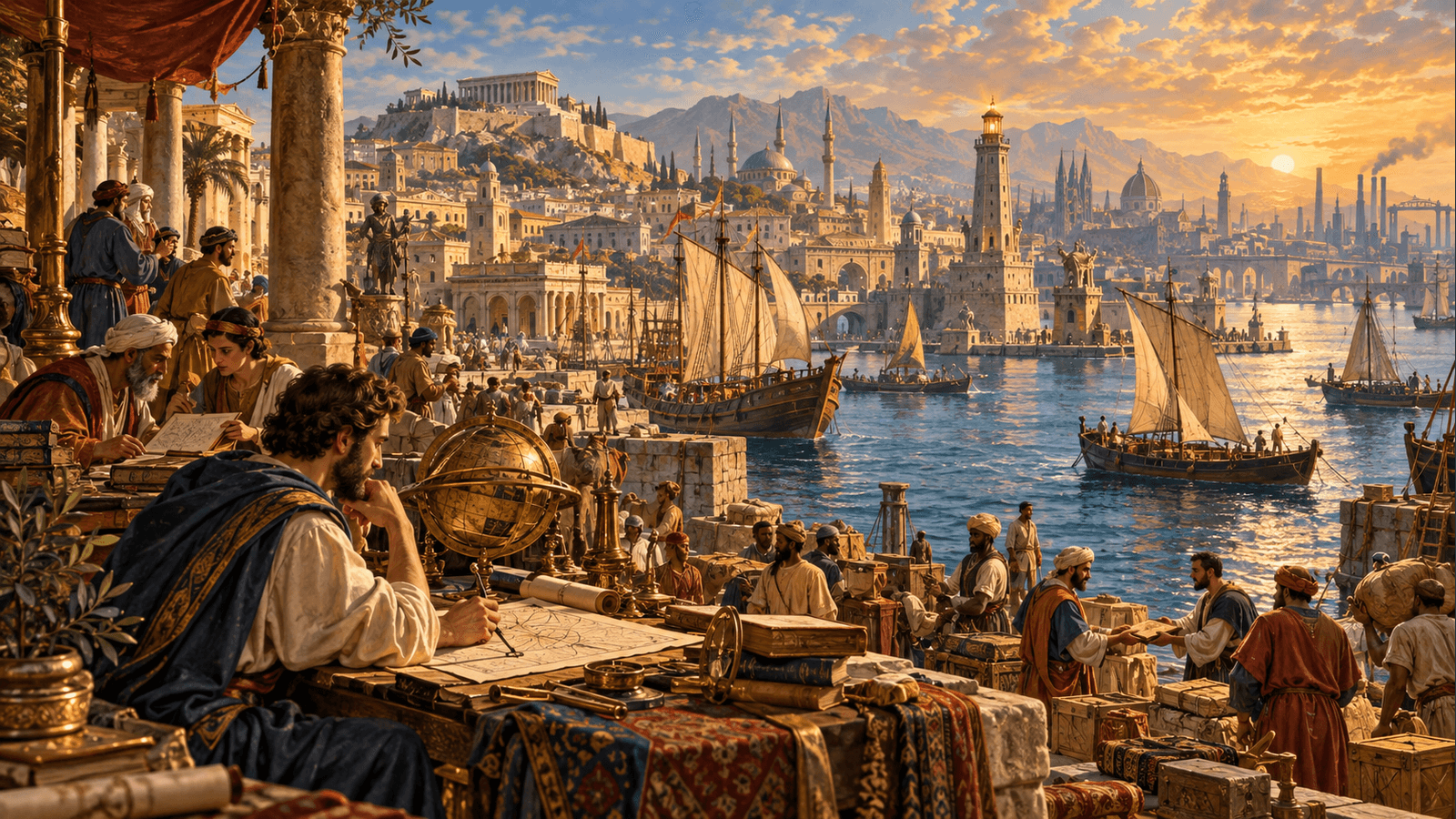
Scientific History
The Human Epic — Knowledge and Insight through World History
Business Science: Understanding Business through Human History
Business Science, EXA’s motto, begins by placing business within human history. A company is an organization shaped by the institutions, technologies, knowledge, and values of its time. The problems it faces carry the traces of much older human experience. Power and cooperation, the allocation of resources and competition, judgment under uncertainty, growth and decline: questions that once confronted states and communities recur in the companies of today.
The modern company took shape relatively late in the long span of human history. Yet the problems of bringing people together, dividing their work, and using resources toward a common purpose are far older. So are the tasks of reconciling interests within an organization, responding to change, and bearing the cost of poor judgment. The business world remains bound to the historical conditions and human behavior that brought it into being.
Scientific History is a human epic that explores this continuity. Following the course of world history, it examines how mathematics and science, economics and management, engineering and information technology, warfare and military strategy developed and influenced one another. To understand business deeply, it begins with the civilizations and human choices that made business possible.
Scientific History is a long-running series, tracing humanity’s journey from the Ice Age to the present, one installment at a time. The people, events, and questions encountered along the way will not stay within the boundaries of any single era or discipline. How many installments this journey will take is not yet decided. This essay opens that long expedition.
The World in Which Knowledge Was Born
Behind every formula lies a problem it helped solve. Behind every technology are circumstances that made its creation necessary; behind every school of thought, an order it accepted or resisted. The knowledge now divided among separate disciplines took shape within the history of human life.
Textbooks organize the achievements of that long process. Formulas and laws, concepts and theories survive in concise language. The trial and error, the arguments, and the questions that remained unanswered at the time are harder to see. A finished answer alone rarely reveals its full significance.
History restores that context. It shows which problems were urgent, where existing explanations reached their limits, and what a new idea changed. Between the names and dates of discoveries, human lives come into view, and scattered bodies of knowledge begin to connect.
A ship needs a harbor to reach the shore. Knowledge, too, needs a platform through which it can reach people and become intelligible. World history is a platform that brings knowledge within human understanding. By showing the age in which knowledge arose, the lives people led, and the problems they faced, it gives unfamiliar concepts and theories a concrete setting. Once that context is understood, knowledge becomes more than something to remember. It becomes our own: something we can think with and use to make judgments.
This is why EXA Business Science turns to history. To understand a management theory or technique, we need to examine the organizations, systems of production, markets, and societies in which it became necessary. Understanding both the logic of mathematical models and the behavior of real human organizations makes the explanatory reach of a theory—and its limits—clearer.
The Age Behind a Formula
The Pythagorean theorem expresses a relationship among the three sides of a right triangle. Knowing that relationship, however, is a different achievement from proving that it must hold. The passage from an empirically established fact to a proof within a logical system marks a change in how human beings judge knowledge.
Euclidean geometry exemplifies this achievement. Propositions are derived from basic premises; proven propositions then provide the basis for the next. Solutions to individual problems become connected, forming a coherent system.
To understand how this tradition of proof developed in ancient Greece, we must also examine the world around it. How did the politics and debates of the city-states, philosophical inquiry, and knowledge transmitted from other civilizations relate to one another? What exerted an influence, and what merely coexisted? Such questions connect the history of geometry to the society and thought of its time, and to exchanges between civilizations.
Astronomy and physics bring together questions at different levels as well. Kepler identified mathematical regularities in planetary motion and investigated their causes. Newton connected those regularities to more general physical principles through his laws of motion and universal gravitation. Inquiry deepened: from describing observed movement to uncovering the principles that explained it.
There are two kinds of “why” here. One is historical: why did a particular problem arise in that time and place? The other concerns the knowledge itself: what principle explains a phenomenon, and under what conditions does it hold?
Scientific History pursues both questions. It distinguishes the circumstances in which knowledge arose from the logic of that knowledge, while examining how the two meet in history.
Following the Course of World History
The story begins with the people of the Ice Age. It follows migration and settlement, the growth of cities and states, the rise and fall of empires, and the development of religion and philosophy. It continues through the Age of Exploration, the Scientific Revolution, and the Industrial Revolution into today’s information society. The politics and wars, trade and institutions, beliefs and everyday lives of each age form the center of the narrative.
Mathematics and physics, astronomy and Earth science, philosophy and law, economics and management, engineering and computer science, information technology and artificial intelligence enter within that flow of time. So do warfare, military technology, strategy, and military studies. These are among the many ways people have sought to understand nature, use resources, organize collective effort, and respond to competition and conflict. The attention given to each field, and the depth of its treatment, will vary with the problems and objects of inquiry people encountered in each era.
War is a major subject of this narrative. We examine the political orders and struggles for power, economic interests and social conflicts of the times in which wars began, tracing the judgments and choices that turned those conditions into armed conflict. Alongside battlefield outcomes and strategy, we consider the powers that chose war and the lives of those who paid its price.
The histories of physics and engineering are entangled in that process. Making weapons, building fortifications, and calculating trajectories and ranges stimulated technology and intellectual inquiry. Accumulated knowledge, in turn, transformed the conduct and destructive capacity of war. Knowledge that helped people survive and prosper also became a means of destroying them. Humanity’s repeated resort to destruction, even as it advanced in knowledge and technology, must be examined alongside the achievements of civilization.
Knowledge develops along many paths. Immediate needs may produce new technologies; pure curiosity or a logical problem within a discipline may also drive inquiry. Sometimes a technology is used before its principles are explained. Sometimes a theory with no obvious application in its own time becomes the foundation of a later technology.
Actual dates and evidence provide the basis for establishing these relationships. Later achievements cannot be written into the past as its inevitable purpose, nor can two events be treated as cause and effect simply because they occurred in the same period. Distinguishing the choices available at the time from outcomes no one could yet know allows history to emerge as concrete human experience, rather than a straight line toward a predetermined ending.
The Conditions of the Earth, the Choices of Human Beings
Human history unfolded in particular landscapes and climates. Rivers and soils shaped the conditions for food and settlement; mountains and seas obstructed movement or opened routes of exchange. The distribution of resources and changes in climate altered where and how people could live.
Ice Age changes in sea level reshaped the land and influenced human movement. Great rivers and fertile plains provided important conditions for the growth of several civilizations. Examining terrain and climate helps us understand the opportunities and constraints people faced.
Yet the environment did not determine how history would end. People responded to their circumstances by developing institutions and technologies and making different political and cultural choices. Those choices, in turn, changed the environments in which they lived.
Earth science provides a foundation for explaining this interaction. Reading terrain and climate, rivers and seas, resources and natural hazards alongside migration, settlement, trade, and war brings the formation and transformation of civilizations into sharper focus.
Beneath the Arrows on the Map
Historical maps mark advancing armies and moving populations with arrows. The expansion and decline of empires appear as shifting borders and colors. Changes spanning long periods become visible at a glance, but the lives of the people who moved along those lines remain outside the map.
Leaving home, losing family in war, and beginning again in an unfamiliar land take far longer than a short line of movement suggests. The rise and fall of states must be read alongside the survival, memory, and losses of individuals and communities.
The Battle of Vercellae in 101 BCE offers one example. From the Roman perspective, the Cimbri were barbarians invading Roman territory. Yet Plutarch’s account of their wagon camp after defeat preserves a human tragedy that the label cannot contain. He describes the horrifying sight of women killing their children and then taking their own lives.
That account cannot tell us everything they feared or sought to protect. But it does compel us to ask whether describing their migration and struggle simply as a barbarian invasion intent on plundering Rome is enough. Behind the battlefield were families: a community that had moved together and sustained its life along the way.
Accepting the details as historical events requires careful scrutiny of the source. Even so, the account reveals the fate of the defeated, obscured by the phrase “Roman victory.” An event remembered as glory in one people’s history may have meant the destruction of home and community for another.
Scientific History broadens its gaze from the decisions of kings and generals to the people who lived beneath those decisions. It considers both those whose names survive and those who disappeared without a name in the record, without filling the gaps in the evidence with invented scenes. Discovering how much the surviving traces allow us to know is itself part of understanding human history.
Insights That Connect the Ages
Different eras confront problems that resemble one another: the concentration of power and weakening of institutions, organizational growth and rigidity, the prosperity and disruption brought by technological change, competition for resources, and the movement of populations.
Resemblance is the beginning of comparison. Institutions, technologies, and social relationships differ across eras, so apparently similar events cannot simply be assumed to share the same causes. Similarities and differences must be considered together, along with the conditions under which a comparison holds—and where it breaks down.
In this series, an event will first be explored within its own age. Where a meaningful connection arises, the narrative will then bring in a later example. Rome’s political crises might be compared with later concentrations of power, or ancient migrations considered alongside war and expulsion in other periods. After the comparison, the story returns to its original point in time and resumes the course of world history.
The same approach applies to war. After tracing how political struggles, rivalries, perceptions of threat, and misjudgments of an opponent’s intentions escalated into conflict, we turn to later wars in East and West that arose in comparable circumstances. Which conflicts recurred? How did the possibility of compromise disappear? Why were similar choices repeated even after the experience of destruction? Such comparisons rest on the actual records and conditions of each war, with differences between eras and limits of explanation made clear. The narrative then returns to its original timeline, following the changes war left behind and the emergence of the next age.
Historical insight takes shape through this process. Identifying differences and counterexamples that resist familiar explanations matters as much as recognizing recurring structures. Rather than attaching a lesson to every event, comparison reveals what can be explained and which questions remain. From there, we can consider what past experience may mean for judgment today.
Connections to business follow the same standard. States, armies, and companies differ in their purposes, responsibilities, and forms of authority. Military victory cannot simply be adopted as a model for business competition. Yet the transmission of information, the allocation of resources, the distance between command and conditions on the ground, and the reasons successful organizations become insensitive to change all offer worthwhile questions for comparison. Exploring these questions while preserving historical conditions and differences is part of the inquiry of Business Science.
From Questions to Understanding
Socrates’ questions led people to reexamine what they believed they knew. In Eliyahu Goldratt’s much later novel The Goal, questions and dialogue also serve as a way of discovering the essential nature of a problem. Situated in very different contexts, the two examples illuminate the role of questioning in understanding.
The narrative of Scientific History likewise follows questions. It examines a problem in its own age, follows attempts to solve it, and moves toward the principles and new questions that emerge along the way.
A small needle becomes a clue to Ice Age survival and the transmission of skills. A shadow can become the starting point for reasoning about the size of the Earth. An account of war can challenge the way a civilization’s prosperity is judged. Inquiry begins with particular objects and events, then opens into a wider history and a broader field of knowledge.
Where needed, mathematical derivations and physical principles receive sustained attention. Once we understand what a principle explains and where its limits lie, we return to the history in which that knowledge was used and transformed. This movement back and forth connects the flow of the narrative with intellectual depth.
A Story That Begins in a World of Ice
Artifacts and historical sources, historical maps and scientific diagrams underpin this long narrative. Visual reconstructions of daily life help readers understand the environments people inhabited. Distinguishing established facts from interpretations, hypotheses, traditions, and literary reconstruction makes both the grounds and the limits of an explanation visible.
At the center are human beings seeking to understand their world and find ways to live in it: people who endured war and disaster, questioned the order they inherited, corrected failed methods, and passed what they had learned to the next generation. Through their experiences and choices, knowledge accumulated. Meeting the questions of another age, it acquired new meaning.
EXA’s Scientific History draws that process into one extended world history. It examines civilization’s achievements and costs, human choices and their consequences, tracing the paths by which today’s knowledge and ways of thinking took shape. The company finds its place within that history as one form of organizing people, knowledge, and resources. EXA’s Business Science draws on this long experience to examine the problems of management and the grounds—and limits—of its judgments.
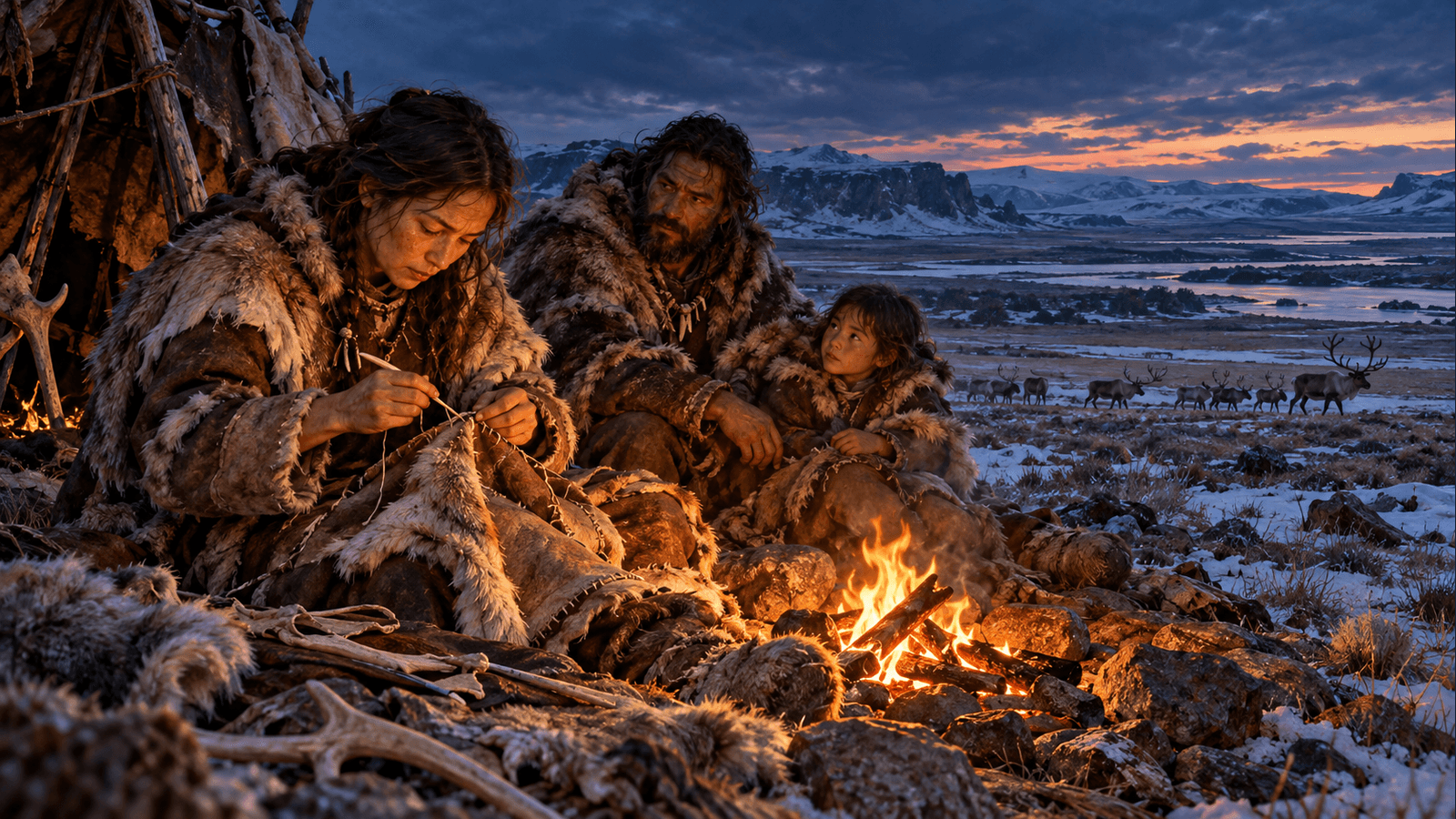
The first installment of this long journey begins roughly twenty thousand years ago, in a world of ice.
Mammoths had thick fur. Reindeer had bodies adapted to the cold. Human beings could not endure that harsh environment for long with their bodies alone. Yet they stayed, lived, and passed the skills of daily life to another generation.
Among the traces of their survival, one small needle remains.
A hand shaped bone, pierced an eye, and stitched hides together. In the skill that hand acquired and the knowledge it passed on begins one scene in humanity’s long history of living beyond the limits of the body.

Join the discussion