

1. Trees Carried across the Sea
People are carefully lifting trees aboard a ship. These are not trunks cut for timber. They are living trees, their roots still cradling the soil, nestled in baskets.
Gold and ebony, exotic aromatics and unfamiliar animals are coming aboard as well. Amid the bustle, green saplings stand ready to cross the waves.1
The scene appears on a relief in Hatshepsut’s mortuary temple, rising above the west bank at Luxor, Egypt, at Deir el-Bahari. Across the walls of this sanctuary, built to honor a dead ruler and serve the gods, unfolds the journey of an expedition dispatched by the queen to the distant southern seas.
Prepared aromatics alone would have been worth so long a voyage. Why go to the trouble of lifting living trees aboard, roots and all, without even shaking off the heavy soil?
The expedition wanted trees to plant in the temple gardens. They meant to transplant an entire piece of that distant land to the banks of the Nile: trees that would yield the sacred resin offered to the gods.2
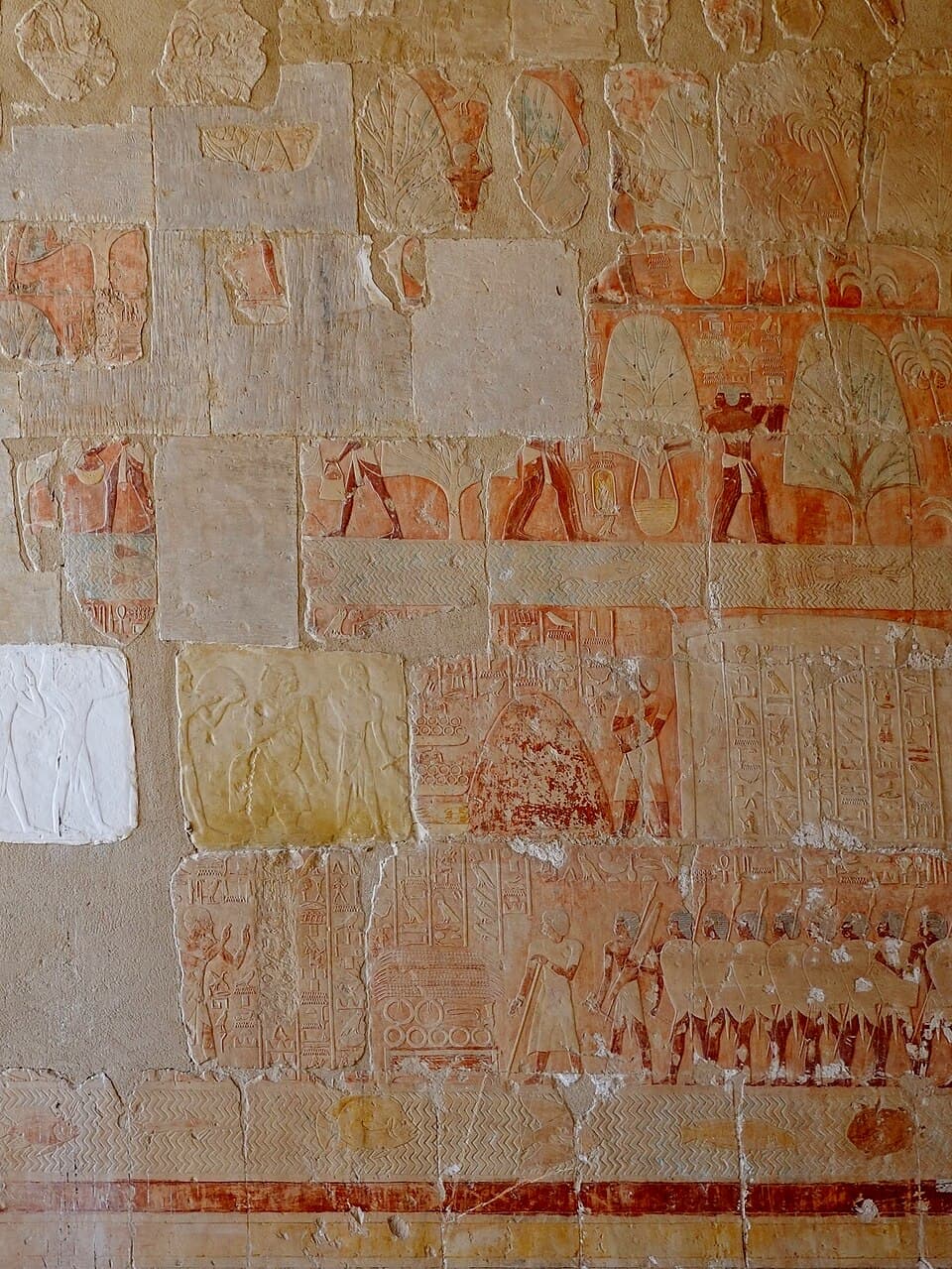
Relief of the Punt expedition at Hatshepsut’s mortuary temple. Figures carrying trees remain visible in the upper part of the wall. Photo: Olaf Tausch, CC BY 3.0.
Their destination was Punt. Somewhere to the south along the Red Sea lay a land that had long supplied the Egyptian court with rare treasures and raw materials. The temple walls even bear the figures of Punt’s ruler and his wife, with their unusual physiques. By recording the people and products of a foreign land one by one in solid stone, the pharaoh proclaimed to the world how far the royal reach could extend in the search for supplies.
This was the fifteenth century BCE.
At the close of Part 8, Ahmose I drove the Hyksos out of the Nile Delta and reunited Egypt. The rulers of the New Kingdom that followed no longer confined themselves to the Nile Valley. To the south, they took hold of Nubia’s gold mines; to the northeast, they advanced beyond the Sinai Peninsula into the Levant.
An agrarian state that had watched the Nile’s floods, collected taxes, and stored grain had grown into an empire dealing directly with ports, trade routes, and rulers beyond its borders.3
The farther the court reached, the more it could acquire, but the longer the frontiers it had to defend became. Securing metals and timber from distant mines and forests, keeping strategic cities ready to receive envoys, and maintaining supply routes to feed armies on campaign became central tasks of royal government. A ship returning unhurriedly from Punt with trees aboard reveals one face of that widening world. On another horizon, soldiers were already hammering at someone else’s gates.
North of Egypt, wealthy city-states lined the eastern Mediterranean coast. This was the Levant, extending across what is now Syria and Lebanon. To its northwest, on the Anatolian plateau, the Hittites stood their ground with infantry and chariots. In Mesopotamia, along the Tigris and Euphrates, the great powers of Mitanni, Assyria, and Babylonia vied to hold the balance. Across the Aegean, Mycenaean civilization was also gathering strength, drawing wealth and labor into its palaces.
In this intricate contest among powerful rivals, blades and chariots alone could not uphold a king’s standing. He needed messengers who could understand exactly what the other side wanted and convey his own demands to a foreign court without the slightest distortion.
A letter from a Babylonian ruler to the pharaoh on the Nile arrived, unexpectedly, not as hieroglyphs on papyrus but as wedge-shaped impressions pressed into a palm-sized tablet of clay.
2. The Same Letters, Different Forms of Address
In New York’s Metropolitan Museum of Art survives a letter from an Assyrian king, unearthed in the sands of Egypt. Cuneiform signs crowd the surface of a clay tablet small enough to fit snugly in one hand. In the fourteenth century BCE, Ashur-uballit I, ruler of Assyria, sent it to the king of Egypt.
He enclosed gifts: a chariot, two fine horses, and blue lapis lazuli. He also asked that his envoys be allowed to look around Egypt. He intended to bring his people into the other ruler’s domain and make his name and gifts unmistakably present at the Egyptian court.4
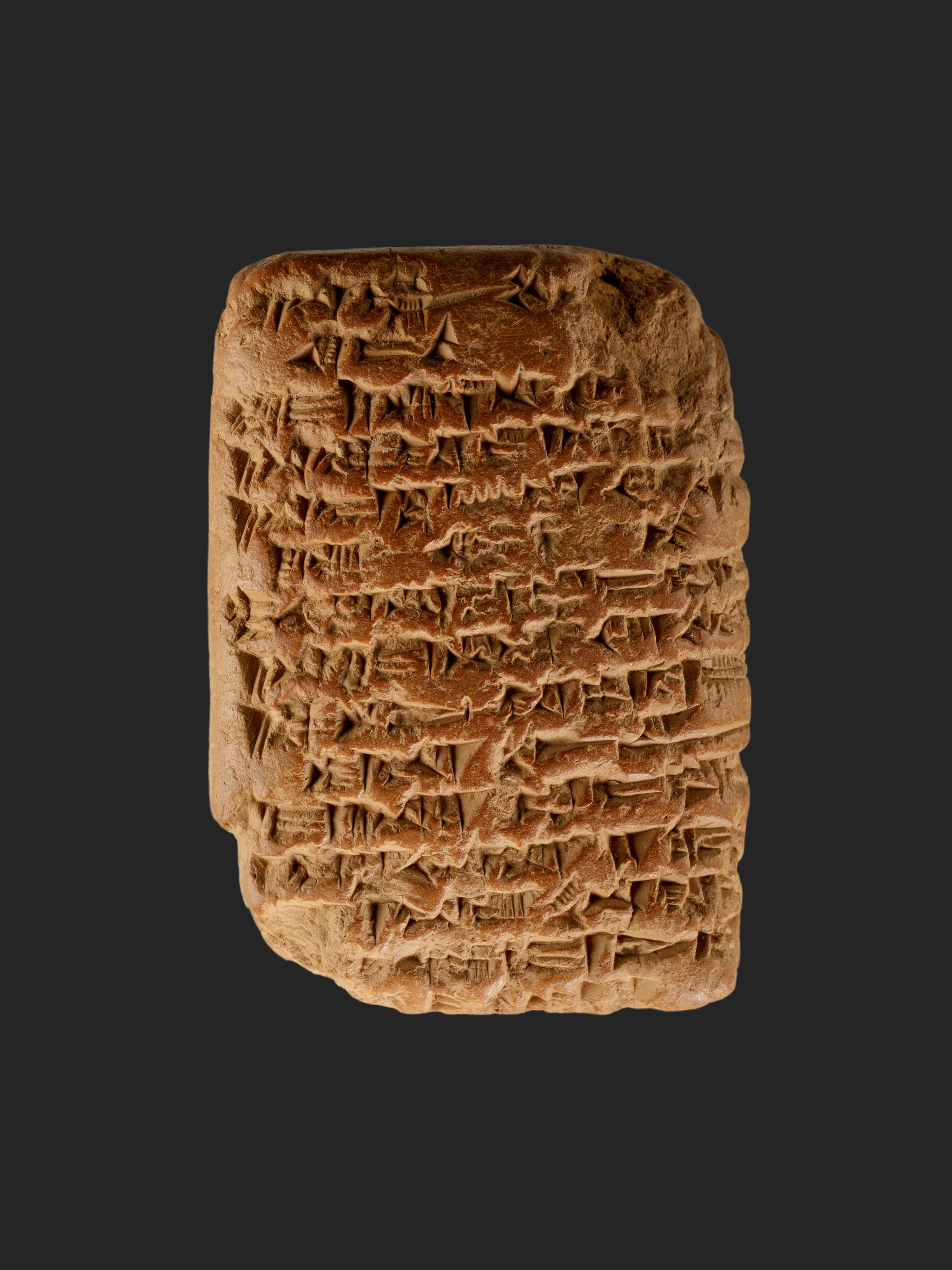
EA15, a letter from Ashur-uballit I to the king of Egypt. The Metropolitan Museum of Art, 24.2.11. Photo: The Metropolitan Museum of Art, CC0.
The tablet belongs to a collection of diplomatic documents that later historians named the Amarna Letters. Unearthed at the site of Amarna in central Egypt in the late nineteenth century, these clay tablets preserve the intimate bargaining and sparring of the great rulers of the age.
Their common language was Akkadian, originating in Mesopotamia. Egyptian scribes read and deciphered the letters of foreign rulers before they reached the pharaoh. Kingdoms differed in faith and native tongue, yet dealings between their courts depended on a shared diplomatic grammar that had to be learned and mastered.5
In another letter from Ashur-uballit, his voice grows more assured. He freely addresses the pharaoh as “my brother” and makes it clear that he too is a “Great King,” an equal. Then he openly complains that Egypt has sent far too little gold. Send enough gold to adorn a new palace, he grumbles; this amount will not even cover the envoys’ journey there and back.6
His demand was plain: if the two of them were brothers and equals, he should be treated as such standing deserved.
One neighbor was far from pleased to see Assyria enter this circle. This was Burna-Buriash II of Babylonia, an established great power. He sent the pharaoh an angry protest, insisting that the Assyrians had been mere vassals subject to him and demanding that their envoys be sent home empty-handed.7
Some called themselves brothers; others sought to keep those same men beneath their feet. The gifts and envoys arriving at the pharaoh’s court stood at the center of this struggle over rank. By admitting one delegation to his courtyard and accepting its offerings, or refusing another, the pharaoh could recognize a ruler’s international standing or dismiss it outright.
Yet within the same collection, the sentences of the lesser rulers on the Levantine coast shift into an entirely different register. For them, the king of Egypt was no brother. In their letters, the pharaoh was “my lord” and “the sun in the sky.” They were merely servants prostrate at his feet, licking the dust. The merciless gulf in power showed itself in the very form of the salutation.
The letters that Abimilku, ruler of Tyre, sent to the pharaoh make that gulf chillingly clear. Governing a narrow island city off the Lebanese coast, he professed unquestioning loyalty and pleaded desperately for military protection.8 Two expressions recur in his letters with almost obsessive persistence: “drinking water” and “firewood.” The ruler of neighboring Sidon had cut off access to the mainland water supply, leaving the people trapped on the island unable to obtain even water to drink. In one letter, he complained that he had nowhere even to bury the dead.9
The ruler of a trading port surrounded by the sea was begging for a mouthful of water for his people. Imperial authority, for him, was not a matter of prestige at a distant court. It was the lifeline to the mainland before his eyes.
For the Great Kings, diplomacy was a game of hierarchy played through honor and gifts. For the rulers of small states, it was a tightrope on which a day’s survival for the people inside the gates depended. A scribe might press the same cuneiform signs into the same clay with the same reed stylus. Change the form of address in the opening line, however, and the weight of the reality behind it was utterly different.
This order held for generations. Rulers fought wars large and small along their borders and still exchanged envoys. They competed and continued to ship one another the goods they needed. How far those goods actually traveled is silently attested by a single ship lying beyond the palace archives, on the floor of the Mediterranean.
3. The Hold of the Uluburun Ship
In 1982, an ancient shipwreck was discovered off Cape Uluburun on Türkiye’s southern coast. Meticulous underwater excavations continued for ten years, from 1984 to 1994. The ship had sunk in the late fourteenth century BCE, around 1320 BCE according to the date proposed by the researchers.10
About ten tonnes of copper.
About one tonne of tin.
Those were the weights of the metal ingots raised from the floor of the sunken hold.11
Cast in the shape of oxhides, these masses of metal were not yet sharp blades, sturdy spearheads, or imposing ritual vessels. They were raw materials for craftsmen at their destination to melt in crucibles. Bronze, made by mixing copper and tin in a ratio of roughly ten to one, was a foundational technology behind the age’s principal weapons and tools. A single court’s armory and workshops were intimately connected to mines and smelters thousands of kilometers away, beyond an unseen sea, and to the landing places where ships could dock.
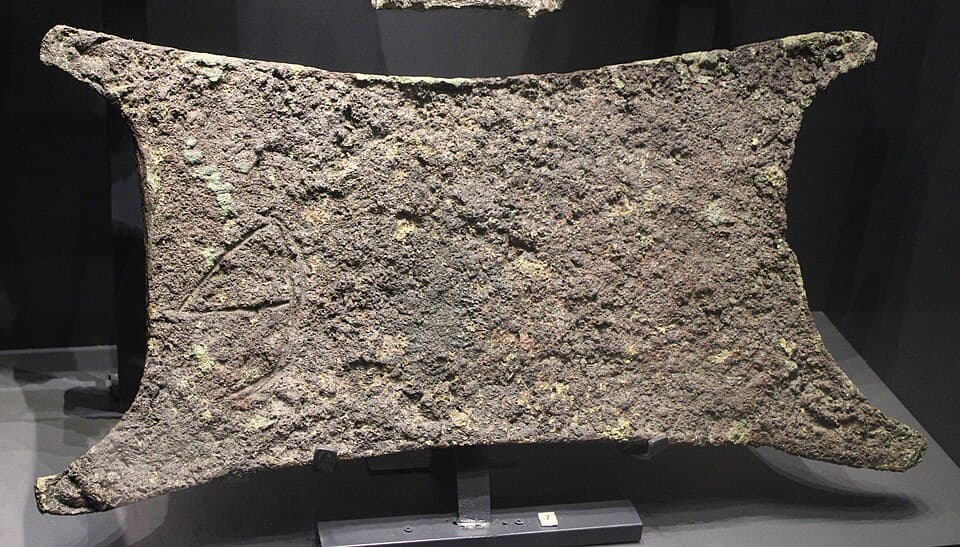
An oxhide-shaped copper ingot recovered from the Uluburun wreck. Bodrum Museum of Underwater Archaeology. Photo: Zunkir, CC BY-SA 4.0.
Most of the copper aboard had come from mines on Cyprus. Nor was copper all that filled the hold. There were ingots of raw glass, elephant ivory, hippopotamus teeth, African ebony, ostrich eggshells, and hundreds of pottery vessels made around the Mediterranean. Precious luxuries destined for royal treasuries crossed the waves in the same ship as industrial metals to be melted in forges.
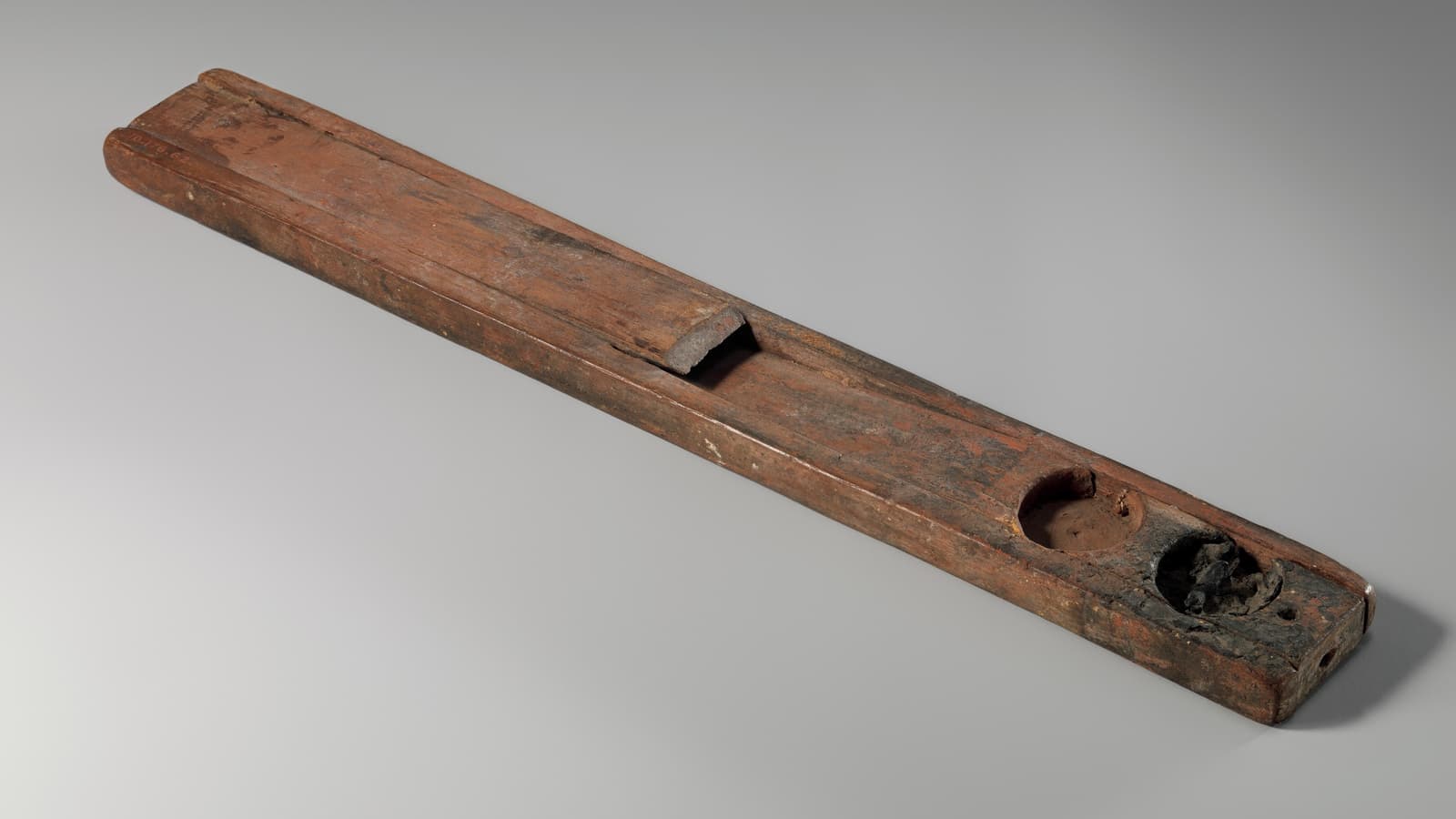
Among the cargo lay finely made balance weights, probably used by a merchant, and a small wooden writing board that opened and closed on ivory hinges. These were tools for weighing goods, assessing value, and recording transactions. Moving heavy metal required the strength of sailors; agreeing and guaranteeing how much had changed hands required shared measures and a system of records. The practices of calculation and recordkeeping encountered in earlier ages in the Nile’s grain accounts and Mesopotamian land surveys were now at work aboard a ship at sea.
The ship’s final destination and the identity of its owner remain uncertain. Its cargo list alone, however, eloquently reveals the eastern Mediterranean of the time as one vast supply network, deeply dependent on what others produced.
The great trading network did not stop when the Uluburun ship slipped beneath the water. More than a century would pass before the kingdoms supporting it were shaken to their foundations. In the meantime, the great powers continued to test one another through war and compromise.
That taut struggle for supremacy reached its height on the plain of Kadesh.
4. The Chariots of Kadesh and the Promise on Silver
Across the walls of Ramesses II’s temples, vast reliefs show the pharaoh’s chariot sweeping single-handedly through the midst of enemy ranks. The king towers several times larger than the other warriors; enemies lie helpless beneath the horses’ hooves. The battlefield on the temple walls belongs to a world of myth, where the ruler’s supreme valor subdues every force of disorder.
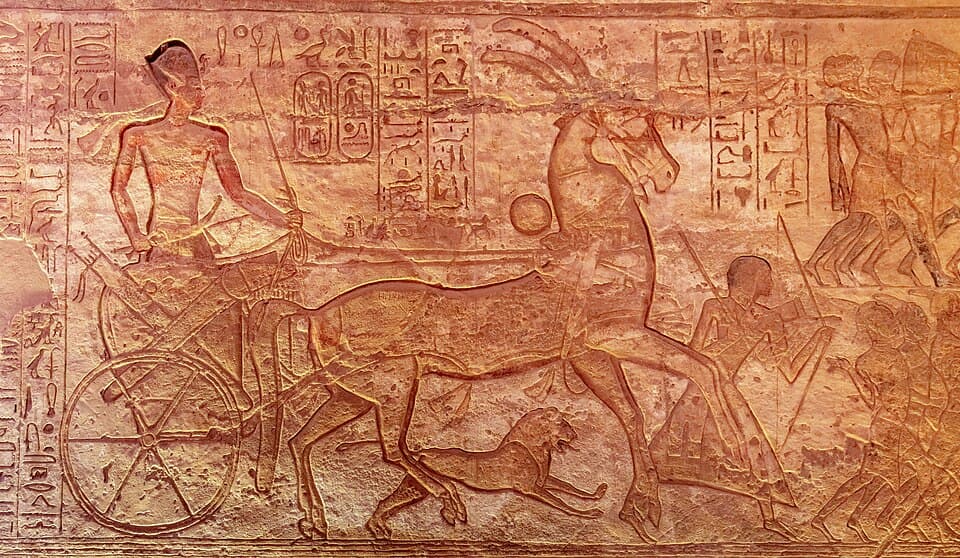
Relief of the Battle of Kadesh in the Great Temple at Abu Simbel. Ramesses II draws his bow from his chariot. Photo: Diego Delso, CC BY-SA 4.0.
Around 1274 BCE, in the fifth year of his reign, the young Ramesses II confronted the Hittite king Muwatalli II on the plain of Kadesh beside Syria’s Orontes River. It was a direct contest over who would command the Levant’s wealthy trading cities. The Egyptian king proclaimed throughout his empire the heroic story of a victory in which he had broken through encirclement and annihilated the enemy. Once the blades were lowered, the reality was different. Egypt had not subdued the Hittites, and the strategic city of Kadesh remained in Hittite territory.12
An unbridgeable gulf separated the inflated images of victory on stone walls from the cold political gains behind the battlefield. A chisel could enlarge the pharaoh’s body for all to see. It could not erase an equal empire standing beyond the border as instantly as an enemy carved in stone.
The battle also forms a climax in Christian Jacq’s historical novels, the five-volume Ramses series. The third volume is titled The Battle of Kadesh. Readers who encountered the romance of the New Kingdom court and the pharaoh’s life through fiction may know the name as a heroic victory. The historical Kadesh, however, was a scene of terrible stalemate: two empires pouring out their strength and still failing to settle the contest.13
Some fifteen years after the battle, around 1259 BCE, in Ramesses II’s twenty-first regnal year, the two countries finally laid down their weapons and sat across from each other. The Hittite throne had meanwhile passed to Hattusili III.14
The two great rulers concluded a perpetual peace treaty. They pledged never to invade each other’s territories and to provide military help against attacks by a third country or internal rebellion. Once again, the document invoked peace and a relationship of “brotherhood.” These were not empty flourishes. It specified detailed obligations of mutual assistance that the rulers were expected to fulfill.
The original documents exchanged on silver tablets have not survived. An Akkadian clay copy unearthed at the Hittite capital of Hattusa and a hieroglyphic version carved on the walls of Karnak in Egypt still bear witness to the agreement. The courts of two entirely different countries kept the original texts in their archives and set down their terms in different scripts, on clay and stone. Trust could be shared only if the same promise could be read again at any time in both countries.
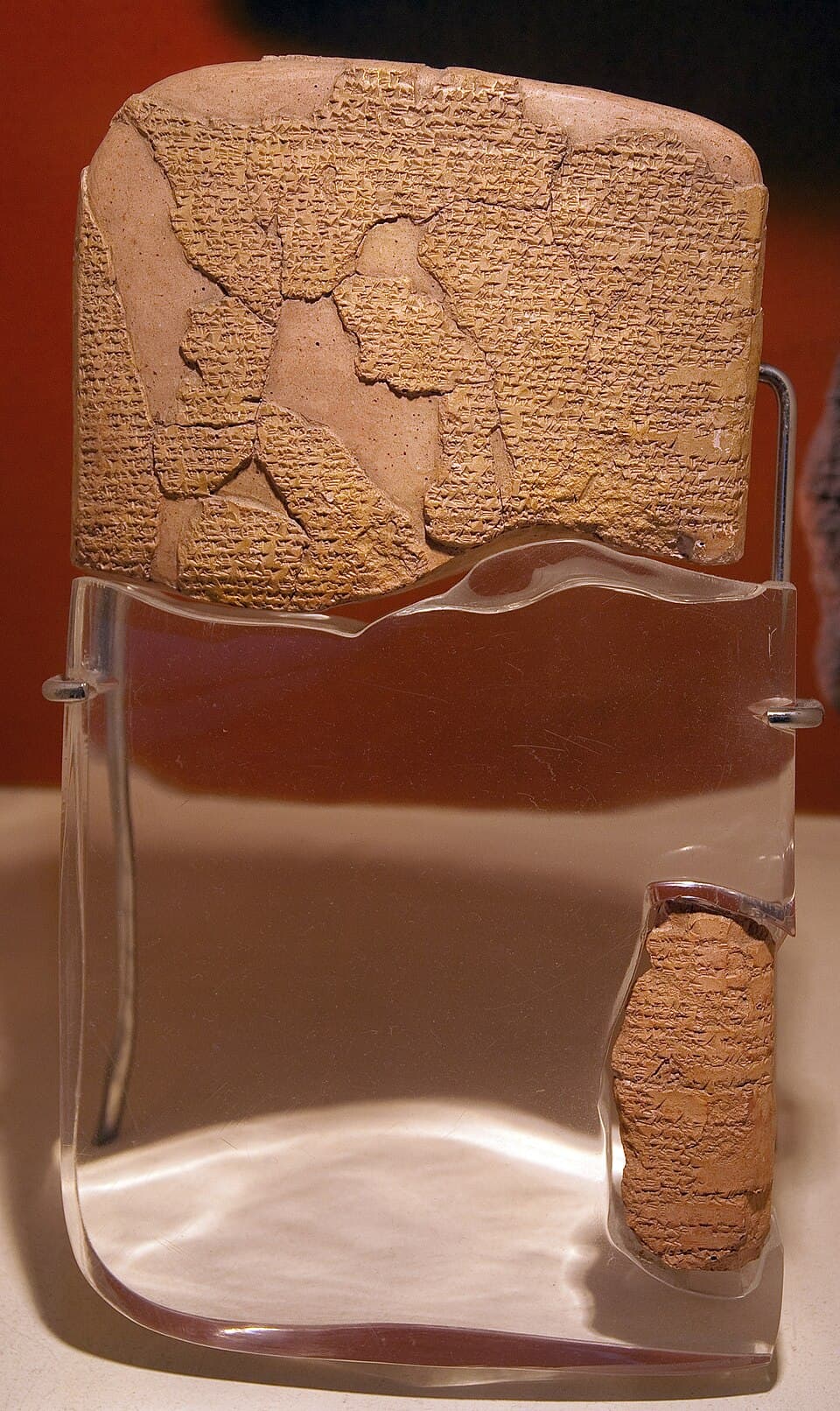
A clay copy of the Egyptian–Hittite peace treaty, excavated at Hattusa. Istanbul Archaeological Museums. Photo: Iocanus, CC BY 3.0.
The international order of the Late Bronze Age possessed mechanisms mature enough to achieve a compromise of this sophistication. With a single document, two empires that had opposed one another for decades redefined their relationship and quieted a destructive conflict. Beneath the treaty lay a firm belief that, after so many wars, these empires would endure for hundreds of years to come.
Yet only two or three generations later, the correspondence of kings began to record a very different kind of crisis. A coastal ruler was no longer worrying about costly gifts to a king across the sea, but about the few ships that might defend his walls against an invader the very next morning.
5. Enemies from the Sea, Drought in the Fields
On the eastern Mediterranean coast, Ugarit stood at the meeting point of sea lanes and inland trade routes, a foremost international trading city of its age. Documents excavated at Ras Shamra in Syria reveal the prosperous network that connected it with the Mediterranean world. Among them survives an urgent letter that Ammurapi, Ugarit’s last king, sent to the king of Cyprus, or Alashiya.15
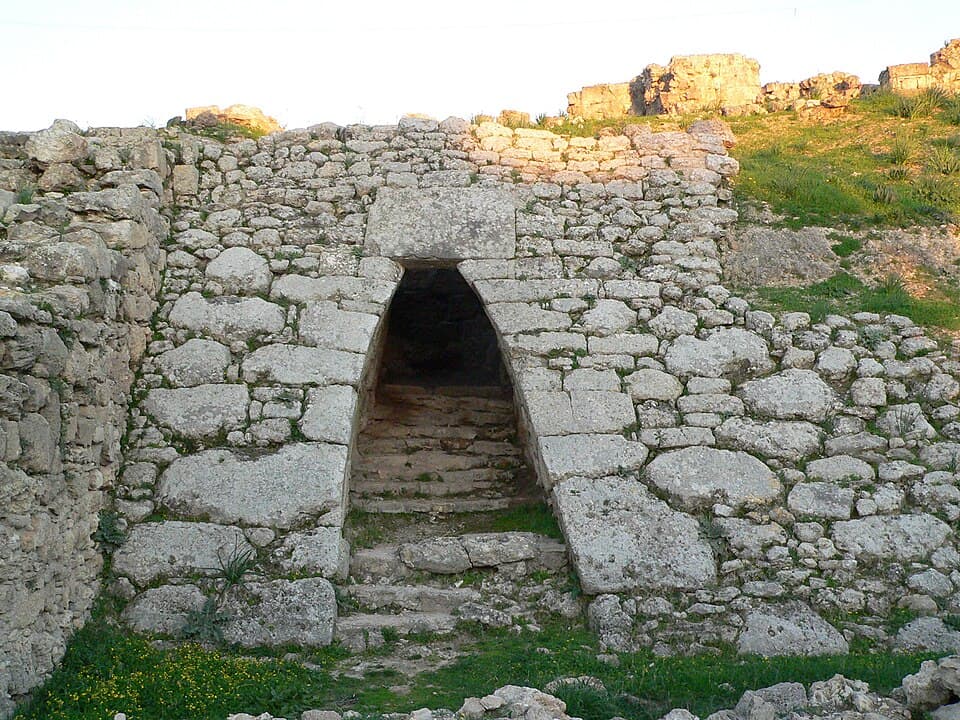
A stone passage surviving among the ruins of Ugarit. Photo: Disdero, CC BY 3.0.
In the letter, Ammurapi addressed the other ruler as “my father,” a kinship title used between kings. What followed was almost a cry of anguish. Unidentified enemy ships had descended on the coast, burning cities and ravaging the country.
The king’s infantry and chariot forces had been sent north, to the land of Hatti—the Hittites.
His ships had been deployed in the waters of Lukka, in southwestern Anatolia.
They had not yet returned. According to the letter, the enemy ships attacking Ugarit’s cities numbered just “seven.”
The king had soldiers and ships. Yet when his cities were burning and his country was suffering, not a single man of that army stood beside him.
Sending troops far away to serve the Hittite overlord was a duty a vassal kingdom had to shoulder within this sophisticated international order. But that very military obligation kept the soldiers who might have repelled the enemy before his eyes tied down beyond distant borders. Ammurapi desperately implored the king of Cyprus to send word by any means if the enemy ships appeared again.
A letter traveling in the opposite direction also survives. A small clay tablet in the Louvre preserves advice from the king of Cyprus to the king of Ugarit on how to confront seaborne invaders.16 Along the coast, rulers exchanged urgent reports and discussed their response. Yet as the ships carrying those tablets crossed the sea, the raiders’ vessels were moving too, and the flames of destruction were already reddening the sky above another port.
Deep inland, meanwhile, events were moving toward a catastrophe of another kind. The Hittite Empire in central Anatolia fed its vast population and armies through agriculture dependent entirely on rainfall. When the sky withheld rain and harvests failed again and again, even a Great King who commanded the world had to worry about a measure of barley for the soldiers guarding his frontiers.
A study published in Nature in 2023 read the climatic crisis of this period in the trunks of ancient trees. Researchers closely analyzed tree rings and carbon isotopes in juniper timber excavated at Gordion in Anatolia. In this old wood, later used to build tombs, hundreds of years of growth had been inscribed like a diary, one year at a time.17
Around 1198–1196 BCE, with a dating uncertainty of about three years, an exceptionally severe drought struck central Anatolia for three consecutive years. The tree rings had become almost breathlessly narrow, and changes in carbon isotope ratios clearly registered a response to moisture shortage.
A single failed harvest can be endured with state grain reserves. When the land dries out for two years, then three, choices disappear. Feed the people starving now, or break into the last seed grain stored for next year’s sowing? An administration and standing army sustained by grain taxes from the harvest lose their footing when food distributions cease. As drought persisted, a farming household’s hunger and an empire’s administrative system scraped the bottom of the same grain sack, drawn together into the vortex of ruin.
The deadly drought that scorched Hittite fields and the enemy ships that attacked Ugarit’s coast reach us in fragments from different sites. There is no magical record within the archaeological layers that neatly fits the destruction of all these kingdoms to a single decisive cause. Brush the dust from the ruins and step farther in, however, and each city can be seen falling in its own way.
6. Different Endings
At Hattusa, the Hittites’ vast rocky capital, traces of fire have been found in temples, palaces, and other major buildings. Archaeologists do not simply read those fires as a single final assault in which savage invaders stormed in and overran the royal palace at a stroke.
Detailed excavations have raised the possibility that valuables had already been removed in an orderly way from the palace and some major buildings before the fires. In this interpretation, the capital’s political functions weakened and people began to abandon the city before its final destruction. When and where the royal household and officials fled, and how long the gradual emptying of the city took, remain subjects of research.18
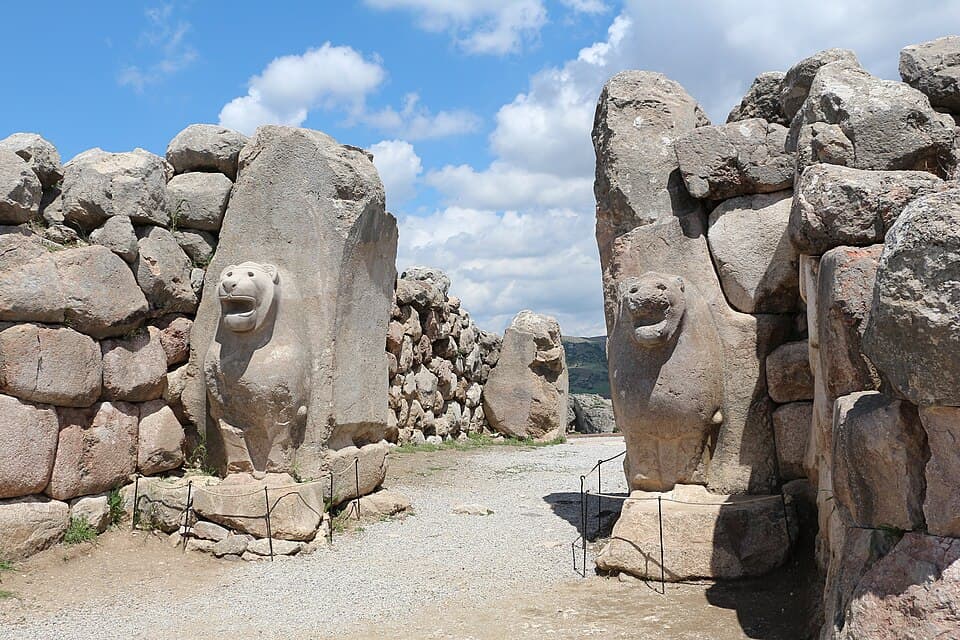
The Lion Gate at Hattusa today, including some restored portions. Photo: Bernard Gagnon, CC BY-SA 3.0.
As the court emptied, the empire’s nervous system seized up. Where to send the grain collected in the provinces, whose judgment to seek when disputes broke out, who was to feed the soldiers on the frontiers: all these certainties collapsed at once into thin air.
Across the Aegean, at the palace of Pylos in the southern Greek mainland, a center of Mycenaean civilization, a very different destruction was recorded. Numerous Linear B tablets were excavated from the ruins of a palace consumed by a fierce fire around 1200 BCE. These were the court’s administrative documents, dense with syllabic signs recording an early form of Greek.19
The tablets had not originally been intended for firing and permanent preservation. They were simple sun-dried clay tablets that could be softened with water and reused after the year’s accounts were closed. The intense heat of the fire that engulfed the palace, however, baked the not-yet-dry clay as hard as brick. Paradoxically, the very conflagration that destroyed the royal palace preserved its intimate, hidden accounts intact for thousands of years.20
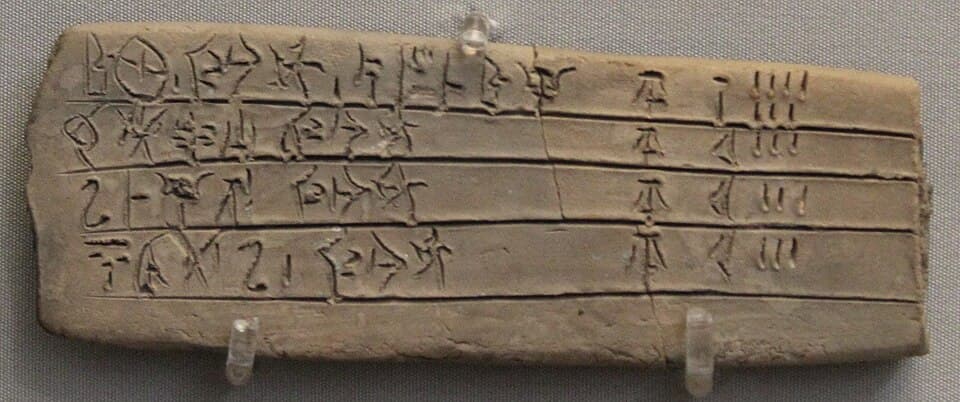
Linear B tablet Es 727 from Pylos, an administrative document recording offerings to Poseidon. Photo: Zunkir, CC BY-SA 4.0.
The scribes’ records were meticulous to the point of coldness. They listed the workers mobilized, the bronze weapons remaining in storage, the allocation of livestock, and the quantities of olive oil issued to workshops. These tablets vividly reveal how minutely the palace, as a centralized bureaucracy, controlled and redistributed people’s labor and produce. In a world where the countryside’s surplus flowed into palace stores and was issued again to people and workshops according to the court’s calculations, counting and bookkeeping formed the very backbone of government.
Once the palace of Pylos fell in flames, however, the mainland Greek tradition of keeping accounts in Linear B broke off as if it had never existed. People continued to speak Greek, but the script that had monopolized palace storeroom records, and the educational system that taught it, vanished when their chain of transmission broke. It was a melancholy glimpse of history: highly specialized knowledge could lose its entire basis for survival when the organization that needed it every day collapsed.
Ugarit, a flower of maritime trade, likewise suffered irreversible destruction early in the twelfth century BCE. The splendor of its international trading port never returned. Traces show that people later lived on the site again, but its standing as a center exchanging international letters in many languages was never recovered.21
Egyptian kingship on the Nile, by contrast, survived after a desperate struggle. After the age of Ramesses II, who had fought at Kadesh, Ramesses III recorded on temple walls in the twelfth century BCE that he had repelled invaders arriving by land and sea. The great reliefs at Medinet Habu show a ferocious naval battle: ships entangled on the water, oars breaking, bows drawn, enemies driven into the marshes of the Nile Delta.22
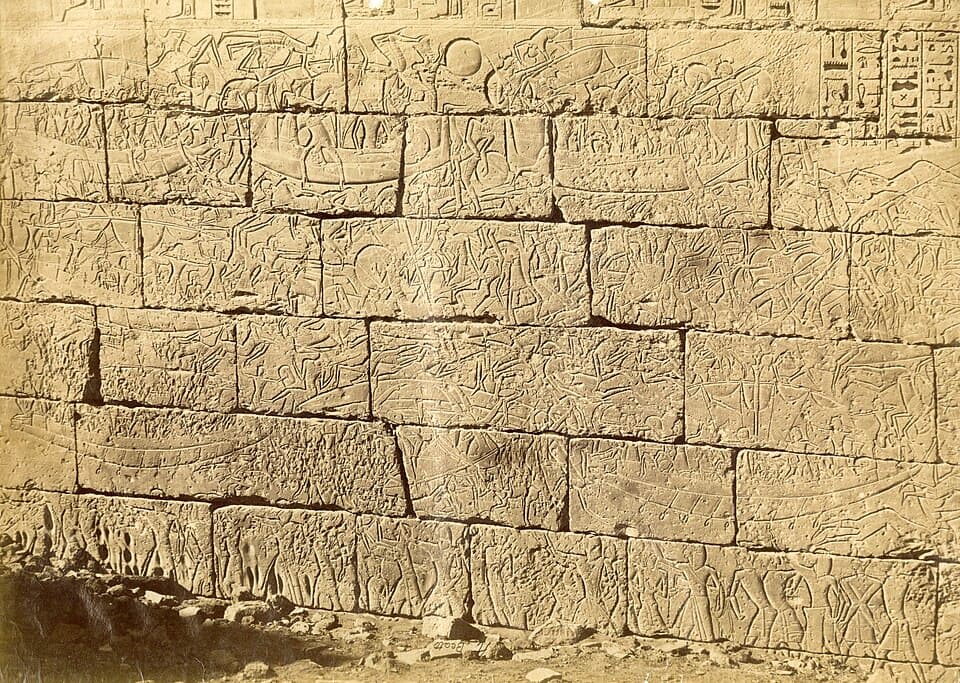
A nineteenth-century photograph of the naval battle relief at Medinet Habu. Museo Egizio, Turin, photographic archive, INV10 008. Photo: Antonio Beato / Museo Egizio, Torino, CC0.
The migrating groups now commonly called the “Sea Peoples” are the actors in these records. Their origins and routes of movement remain fiercely debated. The victory records in Egyptian temples were nothing more than political monuments meant to proclaim the divine power of the pharaoh who repelled foreign enemies. No single relief can fully identify the destroyers who reduced the Mediterranean world to ashes.
What is clear is the vast void that opened in the international order of the Great Kings who had called one another “brother” and dominated the Mediterranean. Royal capitals stood empty and abandoned. Prosperous ports lost their former glory. Even kingdoms that barely survived were too busy tending their wounds to look beyond their frontiers. The expectations of minor rulers who believed loyalty to a sunlike lord would secure protection to the end, and perpetual peace treaties premised on another kingdom’s eternal existence, were cruelly shaken among the ruins of the Mediterranean.
7. Meanwhile, in the East
While the western courts of the Mediterranean were falling amid fire and hunger, on the other side of the continent, in East Asia, another royal house was recording its world in its own script on hard bone.
Yin Xu at Anyang, in China’s Henan Province, is the site of a great royal capital of the late Shang dynasty. Grand palace foundations and monumental tombs, bronzes and oracle-bone inscriptions carry the breath of the Shang court from the thirteenth to the mid-eleventh century BCE. Even during the century in which eastern Mediterranean courts faced an unprecedented crisis and tumbled into a dark age, Shang kingship in the Yellow River basin endured firmly.23
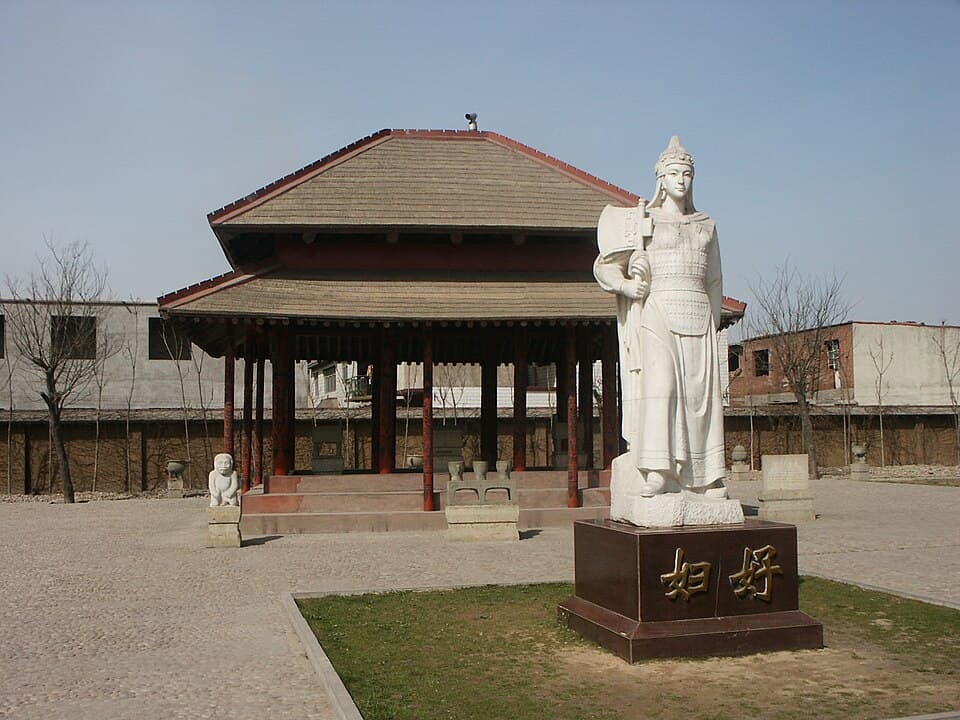
Modern reconstructed facilities commemorating Fu Hao’s tomb at Yin Xu, with a statue of Fu Hao. Photo: Gary Todd, CC0.
Among the many people of that court, one woman left an unusually distinct name. She was Queen Fu Hao (婦好), the wife of Wu Ding, the ruler who presided over one of the Shang dynasty’s greatest periods of prosperity. Her tomb, excavated untouched by looters, yielded a wealth of bronze weapons and jade objects that displayed the power of the royal house. Yet her life is not confined to the silence of those grave goods. Records survive of divinations performed by the court concerning her safety as childbirth approached.
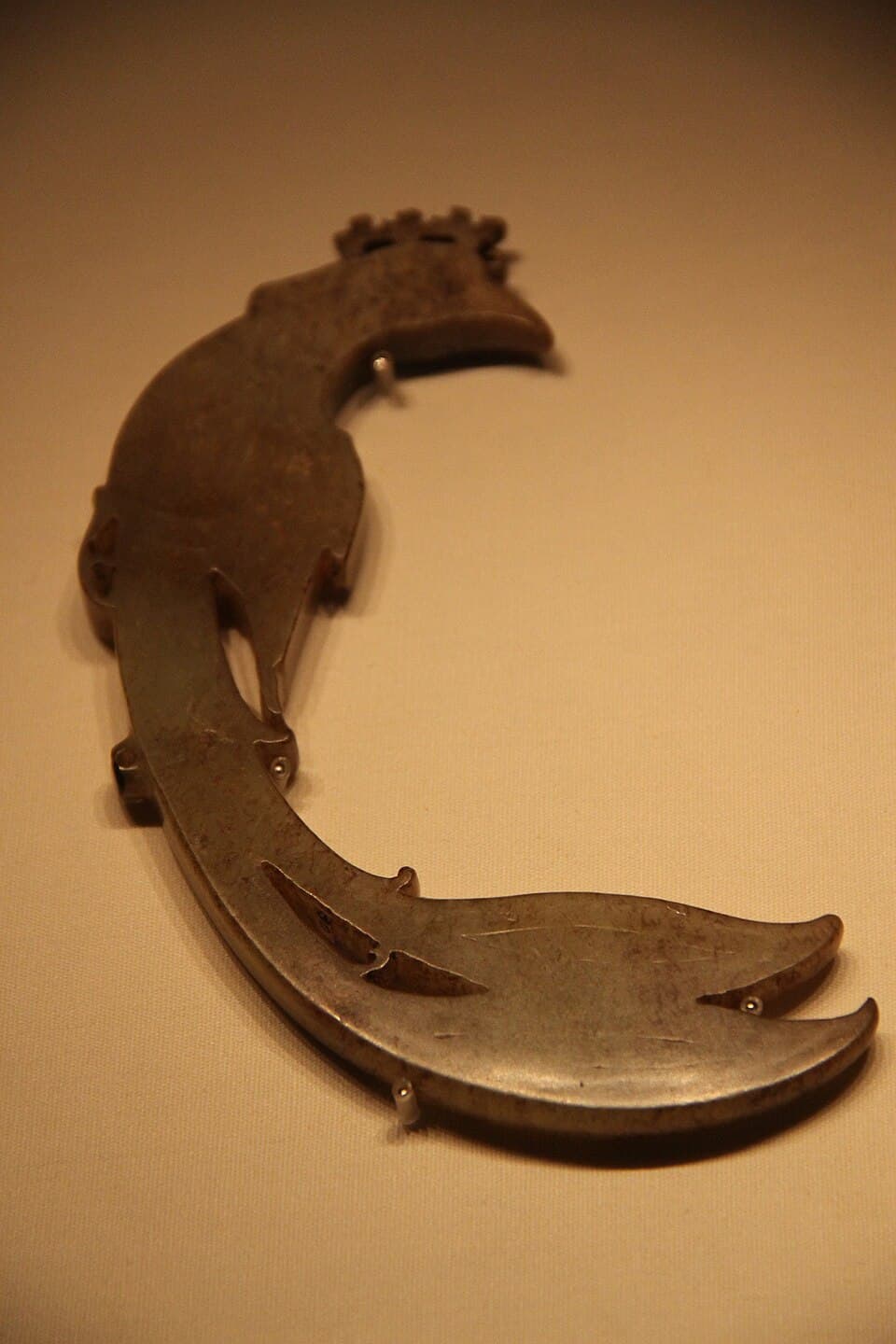
A jade phoenix excavated from Fu Hao’s tomb, illustrating jade craftsmanship at the Shang court. National Museum of China. Photo: Gary Todd, CC0.
On a turtle plastron—the underside of its shell—held by the Institute of History and Philology at Academia Sinica in Taiwan, divination inscriptions made before Fu Hao’s delivery are finely incised with a blade.24 Through divination, the king asked the gods whether her childbirth would be auspicious. Even the household of an absolute ruler who commanded the world and monopolized its oracles could not know the future at the threshold of a new life. They had to apply heat to bone and read the resulting cracks to judge good or ill.
Following the divination is a chilling sentence added to record what actually happened: a verification statement. Thirty-one days later, on the jia-yin day, the child was at last born. It was a daughter. Beneath this, a cold blade carved a pitiless judgment in just two characters: “It was not auspicious (不嘉).”25
The anxious question posed while awaiting a child and the cold judgment delivered after her birth were carved back to back on the same shell. In this short record, the precise system of counting days by cyclical signs, the royal household’s hopes, and the harsh values with which the age received a daughter’s birth appear as a single whole.
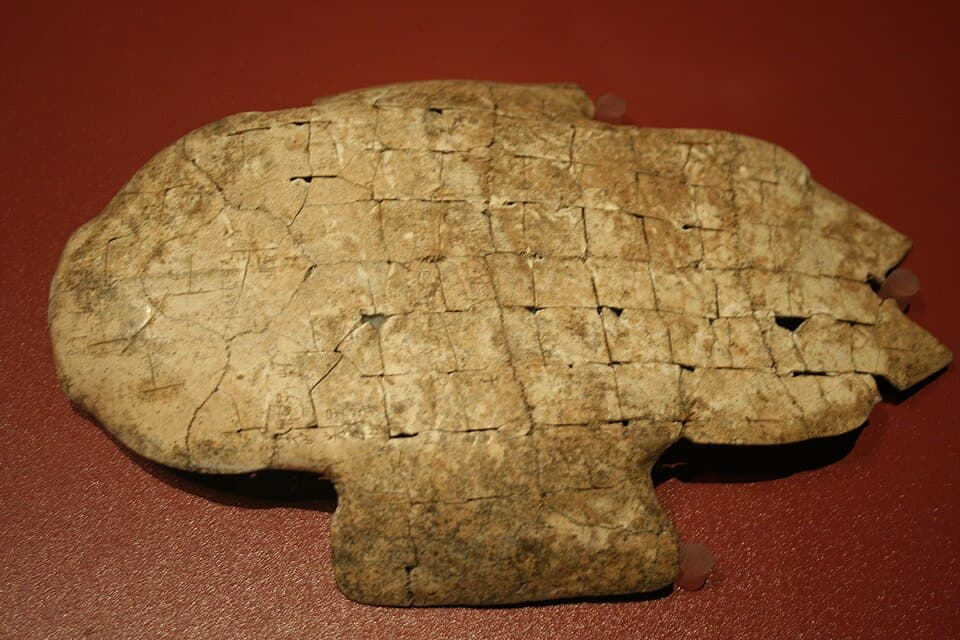
A Shang turtle plastron displayed at the Yin Xu Museum. It is a different object from the record of Fu Hao’s childbirth discussed in the text (丙247). Photo: Gary Todd, CC0.
On the great temple walls beside the Nile, the pharaoh subdues his enemies at a stroke. On the clay tablets of Amarna, a king demands gold and due honors from another king. On Yin Xu’s oracle bones, the royal household asks the gods whether coming events will bring good or ill. What each civilization sought to hold in writing differed. In all of them, however, those who made and interpreted records stood at the deepest and most consequential front line of royal government.
While western courts met their destruction, sacrifice, divination, and written recordkeeping continued without interruption in the eastern royal house. Returning to the Mediterranean, another small clay tablet, recovered from the ruins, awaits.
8. Thirty Letters Learned in the Palace
In 1948, a clay tablet no larger than a finger emerged from the soil of Ugarit’s royal palace. Thirty letters had been neatly inscribed on its surface in a fixed order. It was an alphabet exercise tablet, an abecedarium, impressed by aspiring scribes as they practiced learning their script.26
On the surface, these were unmistakably wedge-shaped impressions in clay. Their operating principle, however, differed fundamentally from the hundreds of complex signs used to write Akkadian in Mesopotamia. Ugarit’s scribes could record their native language in full by combining just thirty phonetic letters. Documents found in the palace and in the private archives of nobles vividly reveal the daily lives of people learning and using this compact script.
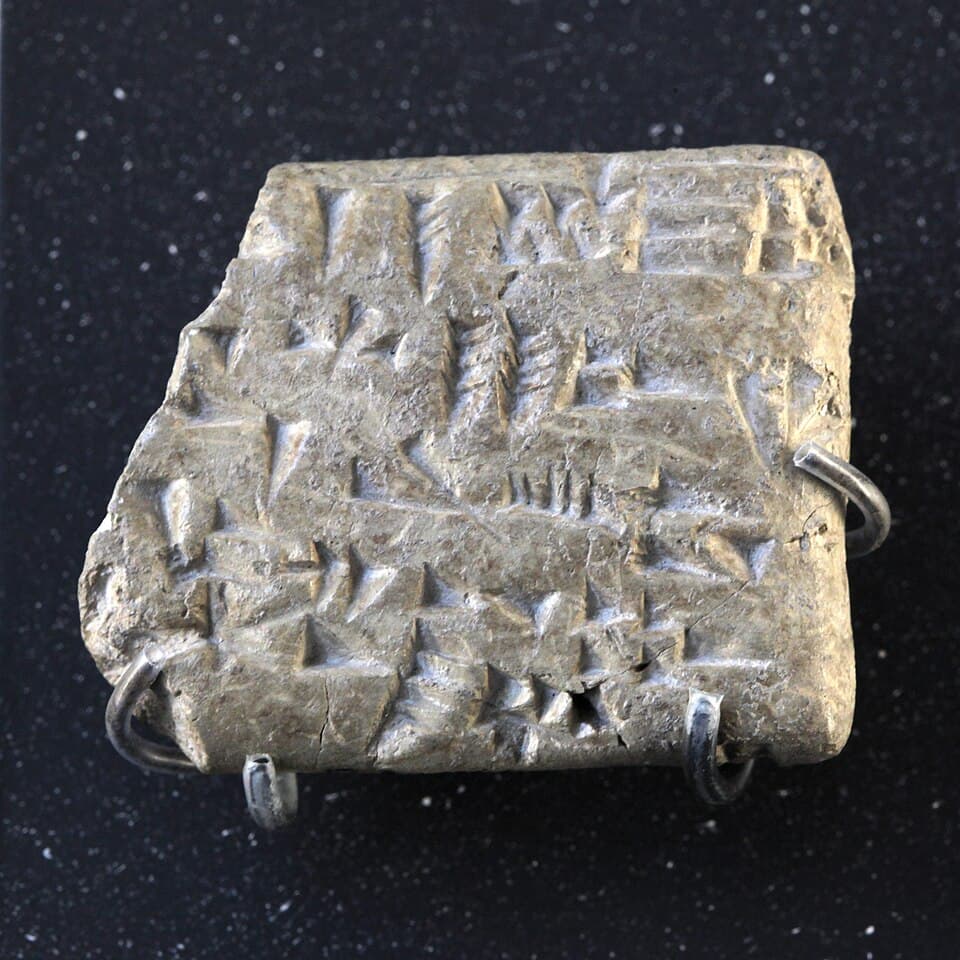
Another Ugaritic abecedarium. Louvre AO 19992 (RS 10.087) was excavated in 1938 and is missing seven letters. It is distinct from the complete tablet found in 1948 discussed in the text. Photo: Rama, CC BY-SA 3.0 fr.
The alphabet did not suddenly fall from the sky when the Bronze Age kingdoms collapsed. Much earlier, from the beginning of the second millennium BCE, experiments with various forms of phonemic writing had quietly begun in Sinai and the Levant. Ugarit, too, was already proficient in its thirty-letter alphabet at the height of the kingdom’s prosperity.27
Pylos and Ugarit pose different questions here. At Pylos, the tradition of Linear B, tied exclusively to the court’s allocation administration, was completely severed when the palace collapsed. At Ugarit, however, the kingdom and its urban civilization never recovered despite the presence of scribes learning a compact phonetic script of thirty letters. A technical advantage—a smaller set of letters, easier to learn—could not by itself guarantee the survival of knowledge and records.
There had to be teachers to teach the script and pupils to learn it. Above all, the workplaces and settings of life in which people needed those letters every day had to survive. In a world where the great courts no longer commissioned administrative documents, the craft of writing had to find a place to endure among other people and new workplaces beyond the palace.
The alphabet that would later spread across the Mediterranean and become the ancestor of many scripts found new uses in the Phoenician ports and the hands of merchants who sailed these ruined seas. A linear alphabet, different in form from Ugarit’s wedge-shaped alphabet impressed in clay, and the struggles of the great merchants who carried it across the waves, stand at the center of the next story.28
At the end of a narrative that opened with the splendid diplomatic correspondence of royal courts lies a quiet, small tablet belonging to an aspiring scribe. Long after the names of the great kings who called one another “brother” had crumbled into history, people kept appearing on the seas, intent on counting and recording something anew. Who they were, and where they inherited and spread their letters, becomes the starting point for understanding the knowledge of the next age.
Epilogue. Those Who Carry the Records On
Hatshepsut’s expedition loaded living trees onto its ships. It was an act of determination: to cross the sea with the soil around their roots intact and make their fragrance rise again in another land.
The people of the Late Bronze Age persistently carried not only copper, tin, and glittering treasures across borders, but speech and writing, and ways of counting and keeping records. The people who truly sustained that vast web of civilization were not army generals, but envoys and sailors crossing rough seas, craftsmen before furnaces, and nameless scribes holding clay tablets. Royal commands drove them on long journeys, and pledges between empires guarded the passages through which they traveled.
The upheaval that struck around 1200 BCE brought down those splendid foundations at a stroke. In some societies, the script itself was cut off as palaces burned. In others, kingship tenaciously survived and continued its records on temple walls. Some people had to leave fallen capitals and seek new work on unfamiliar shores. The span of time endured by objects bearing records was different from that endured by the human societies that read and wrote them. A clay tablet could survive fire and spend three thousand years beneath the ruins, while the school that taught its script might close its doors in a single day.
Yet the history of the next age does not end in the silence of ruins. On ash-covered shores, people appeared again, repairing broken ships, bringing out balance weights to exchange goods, and quietly inscribing newly learned, concise letters on jars and stone walls. Where the splendid imperial sea of kings who called one another brothers had closed, a new solidarity among ordinary people seeking to sustain their lives through trade and records was quietly taking shape.
Sources and Further Reading
Footnotes
Open-access excavation publication on Hatshepsut, Emma B. Andrews project, description of the Punt expedition reliefs. It describes trees being carried to ships in containers and the imported cargo. The narrative is grounded in the actual relief scenes. ↩
Egyptian Museum, Cairo, reliefs of Hatshepsut’s expedition to Punt. Explains the aromatics, ebony, gold, animals, trees for temple gardens, and figures of Punt’s ruler and his wife. ↩
Met, Egypt in the New Kingdom. The conventional chronology of the New Kingdom is approximately 1550–1070 BCE. ↩
Met, letter of Ashur-uballit, 24.2.11. The passages about the gifts and envoys paraphrase the holding institution’s description. ↩
Met, The Amarna Letters. An overview of royal forms of address, gifts, marriage, honors, and the shared diplomatic language, Akkadian. ↩
Harvard HIST1039 collection, translation of EA16; 袁指挥, translations and notes on Amarna EA9, EA15, and EA16. Addresses the Egyptian king as a brother, requests gold for a palace, and complains about the cost of the envoys. ↩
The translation and commentary on EA9 by 袁指挥 cited above. Burna-Buriash’s claim to superior rank is presented as his own assertion. The three letters are not reconstructed as a sequential exchange of questions and replies. ↩
Nadav Na’aman, New Light on the Correspondence of Abimilki, Ruler of Tyre, especially p.396, EA149:49–54 and 74–76. Appeals for water, fuel, and burial space. This passage draws together several letters of Abimilku, beyond the description of the single tablet at the Met. ↩
Institute of Nautical Archaeology, Uluburun excavation. The institution gives a date of 1320±15 BCE. Discovery and excavation dates follow the same source. ↩
Oxford Roman Economy Project, Ulu Burun. Excavated cargo includes about ten tonnes of copper, one tonne of tin, balance weights, and a hinged wooden writing board. Bronze alloy ratios vary with an object’s purpose and type. ↩
Directorate General of Cultural Heritage and Museums, Türkiye, The Kadesh Treaty; A. F. E. van der Ryst, dissertation §2.4.2, the outcome of the Battle of Kadesh. The narrative uses the conventional absolute date of around 1274 BCE. ↩
Hachette, Ramses series, Volume III, The Battle of Kadesh. These are descriptions of the novels and volumes; the historical account of the battle follows the sources and research cited above. ↩
The collection description by Türkiye’s Directorate General of Cultural Heritage and Museums cited above; Marco De Pietri, doctoral dissertation on Egyptian–Hittite relations and the treaty, “The Treaty” section. Regnal year 21 is given as around 1259 BCE. Some scholarly chronologies use 1258 BCE. ↩
Jeffrey P. Emanuel, Cretan Lie and Historical Truth, Harvard Center for Hellenic Studies, “Seaborne Threats and Refuge Settlements.” Paraphrased from the Beckman (1994:27) translation identified there as RS 20.238. The individual letter and the city’s final destruction are not treated as events on the same day. ↩
Louvre, AO 21087. A letter in which the king of Cyprus advises the king of Ugarit on responding to seaborne enemies. The holding institution links it to its original publication in Ugaritica V (1968), no.23, pp.85–86. ↩
Sturt W. Manning et al., Severe multi-year drought coincident with Hittite collapse around 1198–1196 BC, Nature 614 (2023); Cornell’s account of the research. The analyzed species are Juniperus excelsa and J. foetidissima. The findings concern the Gordion samples; they are not generalized as evidence that the same drought affected the entire eastern Mediterranean. ↩
Jared L. Miller, Are There Signs of the Decline of the Late Hittite State in the Textual Documentation from Hattuša?, Anatolia between the 13th and the 12th Century BCE (2020), pp.237–255, especially p.249. Discusses excavation interpretations of the capital’s abandonment and fires in major buildings, and the archaeological difficulty of equating the end of the documentary record exactly with the empire’s final collapse. ↩
University of Oslo DAMOS, Mycenaean Linear B documents; Scribes and their handnotes, The Cambridge Classical Journal 70 (2024), pp.26–66. Scholars differ on the precise storage arrangements of the tablets; the narrative is confined to their essential role as palace administrative documents. ↩
University of Colorado, research by Pylos document specialist Dimitri Nakassis; Gregory Nagy, Pylos scribes and ritual records, 2019. Explains how the palace fire fired the clay tablets and preserved them for later ages. ↩
French Ministry of Culture and excavators, the urban structure of Ugarit; Olivier Callot, Réflexions sur Ougarit après ca 1180 av. J.-C., 2008. The destruction is placed within the early twelfth century BCE, with the limited traces of later occupation also acknowledged. ↩
William F. Edgerton and John A. Wilson, Historical Records of Ramses III, SAOC 12 (1936), translations relating to plates 37–39; Université libre de Bruxelles, Ancient Mediterranean project, naval battle relief. These are royal accounts from year 8 of Ramesses III. ↩
UNESCO, Yin Xu. The late Shang site dates approximately to 1300–1046 BCE and includes Fu Hao’s tomb. ↩
Academia Sinica, Institute of History and Philology, Inscribed Plastron Ping 0247, inventory R041287, excavated at Xiaotun YH127. ↩
江柏毅, Oracle-bone divination and the carving of writing in the late Shang dynasty, National Taiwan University CASE, 2024-04-10. Transcribes and explains the question, royal prognostication, and birth outcome on 《丙》247. The part recording what subsequently happened is called the verification statement (驗辭). ↩
French Ministry of Culture and Ugarit researchers, RS 12.033. A thirty-letter abecedarium found in the royal palace in 1948. This page identifies it as RS 12.033, whereas SNS Mnamon uses RS 12.063/KTU 5.6. These two designations have not been arbitrarily merged. ↩
Met, Alphabet Origins. Distinguishes the origins of phonemic writing in the second millennium BCE from its substantial spread in the first millennium BCE. Phoenician ports and the routes by which the alphabet spread around the Mediterranean will be explored fully in Part 10. ↩
Anne-Sophie Dalix, Les alphabets à Ougarit, French Ministry of Culture research on Ugarit. Explains the distinct traditions and transmission histories of the Ugaritic cuneiform alphabet and the Phoenician linear alphabet. ↩
Join the discussion