

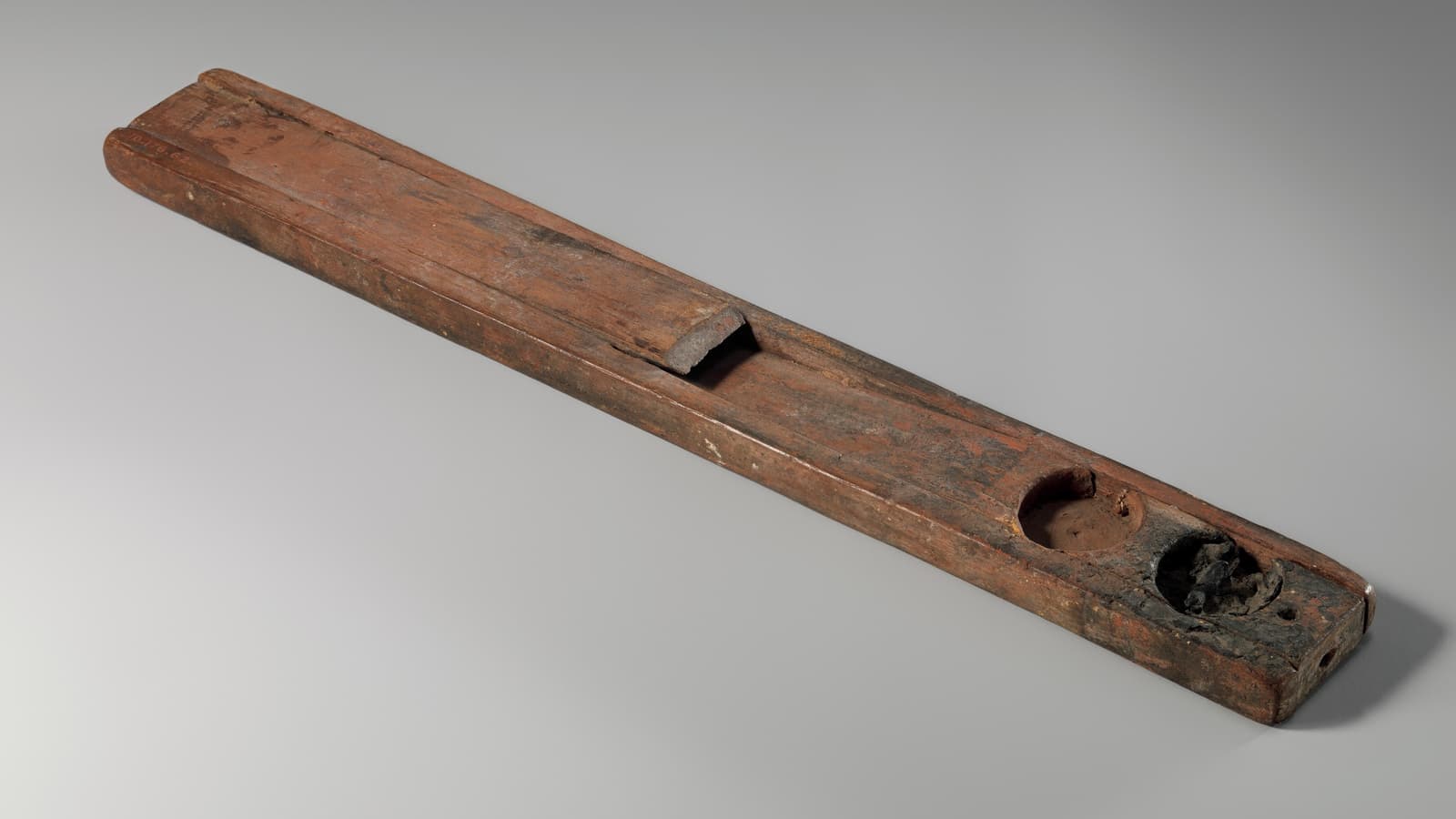
Scribe’s palette, Middle Kingdom–Second Intermediate Period, Egypt (ca. 2030–1550 BCE). The Metropolitan Museum of Art, Rogers Fund, 1910, accession number 10.176.62. Museum record, Public Domain · CC0.1
This is the mathematics commentary for Part 8, “People Waiting for the River to Return — The Nile and Egyptian Calculation”. In the main episode, Heqanakht worried about food lasting until the next harvest, scribes recorded fields and grain in their accounts, and construction workers had to transport stone and maintain a pyramid’s slope. Here we follow, step by step, the calculations we briefly encountered in that story.
Having grain in a storehouse does not, by itself, determine each household member’s share. Measuring the boundaries of a field does not make it easy to compare with other plots unless its area can be calculated. Nor does knowing a pyramid’s height determine the slope of its sides. To record Egyptian life in numbers, people needed ways to divide the quantities before them and compare different sizes.
We therefore begin with the sharing of bread, move through field areas and pyramid proportions, and arrive at the calendar. Halving and doubling, fractions and unit conversions connect the stages of this journey. At its end, we encounter a further truth: even when a calculation is correct, nature does not necessarily follow the timetable people have devised.
EXA seeks to read the histories of mathematics, science, engineering, IT, and management together within the broader course of world history. This commentary forms part of that journey, connecting the problems of everyday life explored in the main episode with the principles behind the calculations used to address them.
Our guide is the Rhind Mathematical Papyrus. Now held in the British Museum, it is the manuscript in which the scribe Ahmose, whom we met toward the end of the main episode, copied an older text in year 33 of Apophis’s reign. The museum dates it to around 1550 BCE and describes 84 problems involving numerical operations, administration, and construction. The manuscript also records that its source came from the Twelfth Dynasty. It is evidence of people learning and transmitting earlier solutions even after dynasties had changed.2
The document does more than list answers: it shows the steps of calculation. This lets us examine the order in which a scribe worked with numbers. Yet starting with ancient notation can make even familiar division seem strange. We will first establish the problem and its answer in modern terms, then set the Egyptian procedure beside it to see how it reaches the same result.
1. Fractions for Sharing Food
Heqanakht’s letter combined demands to conserve food with the shares allotted to members of his household. People still had to eat while grain grew in the fields. If the stores were to last until the next harvest, someone first had to decide how much to give to whom. Before distribution became a figure in an account, it was a household’s daily meal.
Problem 3 in the Rhind Papyrus, copied long after that letter, asks for six loaves to be divided equally among ten people. It is not a transcription of Heqanakht’s actual ration list. But the need to turn a total amount of food into individual shares helps us understand both the letter in the main episode and this teaching problem.3
Today, we would divide the number of loaves by the number of people. Six divided by ten is 0.6, or 3/5 as a fraction. Each person receives three fifths of one loaf.
The scribe’s answer takes the form of one half plus one tenth. To understand why it was written this way, we first need to understand Egyptian fraction notation. Today we write a numerator and denominator together, as in 3/5. The basic Egyptian notation instead added a mark to a number to indicate its reciprocal, 1/n. In cursive texts such as the Rhind Papyrus, a dot above a number served that purpose, while some frequently used fractions had separate signs.
A fraction with a numerator of 1 is called a unit fraction. Apart from exceptions such as 2/3, which had a sign of its own, quantities such as 3/5 were expressed by adding unit fractions. One half plus one tenth was a way of expressing the same share within that system of notation.4 We can now see what it means by imagining the bread being handed out.
Cut five loaves in half, and there are ten halves. After each of the ten people receives one, a whole loaf is still left. Divide that last loaf into ten pieces and give each person another piece. Everyone now has half a loaf and one small piece. That is the quantity represented by the scribe’s answer.
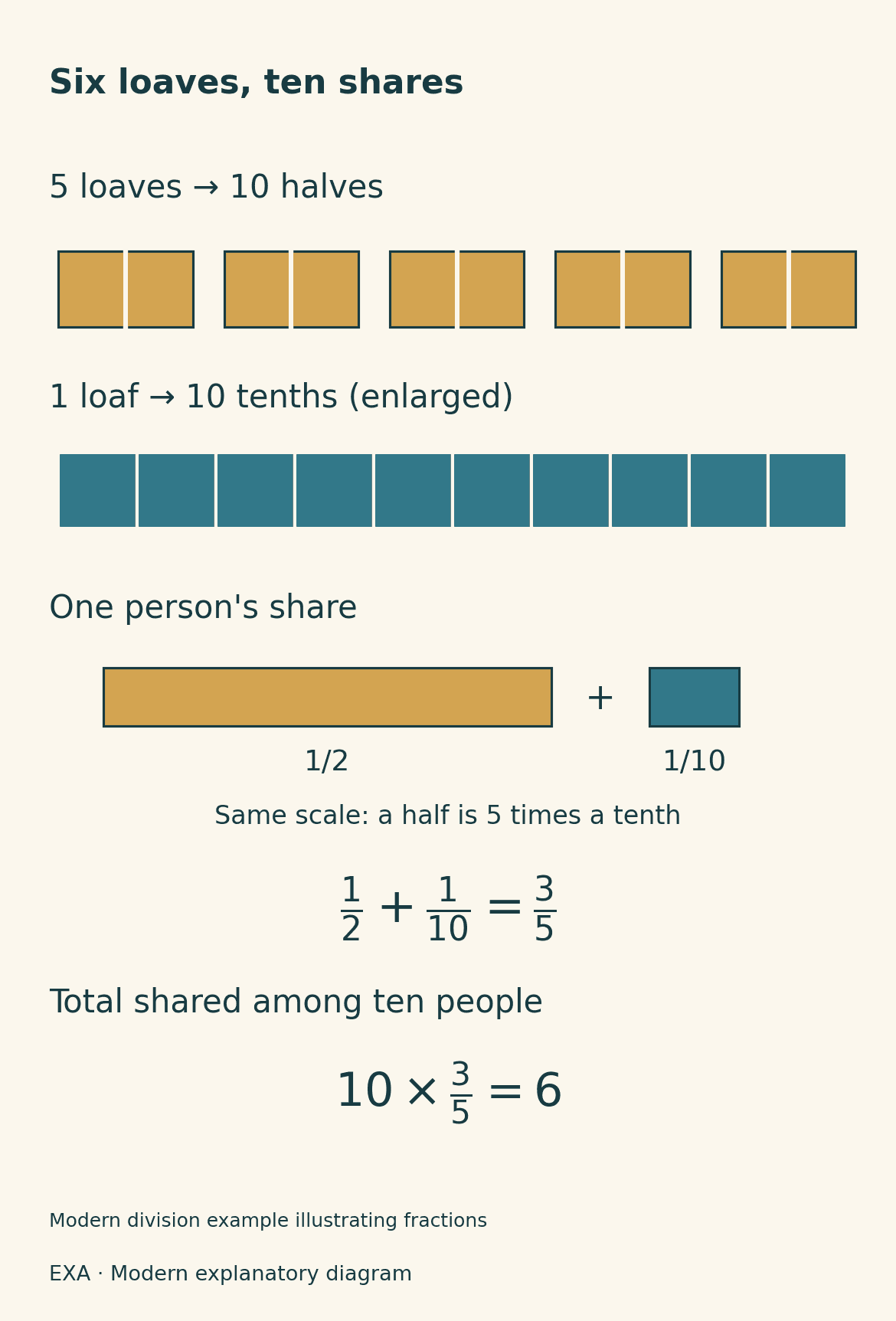
Figure 1. Give each of ten people one half and one tenth of a loaf, and the total is six loaves. The second panel enlarges the smaller pieces; the final panel compares the two portions at the same scale. This is a modern illustration of the fractions, not a reconstruction of cutting instructions in the source. EXA.
What remains is to check the answer. Today, we would multiply one person’s 3/5 of a loaf by ten people and see whether we return to six loaves. In the Rhind Papyrus, one share becomes two, two become four, and four become eight. Ten shares can be obtained by adding eight shares and two shares. This is where Egyptian multiplication, based on repeated doubling, comes into play.
The table below presents that check in modern fraction notation. We do not add every row: we select the two rows whose numbers of people add up to ten.
| Number of people | Amount of bread | Row used in the check |
|---|---|---|
| 1 | 3/5 loaf | — |
| 2 | 6/5 loaves | Selected |
| 4 | 12/5 loaves | — |
| 8 | 24/5 loaves | Selected |
The eight people’s 24/5 loaves plus the two people’s 6/5 makes 30/5, or six loaves. This is not a fresh division. It checks the share already found for one person by multiplying it by ten. Instead of finding ten times the quantity in one step, the procedure combines doubling with addition.
The numbers in the original are written using the Egyptian fractions we have just encountered. The table expresses those quantities in modern notation so that the steps of the check are easier to compare.3
The person responsible for distributing food needed more than a plausible answer. The shares actually handed out had to add up to the amount taken from storage. If someone else could follow the check, the calculation could be verified even when the person setting the shares was not the one distributing them. The six-loaf problem brings fractions and multiplication together in that single task.
2. A Table for Recurring Calculations
Six loaves have been divided among ten people. What if the next task is to divide two loaves among seven? Finding a combination of halves and smaller pieces from scratch every time the total or the number of recipients changed would be cumbersome. A scribe learning arithmetic also needed ways to carry an answer already found into the next problem.
In modern notation, one person’s share is straightforward: 2 divided by 7 is 2/7. The task now is to express that value again as a sum of unit fractions. A table at the beginning of the Rhind Papyrus sets out the results of dividing 2 by odd numbers. Beside 2/7, it gives 1/4 and 1/28.5
To see where 1/28 comes from, imagine first giving each of the seven people a quarter of a loaf. The total handed out is 7/4 loaves: one and three quarters. Of the original two loaves, one quarter remains.
That remaining quarter is then divided equally among all seven people. A piece made by dividing one loaf into four is itself divided into seven, so each person’s additional share is one twenty-eighth of a loaf. The 1/28 is the amount obtained by distributing what remained after the first allocation among the seven people.
To check it, work backward. Put the seven small additional shares together, and they make the quarter that was left after the first allocation.
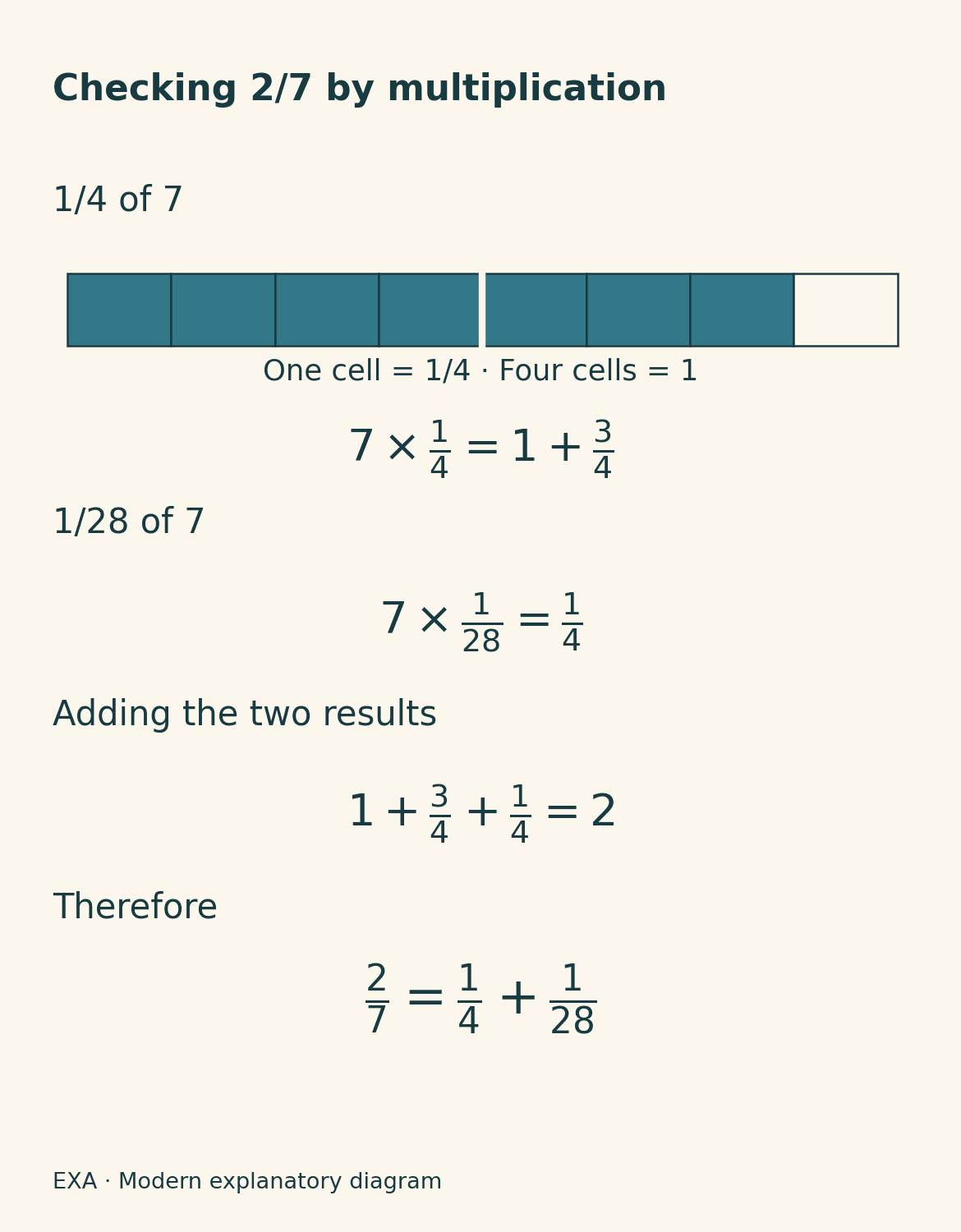
Figure 2. Multiply the two fractions in 2/7 by seven to check that they return to two loaves. Each segment of the bar is one quarter of a loaf; four segments make one loaf. EXA · Modern explanatory diagram.
The doubling used in the previous section offers another way to check the same answer. Adding the amounts for one, two, and four people gives seven people’s shares. We can therefore combine the small fractions and see whether they return to two loaves.
Once a verified combination is entered in a table, the next calculation has a starting point. The mathematical papyrus fragment UC 32159 from Lahun also contains values of 2 divided by odd numbers. The Lahun fragment covers divisors from 3 to 21, while the Rhind table runs from 3 to 101; where they overlap, the same combinations of fractions appear. This does not establish that one manuscript was copied directly from the other, but it does show the same calculations preserved in different documents.6
Here the work of Ahmose, copying an older mathematical text in the main episode, takes a concrete form. The next generation of scribes could do more than memorize a predecessor’s answer: they could check it and use it in a new calculation. Tables reduced the labor of recurring calculations while also providing material through which those calculations could be taught and transmitted.
3. The Area of a Field That Will Yield Grain
The grain distributed from a storehouse comes from fields. Looking one stage back from the allocation of rations, we must ask how much land there is to harvest. As we saw in the main episode’s account of land records and taxation, comparing different fields required turning boundary lengths into areas. Distribution divided a quantity already in hand; surveying involved calculating the quantity that would be recorded in the first place.
Problem 51 in the Rhind Papyrus presents a triangular field and two lengths, 4 and 10. We begin with the principle as it is understood today. To explain the calculation here, we take 4 as the base and 10 as the height perpendicular to that base. A rectangle with the same base and height has an area of 40; the triangle is half of it, with an area of 20.7
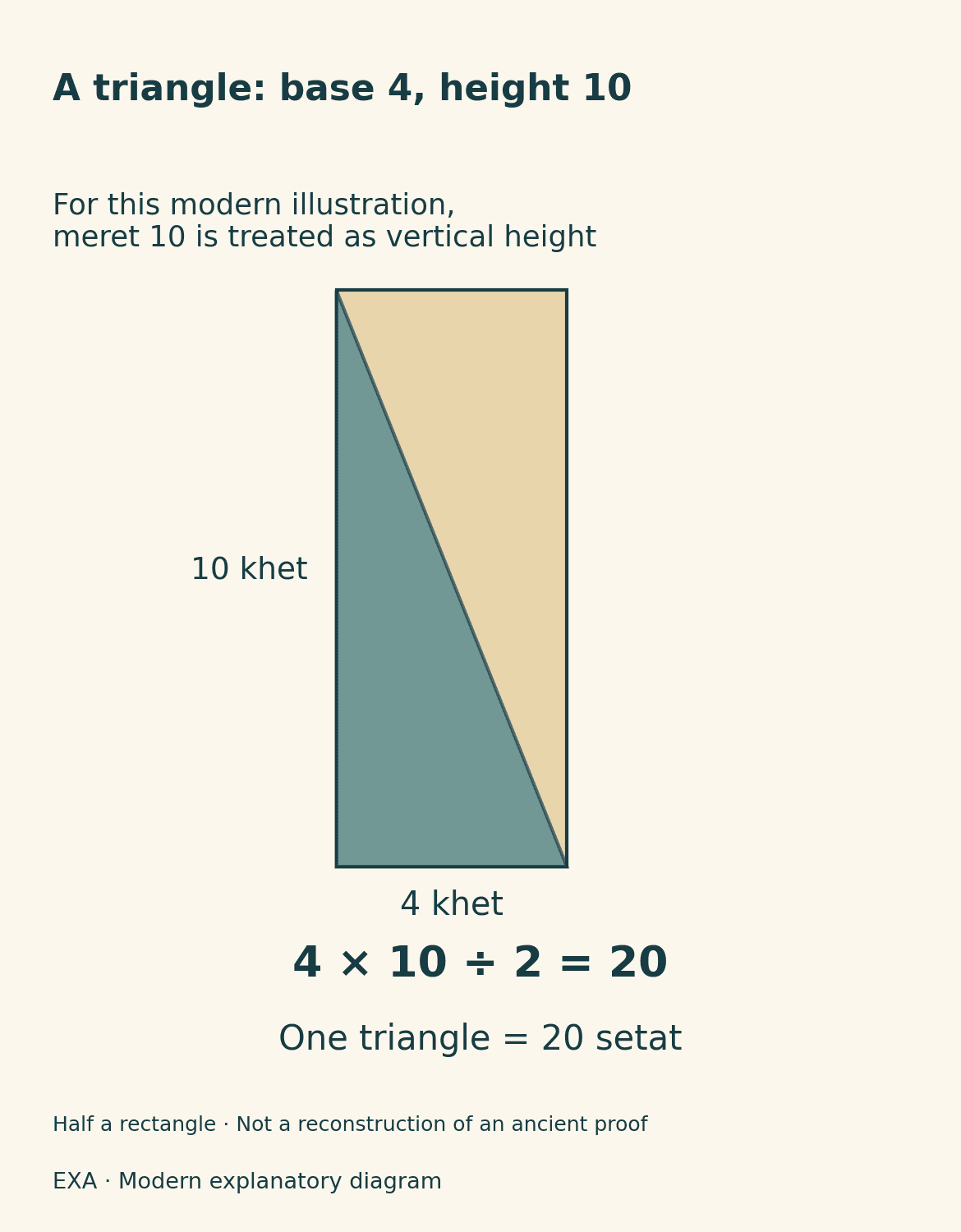
Figure 3. Divide the same rectangle in two to check the area. This is a modern explanation that treats meret as the perpendicular height; it does not mean that this proof appears in the papyrus. EXA.
Dividing a rectangle along its diagonal gives two triangles of equal area. That is why we multiply the base by the height and divide by two. The papyrus reverses this order: it first takes half of 4, obtaining 2, and then multiplies by 10. Multiplying and then halving reaches the same area as halving first and then multiplying.
The number 20 alone, however, does not tell us how large the field is. The unit of length in the problem is the khet: one khet equals 100 royal cubits. One setat, the unit of area, is a square with sides of one khet, or 10,000 square cubits. A rectangle measuring 4 khet by 10 khet therefore covers 40 setat, and the field occupying half of it covers 20 setat.8
The word meret, used for a length in the problem, requires care in translation. Above, we have taken 10 as a perpendicular height to show the principle of the calculation. The modern area formula requires a perpendicular height rather than a sloping side, which is why the diagram includes a right-angle marker.9
An area does not automatically determine a tax assessment or a harvest yield. Soil, water conditions, and the state of cultivation must also be considered. Yet even to record and compare those differences, the size of the land first had to be expressed in consistent units. Between measuring lengths and entering grain in an account, area calculation supplied one necessary step.
4. Proportion for Reproducing a Pyramid’s Slope
In the field, two lengths were converted into a single area. On a building site, the relationship between lengths had to be maintained. Specifying a pyramid’s height alone does not tell us how steeply to raise its sides. Base width and height must be coordinated to maintain the same slope. The immense structure encountered in the main episode now becomes a problem about the proportion between two lengths.
Problem 56 in the Rhind Papyrus describes a pyramid with a base side of 360 cubits and a height of 250 cubits. These are the figures supplied by the mathematical text, not measurements of Khufu’s pyramid. What the problem seeks is the seked: the horizontal distance corresponding to a vertical rise of one cubit.10
The lengths we need become clear in a cross-section passing through the apex and the center of the base, perpendicular to one side of the base. From that side’s midpoint to the center is half of 360, or 180 cubits. The apex rises 250 cubits above the center. A horizontal distance of 180 cubits therefore corresponds to a height of 250 cubits.
Using modern arithmetic, we divide the horizontal distance by the height to find the distance corresponding to a rise of one cubit.
Reducing the height to one two-hundred-and-fiftieth of its original value reduces the horizontal distance in the same proportion. The resulting 18/25 of a cubit is our starting point for understanding the seked. The division runs in the opposite order to the familiar school definition of slope as “vertical change divided by horizontal change.” Nor is this a value expressed as an angle in degrees.
The ancient scribe approached the division by asking what multiplier would turn 250 into 180. Half of 250 is 125, which leaves 55 still needed to reach 180. Add one fifth of 250, or 50, and the total becomes 175. Add one fiftieth, or 5, and it reaches 180. The multiplier is therefore the sum of 1/2, 1/5, and 1/50.
The method that expressed a share of bread as a sum of fractions now expresses a ratio between two lengths. Modern division, 180÷250, and the ancient procedure seek the same value. By combining parts of the divisor to reach the target quantity, the scribe finds the answer to the division.
The last step is to change units. One royal cubit contains seven palms, a unit based on the width of a hand. Multiplying a horizontal distance expressed in cubits by seven gives the distance in palms.
The answer is 5 and 1/25 palms. This small proportion—the horizontal distance corresponding to every rise of one cubit—expresses the slope of the pyramid’s side.
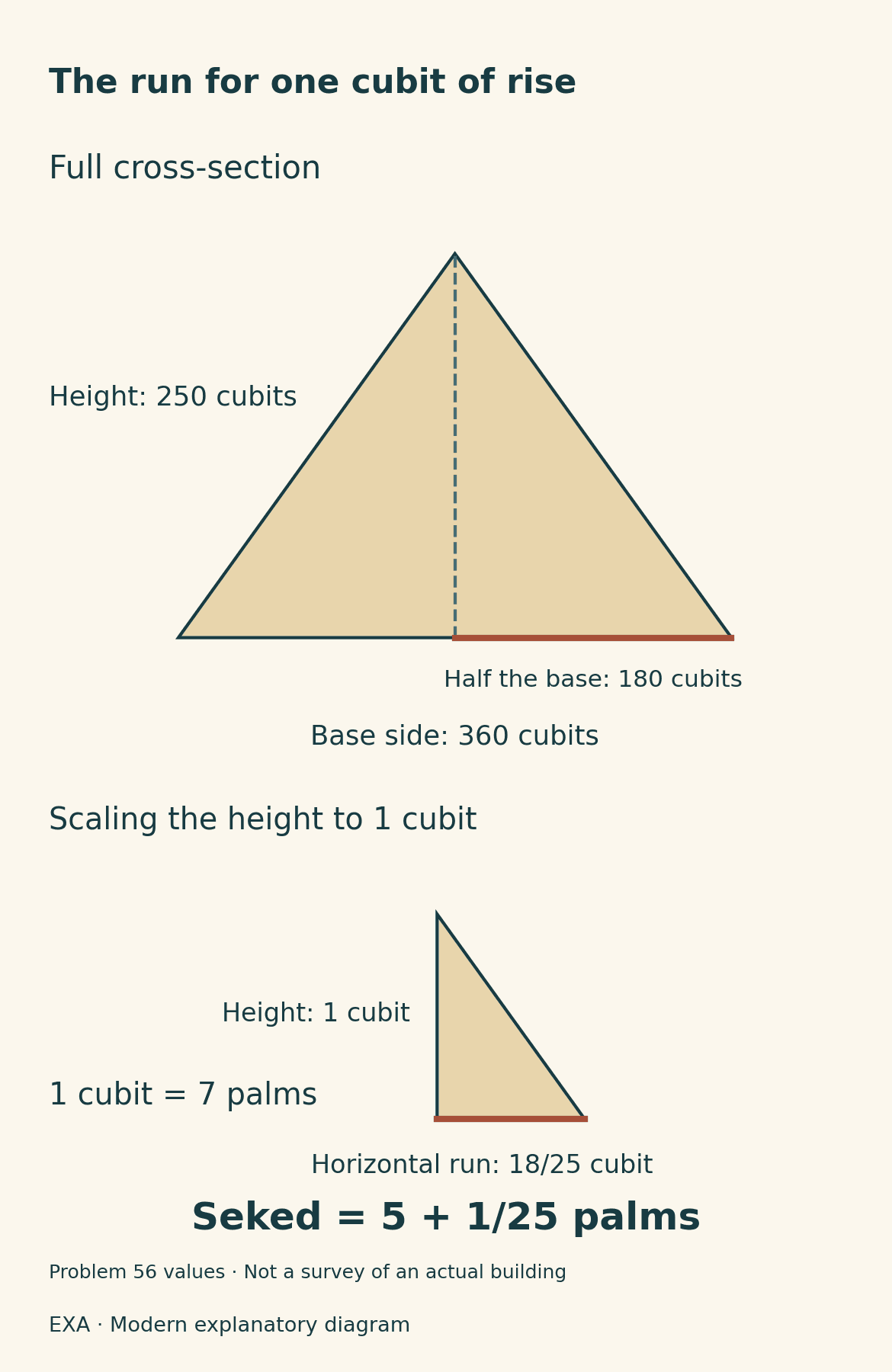
Figure 4. Take half the full base, 180 cubits, and find the horizontal distance corresponding to a height of one cubit. The upper and lower panels use different scales; within each panel, horizontal and vertical scales are equal. A modern explanatory diagram using the figures in Problem 56. EXA.
Multiplying by seven also connects with the earlier calculation: one times, two times, and four times the quantity add up to seven times it. The original multiplies the fractions by seven to convert them to palms. We can check that conversion again through doubling and addition.
Finding the slope of an enormous structure did not require an endless succession of new methods. Halving the base, adding fractions, and changing units were used in sequence. The proportion learned in this way could also be applied to pyramid problems with different dimensions. The knowledge of construction explored in the main episode was transmitted through repeatable calculations that helped make such scale manageable.
5. Seasons Beyond the Calendar
In calculating shares of bread, field areas, and pyramid slopes, the task was to make the given quantities fit exactly. Counting a year presents a different problem. A calendar may organize the timing of agriculture and administration, yet nature’s year does not contain precisely the number of days people have assigned to it. Where the earlier calculations showed ways to reconcile quantities, the calendar shows what changes when a small difference accumulates.
The Egyptian civil calendar encountered in the main episode had 30-day months, twelve months, and five additional days, making 365 days. Each of its three seasons contained four months. There is no error in the arithmetic of adding five days to the twelve months’ 360 days.11
But the seasons take slightly longer than 365 days to complete their cycle. To understand the difference, let us take a year as approximately 365.25 days, or 365 and 1/4 days. This is an approximation for examining an accumulating difference, rather than a calculation of a precise astronomical value. Subtracting the two lengths of a year gives the difference arising each year.
A day contains 24 hours, so a quarter of a day is six hours. After four years without an added leap day, the difference reaches one day; after 120 years, it reaches 30 days. The small fraction we encountered in division now produces a month’s difference over a long span of time.
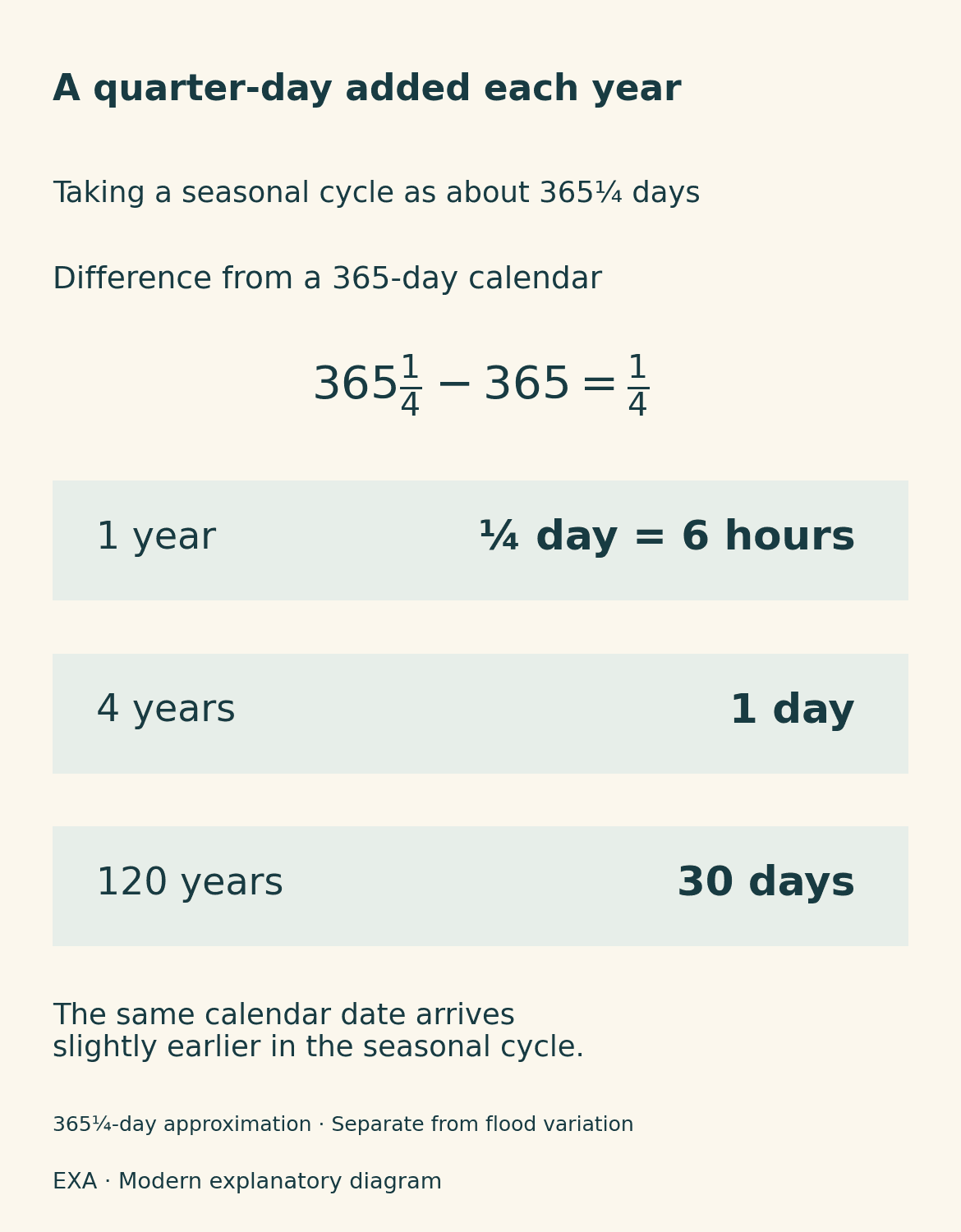
Figure 5. The accumulating difference in a 365-day calendar without leap days. This approximate model takes the seasonal year as 365¼ days. It does not depict year-to-year fluctuations in the actual timing or height of the inundation. EXA.
The direction of the drift matters too. Because the calendar year is shorter, the same calendar date returns a little earlier relative to the seasons. Conversely, when the same seasonal event is entered in the calendar, its date moves progressively later. A month name once associated closely with the inundation season need not still refer to that season in the distant future.
The accumulated difference between calendar and seasons must also be distinguished from fluctuations in the Nile itself. The timing and height of rising water varied from year to year. Reading the calendar accurately could not, by itself, reveal the state of the river that year. Even a quarter of a day helps us revisit why the people in the main episode needed observation alongside records.
6. Back at the Scribe’s Accounts
We began with six loaves for ten people. Finding the shares and putting them back together connected fractions with multiplication; recording recurring answers in a table gave the next calculation a starting point. In fields that would yield grain, lengths were turned into areas. In buildings, proportions between lengths were expressed in smaller units. At the calendar, we found that even correct arithmetic could not remove the need to keep watching the difference between a human system and nature.
The need to distribute shares does not, by itself, explain why 1/4 and 1/28 add up to 2/7. Conversely, memorizing the equation does not reveal who learned and copied such tables, or why. World history is the harbor where different kinds of knowledge can dock in our understanding. That is why EXA reads the problems of an age together with the principles of knowledge in this series.
We are now passing through an early landscape where world history meets the history of mathematics. After following the short solutions on the papyrus, we can return to the main episode’s storehouses and fields and see the figures in an account as more than background numbers. Someone calculated them to determine a person’s portion of food, compare the sizes of plots, and prepare work that another person would carry forward.
Return to Part 8 · Scientific History series
Notes and Sources
Footnotes
The photograph shows a writing tool from the era in which such calculations were recorded. It has not been identified as an object used by any particular scribe or by the person who wrote the problems discussed here. ↩
British Museum, Rhind Mathematical Papyrus. The description records 84 problems, year 33 of Apophis, and copying from Twelfth Dynasty material. The date of approximately 1550 BCE follows the museum’s chronology and is distinguished from the approximate date of 1650 BCE found in older literature. The account of the scribe Ahmose and the copying record also follows section 8 of the main episode. ↩
Arnold Buffum Chace et al., The Rhind Mathematical Papyrus, Vol. I (1927), printed p. 61, Problem 3. The answer for sharing six loaves among ten people and its check through doubling were compared with this account. In the original, four people’s share appears as 2+1/3+1/15, and eight people’s share as 4+2/3+1/10+1/30. Fraction bars, equals signs, and decimals in this article are modern notation for the reader’s benefit. The article follows a scholarly translation and commentary, rather than a direct decipherment of the papyrus. Public PDF. For the date of the manuscript and its relationship to earlier material, see the British Museum’s collection description. ↩ ↩2
Chace et al. (1927), printed pp. 3–4, on sums of unit fractions, dots in hieratic (cursive) notation, and special signs for certain fractions. PDF pp. 19–20. The text explains why sums of fractions were used within that notational system; it does not claim that a method of cutting bread was the historical origin of the system. ↩
Chace et al. (1927), printed p. 50, entry for 2/7. The sum of the two fractions is checked through the products of 7 with 1/4 and with 1/28. The bread-sharing explanation in the text spells out that relationship; it does not reconstruct how the table was discovered. PDF p. 66. ↩
UCL, Lahun mathematical papyri: UC 32159, Problem texts. Agreement in the overlapping fraction tables provides evidence for studying a computational tradition, but does not prove direct copying between these two manuscripts. ↩
Chace et al. (1927), printed pp. 92–93, Problem 51. The given lengths of 4 and 10, the procedure of halving 4 and multiplying by 10, and the resulting area of 20 were consulted. PDF p. 108. ↩
Chace et al. (1927), printed p. 33. The khet is a unit of length and the setat a unit of area. They should not be confused with the hekat, a unit of grain volume. PDF p. 49. ↩
Chace et al. (1927), printed pp. 36–37, discuss whether meret should be understood as a side or a height; the translation of Problem 51 uses “side.” This article flags the interpretive issue on the basis of that 1927 commentary. It does not present the discussion at that time as proof that the issue remains unresolved in current scholarship. The diagram and area explanation explicitly adopt the modern condition that 10 is a perpendicular height. PDF p. 52. ↩
Chace et al. (1927), printed pp. 96–97, Problem 56. Base side: 360 cubits; height: 250 cubits; half-base: 180 cubits; seked: 5 and 1/25 palms. The source commentary’s calculation obtains 1/2+1/5+1/50 and then multiplies each fraction by seven to convert to palms. The values 18/25 and 126/25 in the text are modern notation used to check the result. PDF p. 112. ↩
This section’s calculation is not a numbered problem from the Rhind Papyrus; it was added to explain the calendar discussed in the main episode. UCL, The Egyptian calendar. The discussion concerns the difference between the 365-day civil calendar and the seasonal year. The four-year and 120-year calculations in the text use the approximation of 365¼ days; they do not determine the exact length of the tropical year or actual inundation dates. The page’s correspondence with modern Coptic calendar dates has not been projected back as fixed dates for the Middle Kingdom. ↩
Join the discussion