

1. In the Dust of Susa
The winter of 1901–1902. Susa, in what is now southwestern Iran.
A pickaxe wielded by the French excavation team led by Jacques de Morgan struck black stone. As the dry dust was cleared away, a massive piece of rock emerged, its broken edges sharp. Further excavation brought more fragments of the same stone to light. Three pieces in all. Joined together, they formed a pillar towering above a person's head.
2.25 meters.
Black, heavy basalt. Cuneiform signs crowded its surface. At the top, two figures faced one another. Shamash, the god of the sun and justice, sat on a throne. Before him stood a king, his right hand raised in reverence.1
The standing figure was Hammurabi, ruler of Babylon in the eighteenth century BCE.
What was strange was where the stone had lain. This was not Babylon, his capital. Far to the east, beyond the Tigris, it was the heartland of Elam, a rival that had sometimes exchanged envoys with the cities of the Mesopotamian plain and sometimes fought them in blood. A stele intended to proclaim a king's justice to his people for generations had ended up buried as war booty in enemy soil.
There was another curious mark on the stone. Low on its front, where several columns of cuneiform should have stood, the surface had been rubbed smooth. Someone had erased the king's words. Then carved nothing in their place.
Who erased them, and why? We will return to that question at the end. The black stele now standing in the Louvre in Paris is both a record of the justice a king proclaimed and a witness to the upheavals endured by the kingdom that inscribed it.
The king carved in stone stands before the sun god and speaks of an unchanging order. But one monument cannot show the mud houses and barley fields where his subjects lived, the neighboring kingdoms sharpening their hostility along every border, or the weary days of scribes recording transactions in damp clay. To enter those lives, we must turn the clock back before Hammurabi was born, to the fields of Ur, whose last king and final collapse we encountered in Part 6.
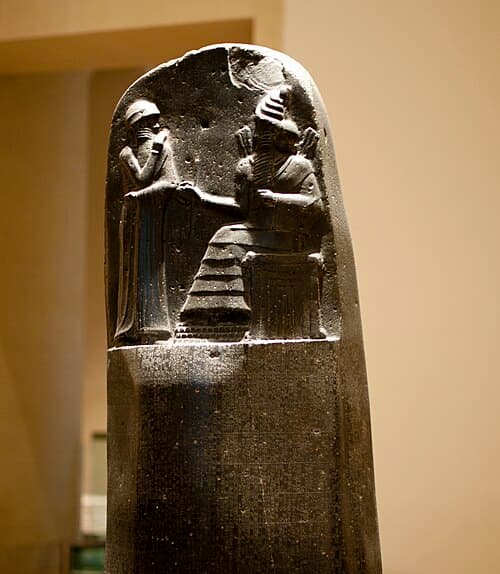
The upper relief of Hammurabi's stele. The standing king faces the seated Shamash. Photograph: Urko Dorronsoro, CC BY-SA 2.0.
2. The Fields of a Fallen Empire
Around 2004 BCE, the Third Dynasty of Ur collapsed.
The empire disappeared, but the habit of keeping accounts remained. The hands that filled dated records with workers' names, grain and oil in storehouses, and livestock received and issued did not stop with the dynasty. Clearing muddy canals, checking boundaries with a neighbor's field, and feeding a family on grain left after offerings to the temple continued to weigh upon daily life, whoever wore the crown.
The cities of the southern plain began competing for the empty throne. Isin, to the north, first took Ur and the sacred city of Nippur, claiming to be the rightful heir to Sumerian kingship. Larsa, to the south, grew strong enough to challenge it. The struggle between them lasted nearly two hundred years. Around 1793 BCE, when Rim-Sin of Larsa finally defeated Isin, the contest seemed settled.2
At about that time, a young Hammurabi ascended the throne in the small northern city of Babylon.
Babylon was not then the center of the world. To the south stood the seasoned and powerful Rim-Sin. To the north, east, and west, other rulers commanded their own fortresses, armies, and networks of allies. Strip away the splendor that later gathered around the name Babylon, and Hammurabi's starting point was a precarious city-state wedged between stronger powers.
The map of this age was drawn in waterways rather than border lines. Cities breathed through rivers and canals as through a network of veins. If an upstream city altered a single weir, a downstream city's harvest and trade routes could be unsettled for an entire year. The harder task came after breaking down the walls: getting the inhabitants of conquered land to plow again the following spring, open the waterways, and deliver grain.
Hammurabi preserved both kinds of achievement in the names of years. In Babylonia, years were named for major events rather than simply numbered. There was a year named for defeating Larsa, and another for digging a canal that brought water to several cities. At the end of contracts to rent fields or borrow barley, people had to write the year's name. Each loan of a measure of barley invoked the king's achievements. Victory in war and water flowing through a canal upheld royal authority by different routes.
3. Among the Alliances of Kings
Hammurabi reigned for forty-three years. Most of the campaigns that greatly expanded his territory came in the latter part of his reign. Elam, the mountain power to the east; Larsa, dominant in the south; Mari, the trading city on the middle Euphrates. One barrier after another stood before Babylon.
Victories look clear-cut in a later chronology. For rulers living through them, tomorrow was always shrouded in fog. An ally embraced today to strike yesterday's enemy might become tomorrow's knife at one's back. A letter conveys that atmosphere: a passage in a report from the Mari official Itur-Asdu to his king, Zimri-Lim.
"No king is powerful on his own. Ten to fifteen kings follow Hammurabi of Babylon, and as many follow Rim-Sin of Larsa."3
Hammurabi was one among several leading powers. What matters in tracing his rise is not the number of battles, but his persistent grasp of political realities: noticing fine cracks in the balance of power and shifting the landscape of alliances in his favor.
The Louvre's tablet AO 7664 lists the year-names of Hammurabi's forty-three-year reign.4 Follow the list downward, and the numbers become a story.
The name of regnal year 31: Larsa conquered, Rim-Sin defeated. The "land of Sumer and Akkad" came under a single command.
The name of regnal year 33: Mari subdued.
The name of regnal year 35: Mari's walls demolished.
Yet conquest did not end when the gates opened. Each city had a patron deity worshipped for centuries and families whose interests were rooted in land worked for generations. A foreign conqueror had to demonstrate the power to collect taxes and conscript labor while persuading people that he was a fair protector of their old customs and livelihoods. That is why swords and prayers, canals and justice, repeatedly appear together in Hammurabi's inscriptions.
The city that bears the most chilling witness to these two faces of government is Mari.
4. Voices from the Archives of Mari
Tell Hariri in eastern Syria, near the Iraqi border. From the palace ruins of ancient Mari came a flood of cuneiform tablets: some fifteen thousand documents from the Amorite period alone. They belonged to the archives of its last king, Zimri-Lim. Here survived the breathing of a state that victory monuments never describe. Not only royal commands, but urgent reports from frontier officials, covert observations by informants, and petitions for grain rations.5
Power changes its face according to where the record comes from. On a victory monument, the king is a hero who decides everything. In an inner palace room, reading a clay tablet, he is different: an anxious decision-maker dependent on distant eyes and ears. If a messenger arrived a day late, or a report of a tribe's movements beyond the river failed to reach him in time, power became a blind giant.
Mari therefore ran on everyday logistics as much as on battle orders. Wheat and oil moved from place to place, meals were arranged for delegations, and the movements of suspicious nomads were carefully recorded. It is because of these records, left by unnamed officials, that we can read Zimri-Lim's age as a layer of living civilization rather than merely one king's glory and disgrace.
Mari had once joined Babylon against Elam. When the balance shifted, it too could not escape Hammurabi's expeditionary army. The Babylonian year-names are cold. They separately commemorate the year Mari was subdued and the year its walls were demolished.
An interval of two years.
Subduing a city and tearing down its walls are different acts. The walls were the inhabitants' last shield and the framework that allowed their city to stand on its own. The record of their destruction two years after submission contains the ruthless logic of hegemony: ensuring that resistance could never take root again.
The righteous shepherd who declared his care for the weak and the conqueror who demolished an allied city's walls were the same man. Erase either face and the truth of the age becomes blurred. Whose order, then, did the justice so insistently proclaimed by the king serve? The answer lies in the words on his black stele.
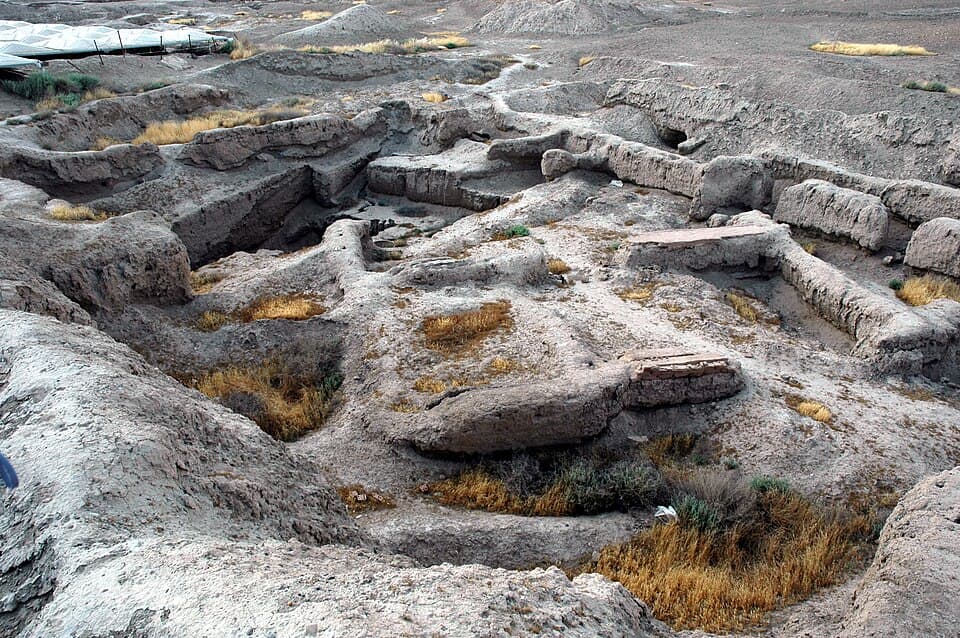
The ruins of Zimri-Lim's palace at Mari, photographed in 2004. Photograph: Gianfranco Gazzetti / GAR, CC BY-SA 4.0.
5. The King Before the God
At the top of the stele, Shamash, god of the sun and justice, sits enthroned, flames rising from his shoulders. He holds a rod and a ring, objects interpreted as measuring tools or as emblems of kingship. Before him, Hammurabi stands with his right hand raised toward his mouth: a gesture of worship. The scene's message is clear. The norms inscribed below are anchored in divinely ordained order, beyond the whims of a human ruler.
The text does not begin with a list of crimes and punishments. A solemn prologue comes first. The gods have called the king to this mission:
"Make justice manifest in the land, eliminate the wicked and evil, and prevent the strong from oppressing the weak."6
The king then lists, one by one, the cities whose temples he restored and the peoples to whom he returned prosperity. Only then do the individual provisions follow. In the prologue, he seeks to stand as a shepherd tending his people's wounds rather than as a conqueror in war. The authority of the rules on the stone and the legitimacy of the ruler are inseparable.
The provisions contain fragments of conflicts that ancient city dwellers faced: entrusted silver lost; disputes over the yield of leased fields; family quarrels over marriage and inheritance; the collapse of a badly built house; injuries inflicted in anger. When interests collided among people living within narrow city walls, power placed itself in the position of final arbiter.
Still, it would be misleading to treat the stele as a modern legal code. Rather than a system exhaustively regulating every possible case, it was closer to a monumental declaration, at home and abroad, that the king was a just ruler.7 On the mud floors of courts, longstanding customs, witnesses' testimony, and the influence of elders would also have shaped judgments.
The stone nonetheless shows clearly what the state put forward as the standard of public order. And as the prologue's lofty call to protect the weak descends into specific provisions on bodily injury, the boundaries of Babylonian fairness emerge.
6. The Same Eye, a Different Price
An eye has been blinded.
Measured only in physical suffering, the darkness the victim must endure is the same for everyone. Yet the judgments on Hammurabi's stele weigh the injured person's social rank before the injured eye. The provisions now numbered 196 and 197 embody the harshness of retaliation in kind, or lex talionis. If a person of the awīlum class blinds the eye of another of the same class, his own eye is to be blinded; if he breaks the other's bone, his own bone is to be broken. An eye for an eye.
Move to the very next provision, however, and retaliation changes course sharply. Under provision 198, someone who blinded a muškēnum's eye or broke his bone was to pay one mina of silver instead of surrendering his own body to equivalent harm. For injuring the eye of an enslaved person, a wardum, the offender was to pay the owner half that person's value in silver. A broken tooth likewise called for the same injury in return when the parties were of equal status.8
There was one wounded body, but the weight assigned to it by law divided three ways. The justice the king promised was not justice in the modern sense of equality before the law. It was a justice of distinctions, enforcing the shares and responsibilities appropriate to each rank within a firmly maintained traditional hierarchy.
The silver compensation for injuries in the Laws of Ur-Nammu, encountered in Part 6, does not justify declaring Sumer gentle and Babylonia a regression into barbaric bodily punishment. That would oversimplify history. Within Hammurabi's stele, harsh retaliation in kind coexisted with a system of quantified compensation in silver.
Beside these distinctions, the promise to protect the weak takes on a different weight. The king declared that he would prevent the strong from oppressing the weak, yet these provisions maintained the boundaries of status. Babylonian justice was a practical compromise: taking the hierarchy accepted by its society as a premise, it sought to prevent that order from disintegrating into unchecked violence.
A modern reader's discomfort here is natural. But for those to whose bodies and families these cold sentences applied, the brief provisions on the stone were the suffocating constraints of everyday reality.
7. A Household in a Year of Failed Harvests
Beside a muddy channel of the Euphrates, a farming family works a few plots of barley.9 That spring, no rain came. Or a swollen river overtopped the embankment and swept across the fields. The ears failed to fill, and the earthen jars stood empty. Not even seed remained for the following year. If the family had borrowed barley from a neighbor or temple the previous winter, disaster did not stop at the field's edge. The creditor knocked at the door.
Provision 48 addresses this household. If the storm god Adad had swept through the field, or drought had prevented the grain from growing, the farmer did not have to repay grain to the creditor that year. The debt tablet was wetted, repayment for the year deferred, and interest waived. A contract was sacred. Yet this was a buffer against a debtor's total collapse before a disaster no person could prevent.
Even after hard labor, a turn in the weather or one failure of water management could push a family into debt's mire. At the bottom of that mire stands provision 117.
It concerns a household head unable to meet his debts, handing over his wife, son, or daughter to work in a creditor's house. The law limited that service to three years. "In the fourth year, they shall be released."
Three years.
Setting an upper limit was an intervention by royal authority against permanent enslavement. But before reading of release in the fourth year, we must not erase the despair of the first three, endured while family members lived in another's house. A few lines on stone became time that a household had to survive day by day.
Waterways also sowed disputes.10 If someone's neglected embankment broke and flooded neighboring fields, he had to repay the ruined grain in barley. If he could not, the law required that he and his property be sold and the proceeds shared among the neighbors (provisions 53–54).
The king boasted that his great canals had brought divine favor. Beside those waterways, farmers fought for survival over a small crack in a neighbor's embankment. The glory of a state that built canals and the liability of a single household met along the same flow of water.
8. Witnesses and Clay Tablets
There was a merchant.11 Before setting out on a long journey, he left silver and cloth at an old friend's house. Their trust ran deep, so he appointed no witnesses. Months later, he returned to collect his property. His friend's expression changed. "I never received anything from you."
Memory blurs; desire rewrites the story. Faced with that denial, there is no way to settle who is right.
Provisions 122 and 123 refused to accept this impasse. Anyone entrusting property to another had to show the goods before witnesses and record the agreement on a clay tablet. If property was deposited without witnesses or a written agreement and the other party denied receiving it, the law would not uphold the claim.
The smile on the day of a transaction can become a different face on the day of settlement. Cuneiform pressed into clay and witnesses' seals were therefore anchors of an institution: they withstood the erosion of time and human fickleness, bringing a past promise into the present.
The law also bound the person who passed judgment. Under provision 5, a judge who heard a case, delivered a judgment, and issued a sealed decision, then subsequently reversed that judgment, had to pay twelve times the disputed amount and was removed from office.12
Twelve times.
The person judging others had to put his own decision in writing and remain responsible for that record. A boundary was drawn so that even someone entrusted with power could not unsettle the institution through personal whim.
The scene recalls the grain accounts left by Ur's officials in Part 6. Recording hundreds of measures of barley received and issued may seem different from impressing a court judgment into clay, but their essence is the same: fixing past events in a record and presenting that record as evidence when a dispute arises, thereby reducing the cost society must bear.
Of course, records were not equally available as a tool to everyone. Only a minority could read and write cuneiform. For a poor farmer or a widow without support, finding witnesses and preparing documents against a powerful person would have been exceedingly difficult.
Even so, civilization's center of gravity was gradually moving from the mire of memory toward the order of documents. To inscribe ownership and debt, marriage and judgment neatly on clay, there had to be places where that skill could be learned and practiced.
9. In a Scribe's Palm
At the Metropolitan Museum of Art in New York is a broad, rounded piece of clay that fits into an adult's palm.13 It is an exercise tablet used in Old Babylonian scribal education. The name of the patron deity Urash is inscribed repeatedly upon it. Once, twice, six times in all.
The hands of a bureaucracy that would one day polish royal inscriptions and draft intricate contracts grew skilled by having the angles of their wedges corrected in damp clay. The words on the black stele shine with abstract authority. Beneath them lie the repeated efforts of countless scribes who kneaded clay, cut reed styluses, and trained their hands to write. An enlarged kingdom needed more than spears and swords. People had to be trained continually to count, measure areas, and record transactions.
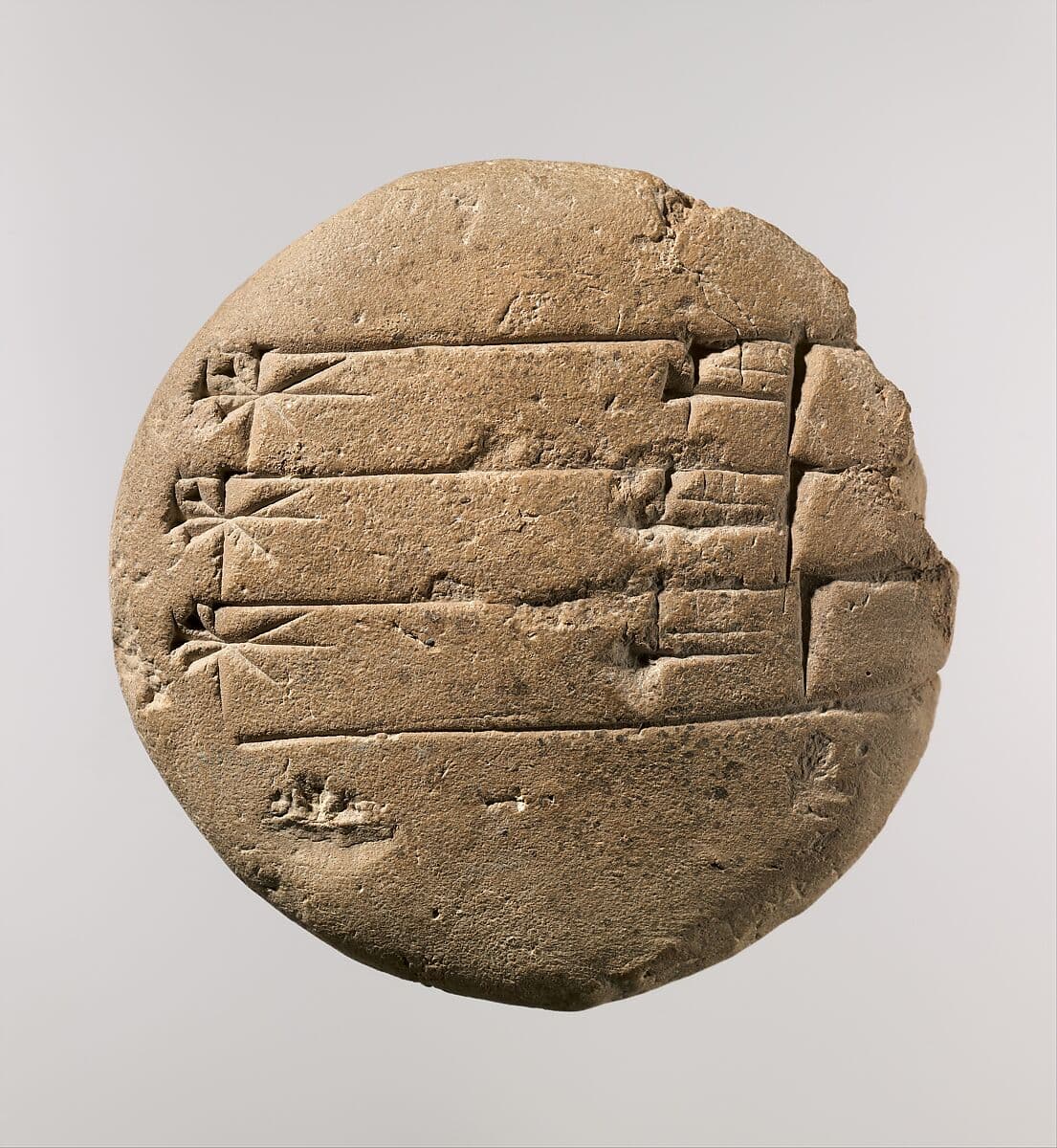
A scribal exercise tablet bearing the name Urash six times. Met 86.11.251. Photograph: The Metropolitan Museum of Art, Public Domain.
On one of these clay tablets, Babylonian thought reaches beyond the bounds of administration.
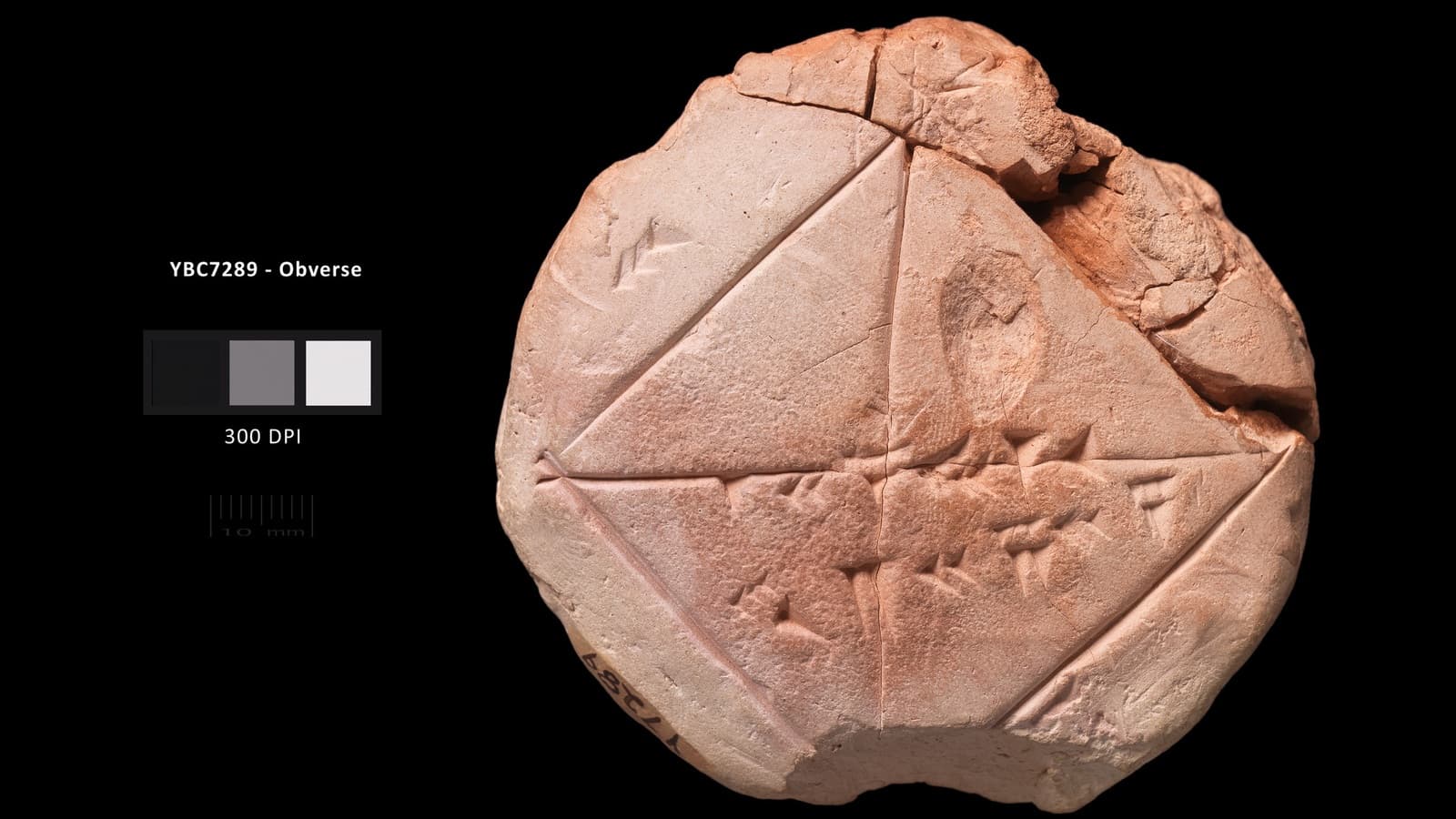
The small tablet YBC 7289 in the Yale Babylonian Collection.14 Two diagonals cross inside a hand-drawn square. A sexagesimal number is written along the diagonal. Rendered in our decimal notation, it reads:
1.41421296.
Its difference from the true value, √2 ≈ 1.41421356, is less than one millionth.
The figure is modest: a square and the diagonals crossing it. Yet knowing the side length does not make the slanting diagonal's length appear of its own accord. Draw the diagonal, and a gap opens between the world the eye sees and the world numbers must calculate. An unnamed Babylonian calculator did not fill that gap by eye. Calculation narrowed it down to the last digit.
It is difficult to treat this tablet as a working plan for a palace or canal. Its precision already exceeds an immediate practical need. Even calculation nurtured in the work of measuring fields and digging canals eventually began to investigate numbers and shapes themselves.
On another tablet, Plimpton 322, numbers related to the sides of right triangles stand neatly arranged in a table.15 More than a thousand years before Pythagoras was born, Babylonian calculators were working with the hidden order among the sides of right triangles.
There is no evidence that these tablets were made on Hammurabi's orders. Yet in the very same historical layers as the law stele, alongside rules for settling disputes, ran an effort to grasp space and shape through numbers.
The conqueror's name remained on a great stone monument. But those who carried human knowledge a little further were the calculators who inscribed the paths of numbers on palm-sized clay and quietly disappeared.
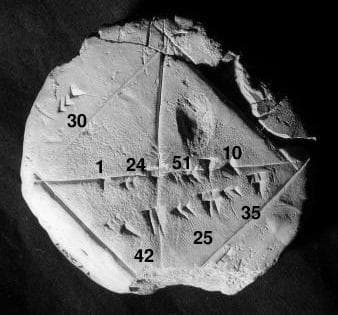
YBC 7289. Modern numerals added to the photograph help readers interpret the sexagesimal signs. Photograph: Bill Casselman · Yale Babylonian Collection, CC BY-SA 3.0.
The photographer's original explanation. Artifact collection: Yale Babylonian Collection.
10. After the King Was Gone
Around 1750 BCE, Hammurabi, who had gathered the plain into one hand, died. His son Samsu-iluna inherited the throne. Conquering land and keeping an enlarged realm intact across generations were entirely different tasks.
Around the new king's eighth or ninth regnal year, the old southern cities rose in rebellion one after another. In Larsa, Rim-Sin II took up the name of its former king. Borders shook on every side, and the region around Mari on the middle Euphrates also slipped from Babylon's grasp.16
Cities and peoples neatly bundled into a single line as "the subjugated" on victory monuments rose again, bearing their own histories and gods. Neither the imposing law stele nor splendid temple offerings could prevent the kingdom from cracking. Declaring order in writing was one thing; sustaining, day after day, the conditions under which people would accept and live within that order was another.
Babylon's First Dynasty gradually lost strength. Around 1595 BCE, more than a hundred and fifty years after Hammurabi's death, a Hittite expeditionary force swept down like lightning from the Anatolian plateau to the north and sacked Babylon. The dynasty ended there.
The black stele's ordeal came much later.
The twelfth century BCE. The Elamite king Shutruk-Nahhunte invaded Mesopotamia and carried monuments from several cities to Susa. Hammurabi's stele was among that booty.17 Some six hundred years after its erection, the stone that had proclaimed justice was hauled into an enemy capital as an ornament of victory.
The erased columns encountered in Section 1 can be read within this scene. One interpretation is that the conqueror intended to remove the king's words and inscribe his own name in their place. Yet the space remained empty.
11. Meanwhile, to the East
In the eighteenth century BCE, as Babylonian armies surrounded walls and scribes pressed calculations into clay, people elsewhere across Eurasia were sustaining civilization in their own ways.
In the Indus basin, the urban order of Harappa, with its regular street grids and sophisticated drainage, was faltering. Changes in climate, waterways, and trade appear to have combined. Yet people did not disappear when great cities weakened. Some moved to smaller settlements; others stayed on the old urban sites. Adapting to a changed landscape, they fired pottery, planted grain, and tenaciously rebuilt their lives.18
Farther east, in the Yellow River basin, the Erlitou culture, preceding the later Shang, was gaining strength. Its people melted bronze and cast ritual wine vessels called jue.19 With materials and a language quite different from Mesopotamia's record of power pressed into clay, they were shaping the relationship between heaven and authority.
Place Harappa's scattered settlements and Erlitou's bronze wine vessels beside Babylon's stone stele, and the view widens beyond one empire's rise and fall to the larger forest of civilizations. History was not a single-file relay in which one civilization passed the baton to the next. Under the same sunlight, different peoples were finding ways to survive on their own land and with their own skills.
12. Epilogue — The King Who Inscribed Justice and the People Who Left Records
We return to the black stele recovered in three pieces from the dust of Susa.
The rubbed-down space near its base remained empty, the king's sentences gone. But the surviving signs did not fall silent. Through them, Hammurabi's voice crosses four thousand years and tells us far more than he intended.
Records Illuminate More Than Declarations
Hammurabi wished to be remembered as the shepherd who removed injustice and rescued the weak. Yet because he also carved specific provisions into the stone, we can read behind that sacred rhetoric the distinctions of status, the harshness of retaliation in kind, and the tears of people forced by debt to part with their families. Records transmit more than the praise a ruler intended. Detailed records sometimes outgrow that intention and reveal the fuller, many-sided truth of an age.
Institutions Are Measured Against the Weight of Life
The provision limiting debt service to three years was plainly meant to protect the vulnerable. But in the households it reached, there were also three long years of darkness that loved ones had to endure in another's home. An institution's worth is measured not by the elegance of its wording, but by a day in the life of the weakest person who bore its full weight.
The History of Knowledge Is Larger Than a King's Name
The messenger hurrying toward Mari's palace through dust, the aspiring scribe repeatedly writing a god's name on a round piece of clay, the unnamed calculator drawing a square's diagonal and narrowing its length down to the final digit. Civilization rested on more than one ruler's conquests. The small struggles of ordinary people to understand and measure the world within their allotted lives gathered to swell the current of history.
Now it is time to step out of the great stele's shadow and face the palm-sized tablet beside it.
A square and diagonal drawn on clay, with closely packed sexagesimal numbers. The accompanying mathematics commentary enters the thinking of Babylonian calculators who opened the doors of number behind the wars of kings and the banners of empire.
Notes and Historical Sources
Footnotes
Louvre collection record Sb 8. Basalt (sometimes described as diorite in older accounts), 225 cm tall, found at Susa in 1901–1902, with a relief of Shamash and Hammurabi at the top. The pickaxe scene opening Section 1 is a description based on the excavation circumstances. The king's hand gesture is interpreted as prayer or worship. The god's rod and ring have been interpreted both as measuring tools and as symbols of kingship. ↩
Elizabeth Knott, The Isin-Larsa and Old Babylonian Periods, Met. Dates follow customary usage within the Middle Chronology tradition. ↩
Excerpt from Mari document A.482. Jack M. Sasson, Comparative Bible Research and the Mari Archives. Comments and Reflections, Claroscuro 18(2), 2019, p. 8, note 20. The sender is Itur-Asdu, an official at Nahur; the recipient is Zimri-Lim. The letter is thought to date to around his sixth regnal year. The quotation in the text is a translation of part of this excerpt. The complete letter remained unpublished when the paper appeared. ↩
Louvre AO 7664, a list of year-names for Hammurabi's forty-three-year reign. Year 31 commemorates the conquest of Larsa; year 33, a waterway and Mari's subjugation; year 35, the destruction of Mari's walls. Given the practice of commemorating the previous year's events, the year-name numbers have not simply been converted into absolute dates for the events. ↩
French Ministry of Culture, Les textes des archives and Étude des textes de Mari; CNRS, Archives royales de Mari. Consulted for document types and the scope of research. ↩
The prologue passage summarizes the reading text adapted from Martha Roth's translation, hosted by SOAS. For individual provisions, see the parallel translations at eHammurabi. ↩
On the stele as a monument to norms and kingship, see the Met and Louvre accounts. Scholars differ on how directly its provisions were applied in actual court cases. ↩
Hammurabi's provisions 196–201. Huehnergard's terminology and older translations were compared at eHammurabi. Provision 198 specifies one mina of silver; provision 201, one third of a mina of silver. The word "gold" in the older Avalon translation is not followed. Renderings of awīlum and muškēnum as "free person" and "commoner" are conveniences; interpretations of their social status differ. ↩
Hammurabi's provisions 48 and 117, eHammurabi. Wetting the tablet in provision 48 is read alongside deferral of the year's debt obligation. This does not assert cancellation of the principal or a particular procedure for rewriting a contract. The opening farming household is a narrative reconstruction based on the provisions. The three-year limit in provision 117 concerns family labor in that debt situation. ↩
Hammurabi's provisions 53–56, on neglect of embankments and irrigation management and compensation for damage. The narrative describes the norms, not documented instances of enforcement. ↩
Hammurabi's provisions 122–123, on witnesses and agreements for deposited property. Provision 123 addresses a deposit made without witnesses or a contract and subsequently denied by the recipient. The merchant scene opening Section 8 is a reconstruction based on these provisions. ↩
Hammurabi's provision 5, summarized regarding responsibility for changing a judgment. This should not be extended into a claim that legitimate appeals or retrials in general were forbidden. ↩
Met 86.11.251, a scribal exercise tablet dated to the twentieth through sixteenth centuries BCE. The record explains its educational use and the six repetitions of Urash's name. The student's age is not established. ↩
NYU ISAW, YBC 7289. Old Babylonian, nineteenth through seventeenth centuries BCE. The diagonal's number is 1;24,51,10 = 1 + 24/60 + 51/60² + 10/60³ ≈ 1.41421296. The difference from the true value is approximately 0.0000006. Reading the numbers and the calculation procedure are covered in the commentary. ↩
NYU ISAW, Plimpton 322. Old Babylonian, possibly from Larsa. Interpretations of its construction and purpose include a table of educational problems and a reciprocal table; it is not identified here definitively as "the world's first trigonometric table." ↩
Paul-Alain Beaulieu, A History of Babylon, Chapter 4. On southern rebellions early in Samsu-iluna's reign, Rim-Sin II, and regional losses under Hammurabi's successors. ↩
On the stele's removal to Susa, see the Louvre's The Code of Hammurabi. For the interpretation of the erased area as preparation for an Elamite inscription, and its limits, see Nathaniel B. Levtow, “Text Destruction and Iconoclasm in the Hebrew Bible and the Ancient Near East,” in Natalie N. May, ed., Iconoclasm and Text Destruction in the Ancient Near East and Beyond, 2012, p. 321, note 37. The fact of removal is distinguished from inferences about who erased the writing and why. ↩
R. H. Meadow and J. M. Kenoyer, Report on the Harappa Excavations, 1998–2000. Consulted for the continuation of life and building in later phases. Explanations of decline include climate, river shifts, and changes in trade. ↩
Smithsonian National Museum of Asian Art, S2012.9.568, a bronze jue, approximately 1800–1600 BCE, probably from Yanshi, Henan. Erlitou is not treated as conclusive evidence for the Xia dynasty. The conventional dates of the Shang dynasty are approximately 1600–1046 BCE (Met). ↩
Join the discussion