

This is the mathematics commentary for Part 7, “Humanity Before a Black Stone Stele — Hammurabi and the World of Babylon”. In the main episode, we met scribes who recorded fields and canals, debts and transactions. Here we explore the principles behind the calculations they learned and passed on. Starting with the diagonal of a square drawn on a small clay tablet, we follow Babylonian base-60 notation and square-root approximation, then examine how the questions they addressed differed from those of proof in later Greek mathematics.
1. Three Lines of Numbers
No king's name. No record of a war. On a palm-sized clay tablet, two diagonals cross inside a square. Beside it, three groups of numbers remain. 30. 1;24,51,10. 42;25,35.
Known today by its collection number, YBC 7289, the tablet is dated to roughly the nineteenth through seventeenth centuries BCE. That range overlaps with Hammurabi's lifetime. Its maker's name is unknown, but the tablet's shape and handwriting point to scribal education.1
Of the three lines, 1;24,51,10 is the one that catches the eye. In our decimal system, it becomes approximately 1.414212963. With a square-root sign, the number it approaches takes just two symbols: √2. More than a thousand years before Pythagoras, a Babylonian scribe had come remarkably close to that value.
The scribe had no calculator, no screen displaying a long trail of digits after a decimal point. What remains is a small clay tablet. Yet the difference between its number and √2 is less than one millionth.
Where did such precision come from? Too much lies behind the tablet to explain it through one person's extraordinary skill alone. It required a way to write numbers, tables for calculation, people to learn from them, and people to teach. To understand the small square, we must first look at the society around it.
2. From Ledgers to Schools
In Part 6, the officials of Ur entered grain and labor in their ledgers. In Part 7, fields and canals, debts and transactions entered the language of law. When a watercourse failed, a neighbor's harvest could disappear with it. The area of a field, the quantity of grain, the share due to a worker: these were quantities on which both government and livelihoods depended.
Recording them was not enough. Different quantities had to be converted into common units, divided, and checked again. Those responsible for calculation needed both literacy and a command of numbers. Mesopotamian scribal education grew within this society.
That does not mean every school problem was a work order from a construction site. Old Babylonian mathematical texts also preserve complex problems that went beyond the demands of working life. Within an education that taught practical skills, room emerged to explore calculation itself more deeply.2
An interest that began with measuring fields could leave particular fields behind and turn toward the properties of shapes. A calculation for dividing a specific quantity of grain could become a method applicable to many problems. Society called for calculation; education provided a place to accumulate and extend it. Mathematics needed both in order to grow.
The numbers on YBC 7289 belong to this accumulation of knowledge. Researchers consider it likely that the maker took the diagonal ratio from a coefficient table. This single tablet does not show the moment a square root was first discovered. It is closer to evidence that a value already obtained could be learned and used by someone else.3
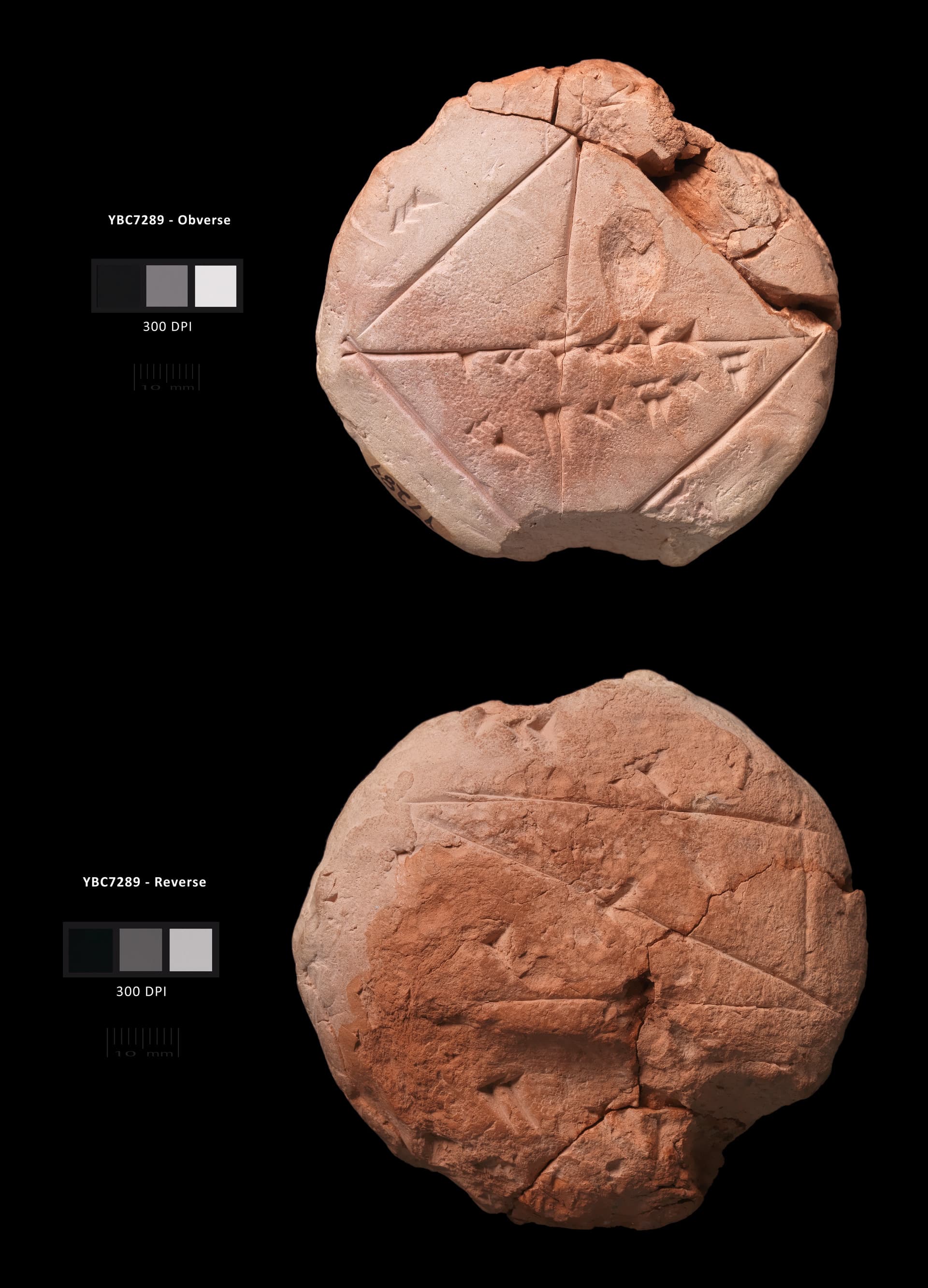
The front (above) and back (below) of YBC 7289. The front preserves the square, diagonals, and numbers read in this article. Photograph: A. Urcia, Yale Peabody Museum of Natural History. Front-and-back composite: Theodor Langhorne Franklin. Original and collection information, CC0.
3. Places Divided by Sixty
1;24,51,10 is not a code made by placing four numbers side by side. It is a number in which each place has one sixtieth the value of the preceding place. The principle resembles our division of an hour into sixty minutes and a minute into sixty seconds.
| Place entry | Value |
|---|---|
| 1 | 1 |
| 24 | 24 ÷ 60 |
| 51 | 51 ÷ 3,600 |
| 10 | 10 ÷ 216,000 |
The number therefore amounts to:
The semicolon and commas are separators for modern readers. These marks were not impressed on the original tablet. There was no equivalent of our decimal point to fix the magnitude, so the units and the context of the problem had to be read together.3
Sixty is convenient for working with fractions. One half becomes 0;30, one third 0;20, and one fifth 0;12. Even one third, which continues indefinitely as 0.333… in decimal notation, ends after a single fractional place here. That advantage alone, however, cannot explain the entire history of how the sexagesimal system arose.
Scribes used multiplication tables and reciprocal tables. A reciprocal is the partner that produces 1 when multiplied by a given number. The reciprocal of 3 is 1/3. Dividing a quantity by 3 becomes multiplying it by 1/3. Instead of solving every division afresh, a scribe could consult a prepared table.
The tablet's three numbers also form a single calculation. Reading one side as 30 gives the diagonal:
The first number is the side length, the middle number is the ratio used to obtain the diagonal, and the last is the calculated diagonal length. The same ratio works for squares with different side lengths. Knowledge acquired once can solve problems of many sizes.
4. A Square with Twice the Area
Area reveals why the diagonal calls for √2.
Join four squares, each with a side length of 1, to make a larger square with a side length of 2. Mark the midpoint of each side of the large square and connect neighboring midpoints. A tilted square appears in the middle. Each of its sides is the diagonal of a small square.
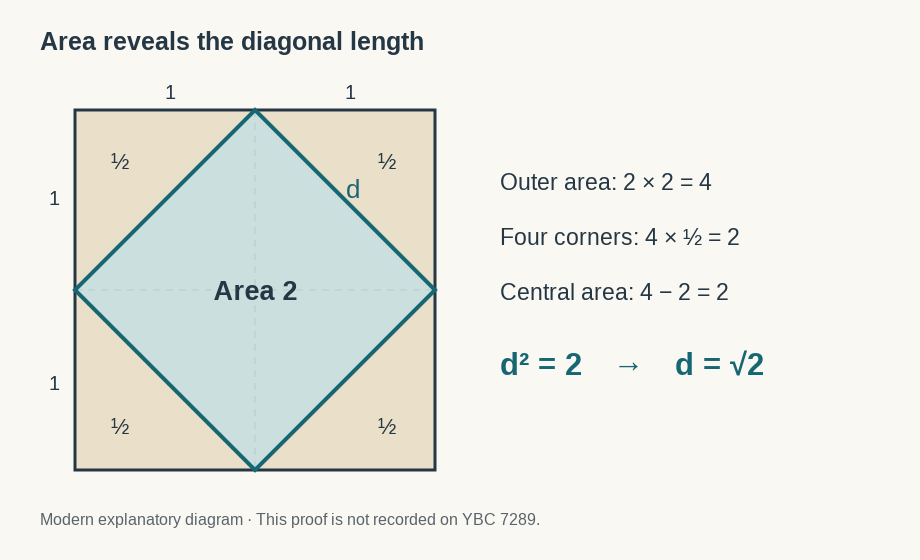
The large square has an area of 4. Each of the four right triangles at its corners has an area of 1/2, making 2 in total. The central square also has an area of 2.
Call one of its sides d, and d²=2. This is the length we now call √2. The symbols and diagram here are modern ways of explaining the principle; they do not mean that this argument is written on YBC 7289.
The problem is now clear. We need a number whose square is 2. One is too small; two is too large. Squaring 1.4 gives 1.96, which falls a little short. We could keep measuring between them with a ruler, but calculation can bring us closer.
5. The Average of Two Lengths
Take a rectangle of area 2 and set its width to 1.5. Its height is then 2÷1.5, or 1.333…. The width is a little long and the height a little short. If the two lengths could be made equal, we would have a square of area 2.
Their average is 1.416666…. Use that as the new width and divide 2 by it to obtain the new height. This time, the gap between width and height is much smaller. Repeat the process of choosing the next value between the longer and shorter sides.
| Stage | Exact fraction | Decimal approximation |
|---|---|---|
| Starting point | 3/2 | 1.5 |
| First average | 17/12 | 1.416666667 |
| Second average | 577/408 | 1.414215686 |
| For comparison: √2 | — | 1.414213562 |
Just two averages reduce the difference to around the sixth decimal place. The rectangle also explains why the method works. In a rectangle of area 2, if one side is longer than √2, the other must be shorter. Their average is smaller than the longer side and at least √2, so the next rectangle comes one step closer to a square.
In sexagesimal notation, the second value is 1;24,51,10,35,17,…. Keep only the first three fractional places and it matches the tablet's 1;24,51,10. The full calculated value is not exactly the same as the value on the tablet.
This calculation helps us understand how the mathematics of the time could approach high precision. YBC 7289 contains no record that its maker followed this sequence. Moreover, the second step requires the reciprocal of 17, so the calculation cannot be completed using only terminating sexagesimal fractions. How contemporary tables and approximation procedures might have been used requires separate investigation. That is why reconstructing ancient methods of calculation matters.3
Finding √2 does not require first knowing the concept of an irrational number. The diagonal of a square is already there, and successive numbers can be found that approach its length. Whether that length can be expressed exactly as a ratio of two integers is another question.
6. The Numbers of Right Triangles
The diagonal of a square is also the hypotenuse of a right triangle. Cut a square along its diagonal and two right triangles with equal legs appear. Babylonian calculation did not stop at this special case.
On the tablet known as Plimpton 322, a table preserves numbers corresponding to relationships among the sides of right triangles. In modern notation, an example of such a relationship is 3²+4²=5²: integers for which the squares of two sides add up to the square of the remaining side. This example explains the relationship; it does not mean that 3, 4, and 5 form a row of the table.
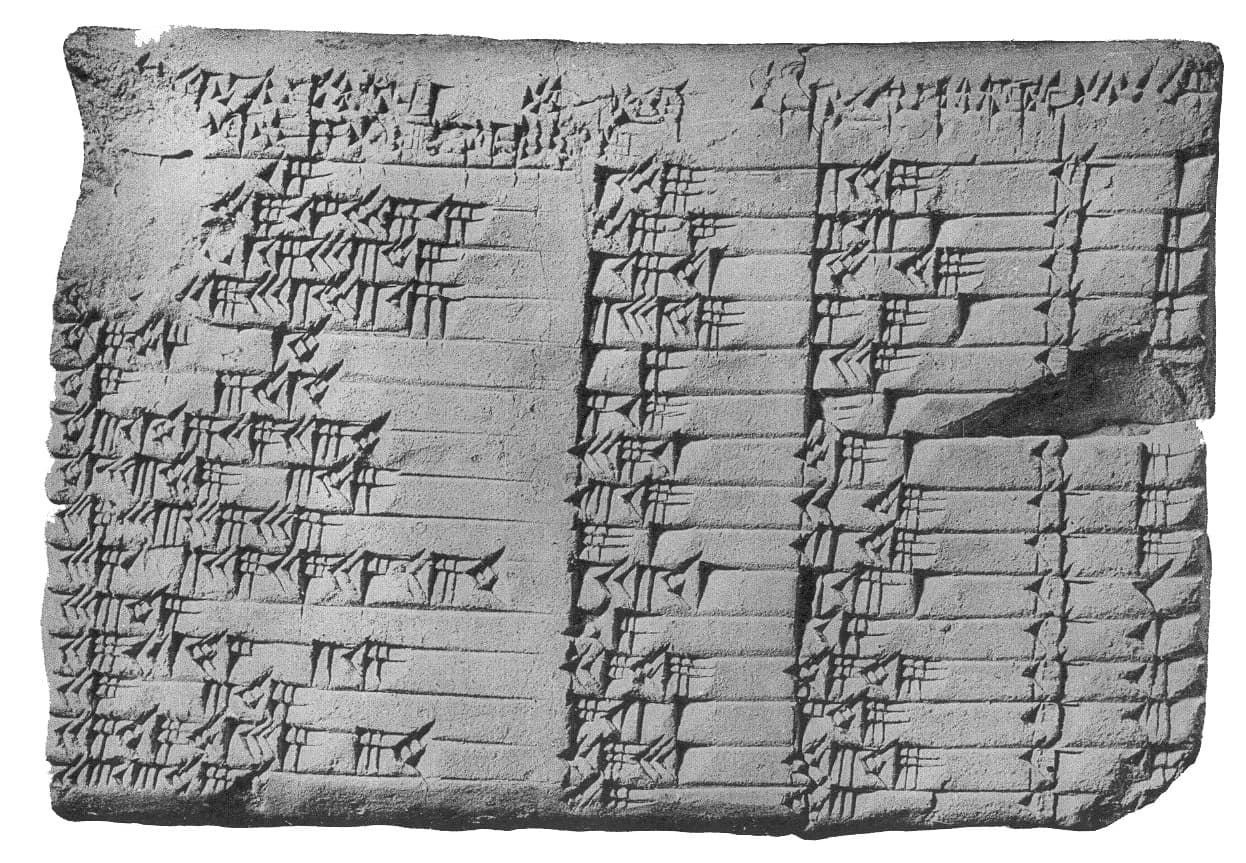
Plimpton 322. Numbers are arranged in a table on the clay surface. Collection of Columbia University. Photograph: unknown photographer, copy provided by Wikimedia Commons, used under the file's public-domain designation.
Scholars debate the table's precise purpose and the process by which its numbers were obtained. What is clear, however, is that calculations involving these relationships existed in Mesopotamia before Pythagoras.4
The history of a theorem now known by one person's name does not necessarily begin with that person. A relationship long in use may acquire a new form and explanation in later mathematics. The history of √2 contains such a change as well.
7. A Length That No Smaller Unit Can Measure Exactly
The tablet's approximation is very useful for calculating a diagonal. Yet adding more digits cannot solve every problem. Is there a common unit that measures both the side and the diagonal of a square exactly?
If the side is an integer multiple of that unit and the diagonal is too, their lengths form a ratio of integers. It does not matter how small the unit is. A single such unit would suffice. Commensurability and incommensurability in Greek mathematics concerned relationships of this kind between lengths.5
In today's notation, the question becomes whether √2 can be written as a fraction. The following argument using odd and even numbers explains why it cannot. It is presented in modern notation, not as a reconstruction of the original discoverer's calculation.
Suppose √2 is the fraction p/q, where p and q are positive integers and the fraction is in lowest terms. Squaring both sides gives:
p² is even. Since the square of an odd number is odd, p must also be even. We can therefore write p=2k. Substitution gives 4k²=2q², and then q²=2k². Now q must be even too.
We began with a fraction that could not be reduced, yet both its numerator and denominator are divisible by 2. A contradiction. Therefore, √2 cannot be expressed exactly as a ratio of two integers.
This is not a limit caused by failing to calculate enough digits. The conclusion is that no choice of integers can make such a fraction. One third also continues indefinitely in decimal notation, yet it can be written as a fraction. What makes a number irrational is not the length of its decimal expansion, but the impossibility of expressing it as a ratio of integers.
The approximation solved the problem of obtaining the accuracy required. This argument resolves whether an exact ratio exists. The same diagonal gives rise to different questions and answers.
8. How Explanations Are Organized
We would miss the history if we divided the story into Babylonians who merely calculated and Greeks who finally began to think. Some Old Babylonian solutions demonstrate the validity of a calculation by cutting and rearranging geometric figures. An explanation is embedded in the procedure. The absence of a Greek-style system of proof in the surviving texts cannot be turned into a claim that reasoning about why things work was absent altogether.6
An important achievement of Greek mathematics was to organize propositions and their grounds into connected chains. In Euclid's Elements, compiled around 300 BCE, each new proposition develops from definitions, postulates, and propositions already established. The relationship among the three sides of a right triangle is proved within that network as well.5
Pythagoras lived earlier, in the sixth century BCE. We cannot simply attribute a particular surviving proof to him, or write as though one discovery transformed all of mathematics. More than a thousand years, and different educational and intellectual traditions, separate the Babylonian tablets from the Greek mathematical texts.
The ability to obtain accurate values and the ability to establish what must hold remained necessary together in later mathematics. Obtaining a proof did not make approximation useless. On the contrary, the more carefully we ask what can be known exactly, the more clearly we can address the error that remains in numerical calculation.
9. The People Who Carry Knowledge Forward
Look at YBC 7289 again, and the numbers beside the square read differently. They record a diagonal's length, but also bear the traces of a society that accumulated and transmitted methods of calculation. Someone refined a method, someone arranged values in a table, and someone learned them and applied them to another problem.
A world that had to manage fields and grain, canals and labor needed calculation. The scribal education that grew within it also addressed problems beyond practical demands. Calculation began in life, but did not remain confined to the answers life immediately required.
This small clay tablet did not predestine the computers of a later age. Yet the act of finding an approximate value, then revising it to come closer is still intelligible to us. Express the averaging formula above in the language of modern calculus, and it is the same formula as Newton's method applied to x²−2=0. This is an equivalence of mathematical structure, not a claim that the intervening history followed a single straight line.
That is also why we follow world history to explore how knowledge arose. Leave only the formulas, and the people who needed them disappear, along with the years spent teaching and refining them. Describe only the scenery of an age, and we pass over the relationships those people actually discovered. The diagonal on the tablet is where the two stories meet.
The Boundary Between Evidence and Explanation
Footnotes
New York University's Institute for the Study of the Ancient World (ISAW), YBC 7289. Dated to the nineteenth through seventeenth centuries BCE; its exact year of production and findspot are not established. ↩
ISAW, Before Pythagoras: The Culture of Old Babylonian Mathematics. Exhibition commentary on educational materials and the difficulty of problems extending beyond occupational needs. The social connections drawn in Section 2 synthesize this material with the context of the preceding installments. ↩
David Fowler and Eleanor Robson, Square Root Approximations in Old Babylonian Mathematics: YBC 7289 in Context, Historia Mathematica 25 (1998), 366–378. The possibility of taking a coefficient from a table is distinguished from the reconstruction of approximation procedures. The averaging calculations and numerical comparisons in this article were checked directly using modern fraction arithmetic. ↩ ↩2 ↩3
ISAW, Plimpton 322. On the relationships among the numbers and the debate over the table's purpose. This article does not identify it definitively as a particular trigonometric table. ↩
Euclid, Elements, Book I, Proposition 47 and Book X, Proposition 9, David E. Joyce's online edition. The odd-and-even argument in this article is neither a translation of these propositions nor an attribution of the first proof. ↩ ↩2
Jens Høyrup, Mathematical Justification as Non-Conceptualized Practice: the Babylonian Example, in Karine Chemla, ed., The History of Mathematical Proof in Ancient Traditions (2012), 362–383, especially 367–371 on the meaning and explanation of geometric operations. This article avoids the simplistic contrast that denies justification to Babylonian mathematics. ↩
Join the discussion