

This is the third commentary following Episode 1 of the EXA Manufacturing Operations Series, “The Idle Five-Axis Machine and the Mirage in the Conference Room.” The first commentary examined departmental decision criteria and factory-wide performance; the second examined the structure of work in process and waiting that those decisions produced. This article turns to the questions that follow that diagnosis: in what sequence to produce confirmed orders, when to prepare materials, tools, and inspections, and how to respond to delays during execution. Underlying these questions is the uncertainty on the factory floor that causes execution to depart from the plan.
The factory in the story already had a production planning system. Process routes and equipment calendars had been registered. Yet first-article approval, tool preparation, and the completion of upstream operations were not connected to the machining schedule. The schedule contained time for machining, but the conditions needed to begin machining at that time were not in place. It was this connection that Martin changed.
This article addresses five questions.
- Why does subtracting processing times backward from a due date not, by itself, produce an executable schedule (Section 1)?
- Under what conditions do advance tool preparation and measurement reservations reduce stoppages at the bottleneck (Section 2)?
- How much preparation allowance should precede the bottleneck, and how should material release dates be set from that schedule (Sections 3 and 4)?
- What does the preparation allowance ahead of the bottleneck protect, and what does the time before shipment protect (Sections 4 and 5)?
- When a delay occurs, which records should guide the response, and what must be reconfirmed with other departments (Section 6)?
After examining scenes from the story and the principles involved, we compare preparation and shipping allowances within a single educational schedule. Before following the calculations in detail, readers may focus on the sequence of times in the tables and the outcome of each comparison. Times in the example are elapsed times measured from a schedule origin of zero, distinct from the actual days and times in the story.
The numerical values and working conditions in the educational example are assumptions chosen to explain the principles. They are not measurements from the fictional factory. Figures taken from the story are identified by their source chapter.
1. Connecting Confirmed Orders with Available Time
The manifolds required 56 hours of five-axis machining. That number alone suggests that starting machining earlier would solve the problem. Yet the schedule Martin examined in Chapters 4 and 5 contained a connected chain of reasons why machining could not begin.
Roughing of the manifolds finished on Wednesday evening, with datum checks and deburring still needed on Thursday. Machine 2 had confirmed orders for other customers scheduled on Wednesday and Thursday. Checking material readiness together with equipment availability showed that Friday morning was the earliest the manifolds could be loaded on Machine 2. Washing, leak testing, and final measurement would still be required afterward.
Here, workload and schedule are distinct. Multiplying 120 parts by 28 minutes per part gives 3,360 minutes, or 56 hours. This is the total time required for five-axis machining. The days on which it starts and finishes depend on the equipment calendar, existing jobs, and readiness. In a schedule with no weekend machining, 56 hours of work is not the same as 56 consecutive hours of calendar time.
The housings presented the same issue. In the Chapter 4 calculation, the 119 parts remaining when machining resumed on Monday, at 42 minutes each, required 4,998 minutes, or 83 hours and 18 minutes. Machine stoppages for tool checks and changes were additional. In-process inspection could take place while the next part was being machined, but the measurement room had to be available at that time.
Finite capacity scheduling sets schedules so that the work assigned to a machine does not exceed that machine's available capacity. Time already assigned to other orders is treated as unavailable. Even a start date calculated backward from the due date must be revised if the necessary equipment and materials cannot be secured at that point.
Reading Chapter 5 through this principle explains why Martin examined the manifold alternatives one by one.
| Alternative examined | Conditions checked together | Outcome established in the story |
|---|---|---|
| Postpone other orders on Machine 2 | Other customers' transport and assembly schedules; the time when the manifolds would be ready | Even after changing commitments to two other customers, only Thursday was actually available for the manifolds |
| Split the work across short openings on Machines 1 and 3 | Occupancy by the housings; fixture installation and removal; repeat first-article measurement | Preparation consumed most of the available openings, so the shipping date did not move forward |
| Overtime at the upstream operation | Five-axis and downstream inspection time available after shortening roughing | Advancing roughing by a few hours did not secure all the time needed to ship on Friday |
| Outsource machining | Fixture and program preparation; quality approval under the customer's inspection plan | This was not a response available for that Friday |
Adding all the empty intervals in a calendar and comparing the sum with the machining hours required conceals this difference. Operations have a sequence, and splitting a job may require preparation to be repeated. It is also necessary to check whether machining possible on one machine can be performed under the same conditions on another.
The Wednesday shipment for the manifolds was proposed only after these alternatives had been examined. The sequence was to use Machine 2 from Friday morning through the following Tuesday evening, then wash and leak-test the parts before final measurement on Wednesday morning. Within this chain, advancing individual operations and advancing shipment of the whole order produced different results.
This commentary examines the execution and rescheduling of orders already confirmed. Estimating a due date by adding a new order to the existing load before accepting it will be addressed in a later episode.
2. Preparation for Machining and Inspection Reservations
In Chapter 7, half of the housing material still to be supplied had not yet completed bottom-face machining at the first operation. That machine was also assigned 500 other automotive parts. If the existing sequence continued, five-axis Machine 1 would stop from Wednesday afternoon onward to wait for material.
After checking the automotive parts' due date, Martin placed the housing work between shifts. The purpose was to supply those parts when the five-axis machine needed them next. This decision was made with regard to the commitments for other orders handled by the first operation.
Tools and fixtures had the same relationship to the schedule. The externalization of setup work in Chapter 5 aimed to complete preparation for the next job away from the machine while it was running, reducing the work that had to be done after it stopped. Single-minute exchange of die (SMED) distinguishes internal setup, which requires a stopped machine, from external setup, which can be performed while it is running. Externalization is the principle of converting feasible portions of internal setup into external preparation.
Installing a fixture on the machine and checking its secure clamping may require the machine to stop. Once the tasks that can be prepared externally have been identified, the people and tools needed for them must actually be assigned if stoppage time is to fall.
| Preparation requirement | Problem in the story | Connection needed for execution |
|---|---|---|
| Assigned personnel | The five-axis operator also tended a general-purpose milling machine while five-axis machining was in progress | Secure time to prepare the next job |
| Tools and fixtures | Too few spare tools available for advance assembly off the machine | Use existing spare holders and distinguish them from additional equipment yet to arrive |
| Job sequence | An urgent order request led to a prepared jig being dismantled again | Maintain the schedule so that the job being prepared does not change; check the effects of any change |
| Quality approval | Production machining could not begin before first-article results were available | Include inspection and approval in the schedule as conditions for starting machining |
The quick-change plate approved on Tuesday did not arrive that week. In Chapter 9, the operator prepared the next tool in an existing spare holder. Those tools and the dedicated staffing assignment were what could be used during the first week. After the plate arrived and the job sequence stabilized, setup time fell from 90 minutes to 25 minutes in Chapter 11.
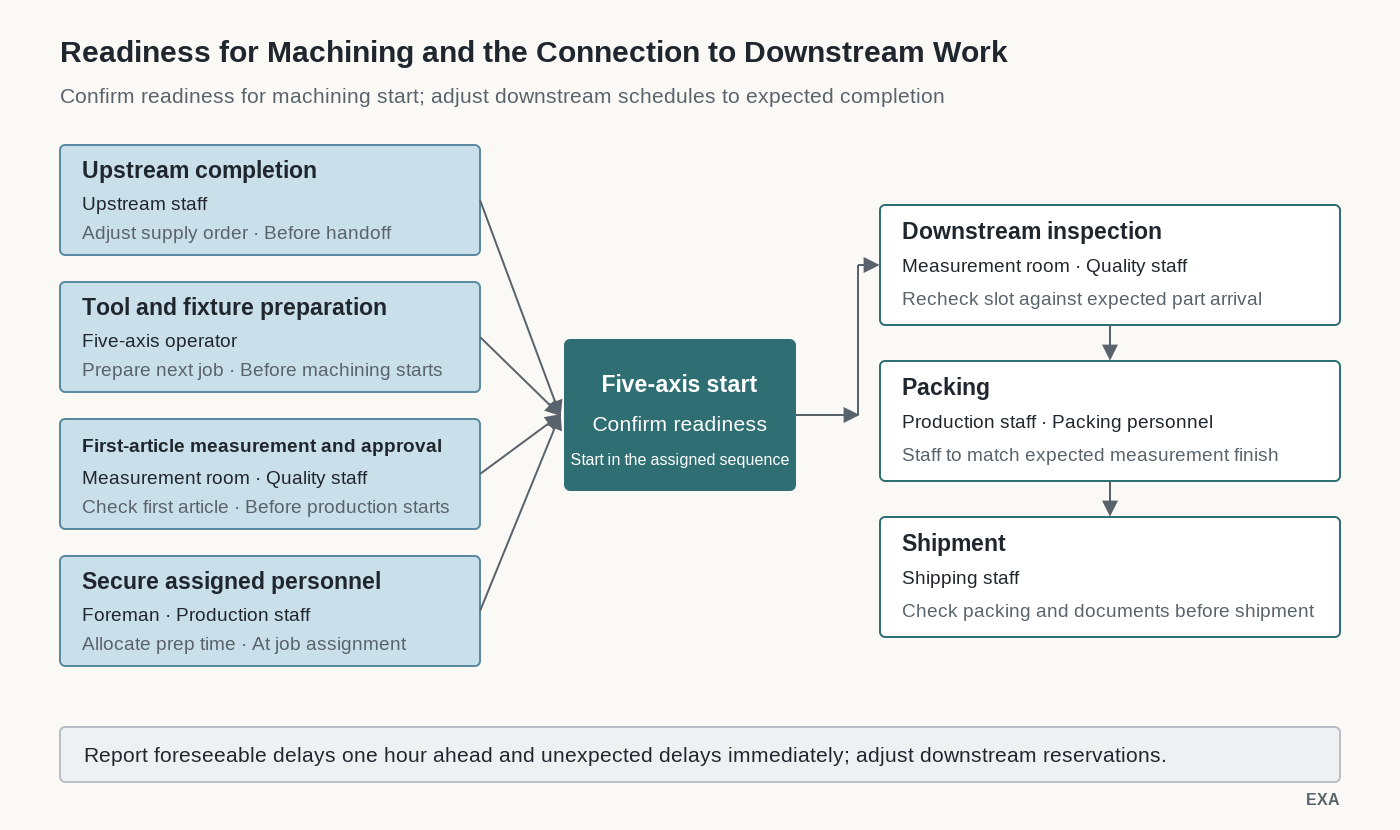
An inspection reservation was a condition for moving prepared parts to the next stage. In Chapter 8, Martin gave the measurement room the times for the housings' in-process and final inspections, and for the manifolds' datum checks, first-article inspection, and final inspection. Inspection staff needed to know more than the fact that Meriden's order was urgent: they needed to know which parts would arrive when, and which downstream operation each measurement would make possible.
The measurement room also had other orders to process. The quality manager explained that if an expected arrival time slipped, another job would take the slot. Martin agreed to report foreseeable delays an hour in advance and unexpected delays as soon as they were identified, then review the remaining allowance together and reset the sequence.
A reservation therefore does not end with securing a fixed entitlement. If the expected arrival of parts or the measurement room's other commitments change, the arrangements must be adjusted together. Assigning the urgent parts in Chapter 10 to available time on Machine 3, instead of inserting them between the housings, likewise preserved the Machine 1 schedule to which preparation and inspection had already been linked.
3. Release Timing and Preparation Allowance Aligned with the Bottleneck Schedule
Commentary 2 distinguished work in process created by early release from the preparation allowance that protects the bottleneck. Even with many parts in the aisle, the bottleneck stops if the parts needed for its next operation are missing. The staging shelf in Chapter 11 was a location for supplying parts in the sequence scheduled for the five-axis machines.
This judgment involves three connections. First, the schedule assigned to the bottleneck serves as the reference for the factory-wide schedule. Second, a time allowance is placed ahead of the bottleneck to prevent upstream delays from disrupting that schedule. Third, material release is tied to the bottleneck schedule so that only as much work as the bottleneck can process is sent onto the shop floor.
The theoretical content of this scheduling approach will be a central topic in the EXA Manufacturing Operations Series and will be discussed in separate articles, one by one.
Even when the bottleneck is scheduled first, the capacity of other equipment must be checked as well. Upstream operations must be able to prepare the parts that will feed the bottleneck, and downstream operations must be able to process the parts that leave it. This is why Martin separately checked the measurement room's schedule and orders that did not pass through five-axis machining in Chapter 5.
Setting a release date begins with identifying the time to be protected: when the bottleneck must start machining the part. Next comes the planned duration from material release to completion of the preparation required by that time. This includes upstream processing and movement, scheduled inspections, and waiting, with the included components made explicit. Adding an allowance for variability to this duration determines the release time.
This relationship applies to a simple timeline on which all resources remain available. With shift patterns, holidays, and other reserved jobs, backward scheduling must follow each resource's actual calendar. Material and personnel availability at the calculated release time must also be checked.
For clarity, this article shows the planned duration and the allowance added to it separately. Where the entire period from release to bottleneck start is managed as a time buffer, the planned duration may already be included. Adding the same processing time again to that total period advances release twice for the same requirement. Before settling on a name, the starting point, ending point, and included times must be aligned.
The initial additional preparation allowance starts with observed upstream records. For the same route and similar working conditions, these records show how long it took from release to readiness, and, when completion was late, at which stage and by how much. An average alone does not reveal infrequent but long delays, so the distribution of observed durations and the causes of long delays must also be examined.
Combining times from different process routes or product mixes obscures the allowance needed. Products with long machining times, those with short machining times, and those with different inspection requirements should be grouped appropriately. When records are initially sparse, a provisional value can be based on the available evidence and shop-floor judgment, then adjusted while recording failures of protection and the times when preparation was completed.
Even after observations accumulate, the allowance should not be increased or decreased automatically on the basis of how often it is consumed. It is first necessary to establish whether repeated delays arise from omitted tool preparation, inaccurate standard times, or an actual shortage of capacity. An allowance that has rarely been used also provides no immediate basis for reduction if the observation period is short or the job mix is unrepresentative.
This adjustment is connected to the decision to release more material onto the shop floor. Increasing the allowance and advancing release increases both the potential to protect preparation and the amount of work in process. This is why bottleneck stoppages, order due dates, and the quantity of prepared parts must be examined together. Commentary 4 will continue with methods for updating estimates of planned duration and variability from records.
4. Comparing Two Protective Intervals Within One Schedule
A single schedule illustrates what preparation and shipping allowances protect. Assume one job passes through an upstream operation, bottleneck machining, and downstream inspection and packing before it is ready to ship. The upstream operation and bottleneck use separate machines, while inspection and packing use separate people and resources. This example tracks the flow of one job only.
| Item | Conditions in the example |
|---|---|
| Time reference | Elapsed time from the planning review point, designated hour 0. All times are in hours |
| Shipping commitment | Hour 20. Inspection and packing must be complete by then |
| Upstream operation | Starts immediately upon release; planned duration is 2 hours |
| Bottleneck machining | 4 hours. The machine is available from hour 8 to hour 20, with no additional orders competing with this job |
| Downstream inspection and packing | Start immediately after bottleneck machining; total planned duration is 3 hours |
| Readiness conditions | Material is available from hour 0. The necessary personnel, tools, and approvals are secured |
| Other conditions | No shift interruptions, holidays, movement, setup, defects, or rework. No variability other than the specified delays |
The bottleneck's unavailability before hour 8 and its four-hour machining duration are the capacity limits in this example. Downstream resources are assumed to be available throughout all intervals calculated in the tables. The example does not include the situation in a real factory where missing an inspection reservation means waiting for the next slot.
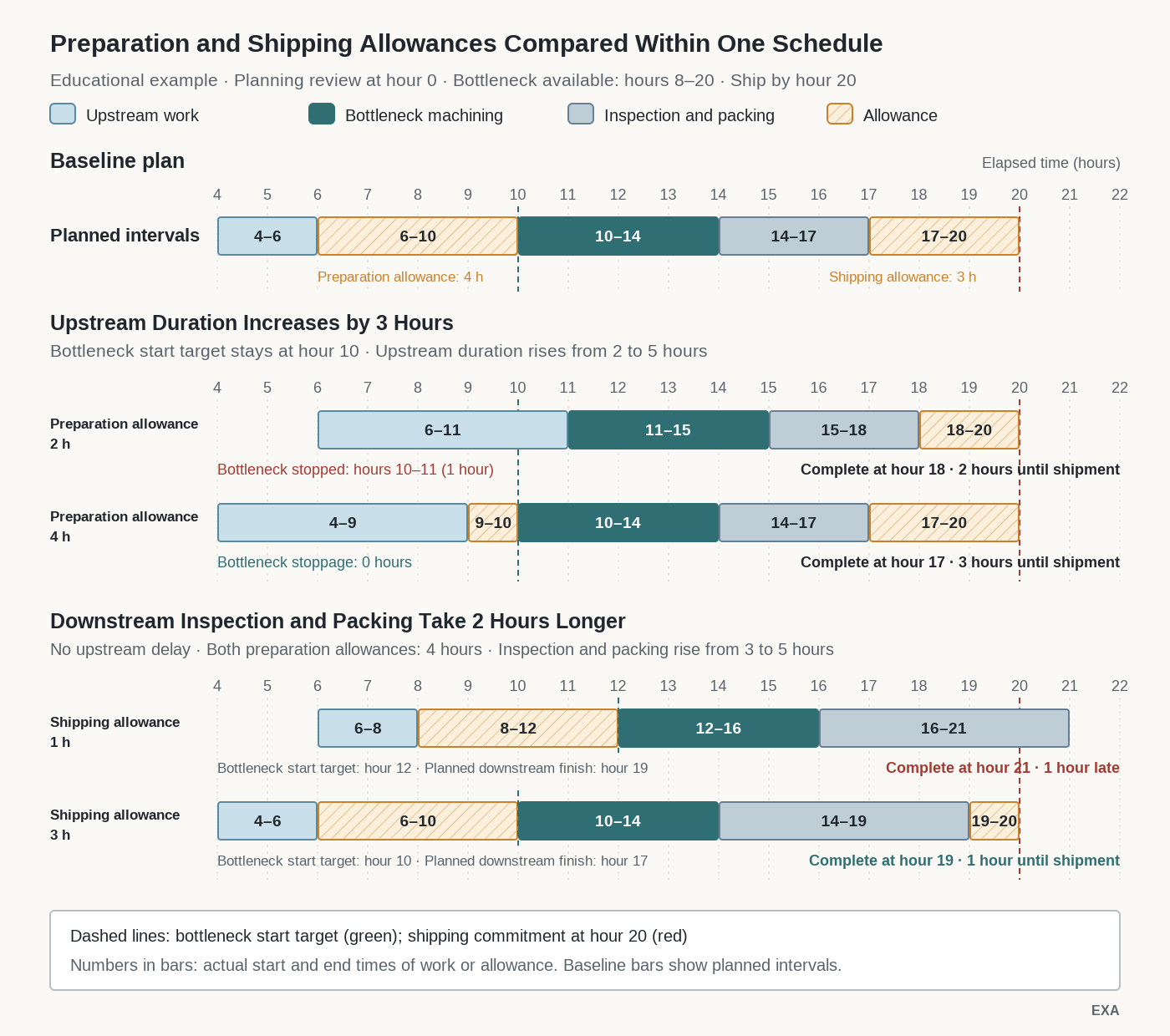
The baseline plan starts the bottleneck at hour 10, finishes it at hour 14, and completes inspection and packing at hour 17. This provides three hours of additional allowance before the shipping commitment at hour 20. The upstream operation is released at hour 4 and finishes at hour 6, leaving four hours of preparation allowance before the bottleneck starts at hour 10.
| Stage | Baseline interval (hours) | Duration (hours) |
|---|---|---|
| Upstream operation | 4–6 | 2 |
| Preparation allowance before the bottleneck | 6–10 | 4 |
| Bottleneck machining | 10–14 | 4 |
| Downstream inspection and packing | 14–17 | 3 |
| Additional allowance before shipment | 17–20 | 3 |
The entire interval from bottleneck completion to shipment is six hours. Three hours are required for inspection and packing, and the other three are additional allowance. The four hours from upstream completion to bottleneck start are an allowance intended to prevent an upstream delay from stopping the bottleneck. The two allowances protect different completion requirements.
The release time in this baseline plan is calculated as follows.
Hour 10 is the elapsed time at which the bottleneck is to start; two hours and four hours are, respectively, the upstream duration and the additional preparation allowance. Subtracting durations from a point in time produces the point at which release must occur. Reducing preparation allowance to two hours while keeping bottleneck start at hour 10 delays release to hour 6.
Upstream Delay and Bottleneck Stoppage
Assume that upstream duration increases by three hours beyond plan in both schedules. The operation takes five hours instead of two. Once the job has been released, its release date is not changed again, and both the bottleneck start target and shipping commitment are retained.
| Comparison | 2-hour preparation allowance | 4-hour preparation allowance |
|---|---|---|
| Release time (hour) | 6 | 4 |
| Planned upstream completion (hour) | 8 | 6 |
| Actual upstream interval (hours) | 6–11 | 4–9 |
| Bottleneck start target (hour) | 10 | 10 |
| Actual bottleneck interval (hours) | 11–15 | 10–14 |
| Bottleneck stoppage due to lack of readiness (hours) | 1 | 0 |
| Inspection and packing completion (hour) | 18 | 17 |
| Allowance from completion to hour 20 (hours) | 2 | 3 |
The plan with two hours of preparation allowance absorbs only two of the three hours of delay. The parts are ready at hour 11, so the bottleneck is stopped for one hour from its planned start at hour 10. Inspection and packing also finish one hour later, reducing the allowance before shipment from three hours to two.
With four hours of preparation allowance, the parts are ready at hour 9. This is three hours later than the planned readiness time of hour 6, but one hour before bottleneck start at hour 10. Bottleneck start and completion, and downstream completion, remain as in the baseline plan.
Both plans meet the shipping commitment. In the first plan, however, the bottleneck schedule was not maintained. Even if the allowance before shipment absorbs an order's delay, it cannot recover bottleneck time already lost to a stoppage. Where other orders follow, the effect of that stoppage on the next job's start must also be checked.
The plan with sufficient allowance has a cost as well. Without an upstream delay, parts given four hours of preparation allowance wait four hours before the bottleneck, while those given two hours wait two. Their time in the system from the upstream operation to the bottleneck is longer. What this example establishes is the difference in protection against the same delay and in release timing. The appropriate allowance must be determined by examining actual patterns of delay together with the burden of work in process.
Downstream Delay and the Allowance Before Shipment
Now assume there is no upstream delay. Instead, inspection and packing take two hours longer than planned, for a total of five hours. Both plans have four hours of preparation allowance before the bottleneck and the same shipping commitment at hour 20. The comparison is between one hour and three hours of additional allowance before shipment.
Increasing the shipping allowance while maintaining the due date requires an earlier completion target. The bottleneck completion target is the shipping commitment minus downstream processing time and additional allowance.
Because bottleneck machining requires four hours, the respective start targets are hours 12 and 10. Both fall within the available interval from hour 8 to hour 20. Subtracting the four-hour preparation allowance and the two-hour upstream operation gives release times of hours 6 and 4, respectively. Increasing the allowance thus entails changes to the schedule of earlier operations.
| Comparison | 1-hour shipping allowance | 3-hour shipping allowance |
|---|---|---|
| Release time (hour) | 6 | 4 |
| Upstream interval (hours) | 6–8 | 4–6 |
| Bottleneck machining interval (hours) | 12–16 | 10–14 |
| Planned inspection and packing completion (hour) | 19 | 17 |
| Inspection and packing interval including the 2-hour delay (hours) | 16–21 | 14–19 |
| Actual readiness for shipment (hour) | 21 | 19 |
| Time beyond the shipping commitment at hour 20 (hours) | 1 | 0 |
A one-hour shipping allowance cannot absorb all of a two-hour downstream delay. Shipping preparation finishes at hour 21. With a three-hour allowance, preparation finishes at hour 19, leaving one hour before the commitment. The actual workload and resource availability are the same in both cases. The second plan places the earlier operations two hours sooner within the permitted time.
In a real factory, this change is not possible if those earlier intervals are already assigned to other orders. Inspection and packing resources must also be available earlier. A time allowance does not arise merely by adding a number to the schedule. The corresponding working intervals must be secured.
These two comparisons separate delays by where they occur along the same process route. The first fixes the upstream delay at three hours; the second fixes the downstream delay at two hours. The outcomes change if both delays occur together or become larger.
5. The Housings' 17 Hours Before Shipment
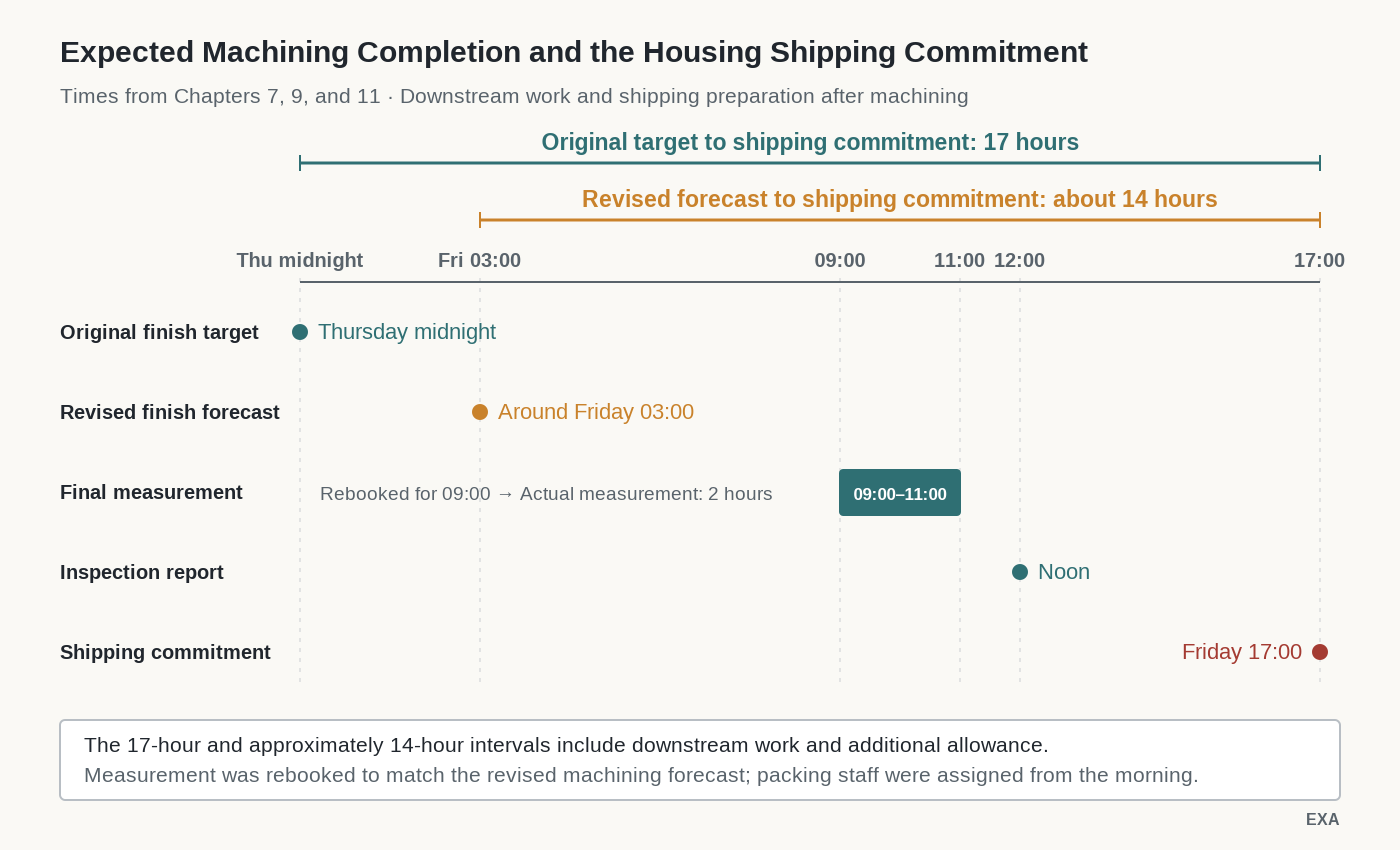
In Chapter 7, the housing schedule called for machining on Machine 1 to finish by midnight on Thursday and shipment at 17:00 on Friday. The 17 hours between those points included washing, final measurement, and packing of the last batch. The few hours after completing those tasks were the allowance for unexpected variability.
The previous section's example secured six hours from bottleneck completion to shipment, divided into three hours of downstream work and three hours of additional allowance. The story's 17 hours likewise include both downstream work and allowance. Because the story does not specify the duration of each downstream operation, the number of hours of pure allowance is not established.
When tool wear accelerated in Chapter 9, the expected completion of the housings changed. The foreman proposed reducing cutting speed. Martin compared the alternatives by calculating that approximately four additional minutes on each of the remaining 75 parts would produce a delay of 300 minutes, or five hours.
This calculation is an approximation used for the decision in the story. The 42 minutes include material changes, so an 8% reduction in cutting speed increases total processing time by a smaller proportion. The story compares an option that treats total processing time as approximately 46 minutes with an option that reduces speed only during internal-bore roughing and replaces the tool in advance.
The selected option was judged likely to keep the increase within three hours. Expected machining completion shifted from Thursday midnight to around 03:00 on Friday. The entire interval to the shipping commitment at 17:00 shrank to 14 hours, within which washing, final measurement, and packing had to be completed.
Martin did not stop at calculating the use of three hours. He rebooked final measurement for 09:00 on Friday and assigned packing staff from the morning. The time and resources to finish the downstream operations had to be secured again to connect the revised machining completion time with the shipping commitment.
| Item | Time or duration stated in the story | Interpretation |
|---|---|---|
| Original machining completion target | Thursday midnight (Chapter 7) | A cutoff that secures time for downstream work and protective allowance |
| Shipping commitment | Friday 17:00 (Chapter 7) | The shipment time promised to the customer |
| Interval between the two | 17 hours | The sum of downstream work and additional allowance |
| Expected completion after the tooling response | Around Friday 03:00 (Chapter 9) | A forecast approximately three hours later than the machining completion target |
| Interval to shipment after the change | Approximately 14 hours | An interval in which downstream work still has to be performed |
| Rebooked final measurement | Friday 09:00 (Chapter 9) | Inspection time secured again to match revised expected completion |
| Actual final measurement and inspection report | Measurement 09:00–11:00; report at noon (Chapter 11) | Measurement and approval still required time after machining was complete |
In Chapter 8, Martin requested one hour for each final inspection. In Chapter 11, however, actual measurement of the housings took two hours, and the inspection report was issued at noon.
Tool wear faster than the reference expectation and final measurement longer than the reserved time are scenes in which the ever-present uncertainty of the factory floor comes to the surface.
As stated in the series introduction, planning cannot eliminate uncertainty, and the initial conditions begin to change as soon as execution starts. Scheduling must therefore be built on uncertainty as a premise, rather than treating it as an exception.
The fundamental task of scheduling is to accommodate within the plan the uncertainty that emerges during execution and keep schedule commitments. This is why scheduling is a central subject of this series.
Dividing three hours by the entire 17-hour interval as the buffer denominator gives approximately 17.6%. But that ratio refers to the entire interval, including downstream work. Reading it as the proportion of pure protective allowance consumed could understate the risk. The judgment in the story rested less on this ratio than on whether the conditions for completing the necessary downstream work still held after the change.
Martin's statement in the meeting about moving allowance from the front to the back can be read in this context. It reflected a shift in judgment: the recovery time previously sought through early release would now be connected to downstream work and the cutoff before shipment. Preparation ahead of the bottleneck remained necessary, however, as the upstream supply adjustment in Chapter 7 showed.
6. Detecting Delays and Timing the Response
Even when the schedule includes allowance, failing to check part readiness can mean missing the opportunity to respond. In Section 4, the job with two hours of preparation allowance stopped the bottleneck for one hour because of upstream delay. If the delay was discovered only when the upstream operation finished at hour 11, the opportunity to preserve the planned start at hour 10 had already passed.
If, instead, the changed forecast of completion at hour 11 was identified while work was still in progress, there would be time to examine possible responses before bottleneck start. Could support from preparation staff advance completion? Could another job with the required approvals be assigned first? How would the change affect downstream inspection and other orders? The feasibility of these responses depends on the resources and quality requirements at the factory.
Buffer management is the control process that checks the status of jobs not yet ready against the schedule being protected and sets the priority of responses. The joint decision in Chapter 9 shows how including allowance in a plan connects with managing that allowance during execution.
Execution requires, at a minimum, that the following items can be checked for the same order.
| Record | What it establishes |
|---|---|
| Time to be protected | Bottleneck start target or shipment time promised to the customer |
| Planned readiness and completion | Targets for upstream completion, bottleneck completion, and inspection and packing completion |
| Current status and expected completion | Operations actually complete, work still required, and the updated completion forecast |
| Cause of delay and response | Where the delay occurred among materials, tools, machining, and inspection, and the actions available |
| Responsibility and next review time | Who will act and by when they will report the result |
| Effects of the change | Effects on inspection reservations, downstream work, and other orders' schedules |
The plan and the forecast are different records. Overwriting the original target with a new forecast every time a problem occurs makes it difficult to establish how late the work is. Keeping the target alongside the latest forecast makes it possible to assess how much allowance has been consumed and which actions have been effective.
In the plan with four hours of preparation allowance in Section 4, an upstream completion forecast that moves from hour 6 to hour 9 consumes three hours of the planned allowance, leaving one hour. The possibility of further problems within that hour must be considered together with the time required to act. The existence of some remaining allowance alone is not a reason to postpone a response.
For example, if obtaining a required tool takes two hours but only one hour of preparation allowance is available, a plan that can act only after obtaining that tool is already inconsistent with the bottleneck start target. Conversely, if readiness is confirmed and no other risks are present, there is no need to change the sequence or release additional work merely because completion is earlier than scheduled.
Response criteria must include both the risk to the schedule and the time required for action. A rule that changes the sequence of every job whenever a fixed percentage is exceeded can create preparation losses and delays for other orders. The measurement room's check of the bracket schedule before adjusting reservations in the story was an instance of considering this effect together.
Sometimes the bottleneck's job sequence must change. Before making the change, its effects on additional setup and approval, materials and tools already prepared, and downstream reservations must be checked. Assigning the urgent parts request in Chapter 10 to Machine 3 resulted from examining an alternative that could respond without changing the housing sequence.
Revised Commitments to the Customer
Even after these adjustments, the manifolds missed the original Friday due date. In Chapter 6, Martin explained to the customer the cause of the delay and the basis for Wednesday shipment, and promised to report on Thursday whether preparations for five-axis machining were complete. Meriden accepted the new schedule while bearing the burden of changing its assembly sequence.
Early notice and an interim check do not remove that burden. They do, however, provide the customer with information and time to adjust its own work sequence. In Chapter 11, the customer's supplier evaluation recorded both the failure to meet the original commitment and the fulfillment of the revised schedule. Execution reliability was not assessed by the revised date alone.
7. Two Shipments and the Scope of the Operating Changes
The housings shipped on Friday, and the manifolds on the following Wednesday. Meriden could not begin module assembly until the manifolds arrived and had to resequence other work.
The improvements five weeks later were still centered on the five-axis area. Material was released on dates calculated backward from the five-axis schedule, and parts that had completed the upstream operation waited on the staging shelf for their assigned machining sequence. The operator prepared the next job while machining was in progress. Work in process continued to accumulate in other areas, however, and one order was half a day late because the time before shipment could not absorb its delay.
These results show an operating change that connected the bottleneck schedule with preparation and inspection. They also reveal what further checks would be needed to extend that connection across the factory. As the product and order mix changes, resource loads and preparation requirements change. An allowance appropriate in one area must be reassessed for a different route.
The following questions provide a starting point for examining the same problem in another factory.
- Does the schedule for confirmed orders include setup, material preparation, first-article approval, downstream inspection, and packing?
- Is the bottleneck's next job ready, including the necessary parts, tools, and personnel? Who confirms readiness, and when?
- Which bottleneck schedule determines material release dates, and does the period calculated backward count processing time or protective allowance twice?
- Which time does the allowance before the bottleneck protect, and which does the allowance before shipment protect? Can the allowance be identified separately from the time required to perform the actual work?
- Which actions are still possible when a delay is detected, and how would they change inspection reservations and commitments for other orders?
- Does repeated consumption of allowance arise from variability, omitted preparation, incorrect standard times, or an actual shortage of capacity?
The schedule in the story was rewritten on the basis of observed times. Even afterward, tools wore out earlier than the reference expectation, and final measurement took a different amount of time from that reserved. Connecting planning and execution requires both responding to current delays and updating the basis for the times used in the next plan. How far can scheduling trust and incorporate these reference values? That question, together with which records should be collected separately and how they should update estimates, is the subject of the next commentary.
Next · Commentary 4. Work Records and Updating Estimates
How reliable are reference values such as standard times, tool life, and inspection time on the factory floor? We examine differences between barcode and controller records, standard and actual machining times, and tool-life expectations and wear alarms. The commentary considers why a factory-wide optimized schedule that accepts every reference value at face value can break down during execution, which values to incorporate into the schedule, and how to update them from records.



Join the discussion