

1. The Daily Cash Report
Tuesday, 7:50 a.m. The finance office of a midsized manufacturing company.
The finance manager began his day with the daily cash report. Previous balance, receipts, payments, closing balance. Four columns summed up the company's day. He read the payments column first. Several raw-material payments fell due that week. He checked the amounts owed to three suppliers against the dates when customers' payments were expected the following week.
Last month's closing report lay on one side of his desk. Operating profit had risen from the previous month, yet the balance in the company's bank account had fallen over the same period. When the CEO had pointed to the two lines and asked about them, the finance manager had answered without hesitation. "Inventory and accounts receivable have increased." At every close, he reconciled profit and cash, item by item. He knew what changes in inventory and receivables did to that reconciliation. For someone who made his living in accounting, none of this was new.
What was new was the question raised by the past two weeks of classes.
The same Company B had three net-profit figures: 2,400, 1,500, and −5,700. Company A showed 1,500 under all three methods. The verdicts differed: B, a tie between A and B, then A. Turning the cover of the financial report, the finance manager thought about the numbers in his own company. The CEO and the finance team read this report. In the factory's meeting room, the screen showed utilization rates; in the sales meeting room, progress against sales targets. The daily cash report never left this office.
He knew how to reconcile the figures. What he could not yet answer was a different question: which numbers should the people in production and sales look at and act on every day?
He signed the approval box on the cash report and checked his afternoon schedule. Two o'clock. The eighth class.
2. Opening the Bank Accounts
Tuesday, 2 p.m. The main lecture hall of the graduate business school.
The professor had left the question mark in the upper-right corner of the board. Beneath it, the final table from the previous week was on the screen again. Three methods, two companies, three net-profit figures.
"In our first session, I promised three things: to calculate the same case using two other methods, to look at both companies' bank accounts, and to ask the question again. We finished the first task last week. Today we turn to the second."
The professor looked toward the middle rows.
"You told us in the first session that you looked at the money before the accounts," the professor said to the business owner. "Would you take us through today's calculation?"
The business owner took the microphone.
"I'll start with the money received. Both companies sold 100 units at 50, so that is 5,000. We were told there were no credit sales, so they received the full amount."
"And the payments?"
"Let's take A first. It made 100 units, so materials cost 100 times 12, or 1,200, and variable overhead was 100 times 8, or 800. It also paid 1,000 in fixed manufacturing costs and 500 in fixed selling costs. That makes 3,500."
A's change in cash = Cash received − Cash paid
Cash received:
Sales receipts
Cash paid:
Materials
Variable overhead
Fixed manufacturing costs: 1,000
Fixed selling costs: 500
Total payments:
Change in cash:
"A's cash increased by 1,500. The same number as its net profit in all three sets of accounts."
The business owner turned a page in his notebook.
"B made 1,000 units. Materials cost 1,000 times 12, or 12,000, and variable overhead was 1,000 times 8, or 8,000. Its fixed costs were the same as A's: 1,000 and 500." He paused to check the figures. "It paid 21,500. It received the same 5,000 as A."
He lowered the microphone slightly, then raised it again.
"Its cash fell by 16,500."
B's change in cash = Cash received − Cash paid
Cash received:
Sales receipts
Cash paid:
Materials
Variable overhead
Fixed manufacturing costs: 1,000
Fixed selling costs: 500
Total payments:
Change in cash:
The professor wrote on the board.
−16,500.
A single table on the screen brought together the cash flows of both companies.
| Cash flow | Company A | Company B |
|---|---|---|
| Cash collected from sales | 5,000 | 5,000 |
| Payments for materials | 1,200 | 12,000 |
| Payments for variable overhead | 800 | 8,000 |
| Payments for fixed manufacturing costs | 1,000 | 1,000 |
| Payments for fixed selling costs | 500 | 500 |
| Total payments | 3,500 | 21,500 |
| Change in cash | +1,500 | −16,500 |
"This is the company that reported net profit of 2,400 under financial accounting," the professor said. "During that same period, its cash fell by 16,500."
The room was quiet. A few of those who had chosen B in the first session turned back through their notes from the past two weeks.
"The calculation we have just seen has a name," the professor continued. "In financial accounting, the statement of cash flows presents cash flows from operating activities using one of two methods. One is the direct method. It lists the gross amounts of cash actually received and paid in operating activities, by category: how much was collected from customers, how much was paid for raw materials, and how much was paid in operating expenses. We will look at the other method later."
"To simplify the calculation, this case assumes that all transactions were settled in cash. It covers only operating activities, excluding investing and financing activities, and there are no revenues or expenses beyond the items in the table. All cash paid to buy raw materials and make products is also operating expenditure. The change in cash we have calculated for each company in this period therefore equals its cash flow from operating activities."
3. The Cash-Generating Machine
The professor switched off the screen and cleared the middle of the board. He drew a large box and wrote a sentence above it.
A business is, fundamentally, a cash-generating machine.
"This sentence is the center of today's class." The professor put down the chalk. "The essence of business activity is to use cash to generate more cash. A company puts the cash it holds into this machine. That cash must pass through several stages inside it and be converted back into cash. And the cash that comes back must exceed what went in."
Inside the box, he arranged five labels in a circle. Cash. Materials. Work in progress. Finished goods. Accounts receivable. He connected them with arrows, bringing the last arrow back to cash.
"This is what happens inside the machine. Cash buys materials. Materials enter production and become work in progress; when completed, they become finished goods. Selling the goods on credit creates accounts receivable. Collecting those receivables brings us back to cash. EXA defines this flow as the Business Cyclic Process."
The finance manager looked at the board and copied the five labels into his notebook. They were all accounts he examined every month.
"These five labels are asset items you see every time you look at a balance sheet," the professor said. "They are all current assets. We usually read them separately: so much cash, so much in receivables, so much inventory. But cash, inventory, and receivables alone do not show the whole machine. Look at fixed assets as well. There are factories and equipment. In manufacturing, these tangible fixed assets form the physical substance of the cash-generating machine."
Between materials and work in progress, the professor drew a factory and wrote 'tangible fixed assets' beside it. The arrow from materials passed through the factory to work in progress and finished goods. He pointed to the factory, then traced the arrow running through it.
"Factories and equipment are used over many production runs. Inside them, materials become work in progress, and work in progress becomes finished goods. Sell the goods and collect payment, and they become cash again. Fixed assets provide the foundation for generating cash; current assets show the forms taken by the funds deployed and circulating through that foundation."
"The balance sheet presents them as separate items. In running a business, however, they work together. The productive capacity embodied in fixed assets combines with the circulation of current assets to generate cash. The balance sheet is a snapshot of how much is sitting at each stage on the reporting date. The cash-generating machine is implicit in the balance sheet we have been looking at all along."
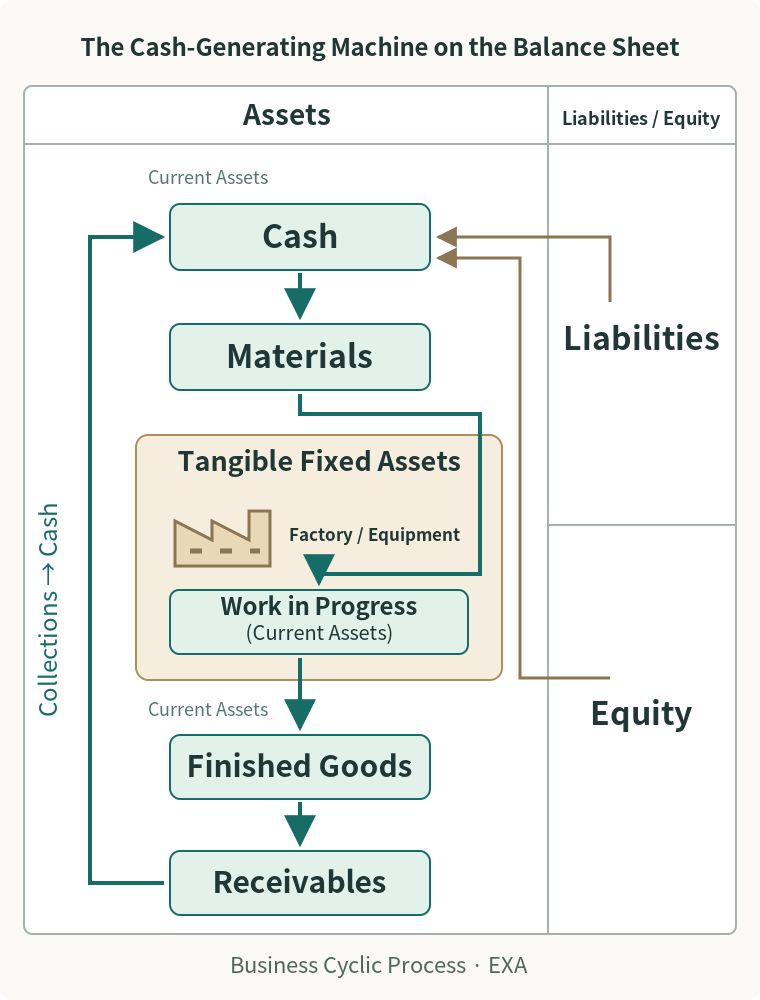
Beside the five labels in his notebook, the finance manager wrote 'current assets.' Between materials and work in progress, he drew a factory and added 'tangible fixed assets.' For the first time, the two classifications he saw at every close had come together in a single picture.
The professor pointed to the parts of the balance sheet he had not yet discussed.
"The balance sheet contains many other items. There are investments and intangible assets, and on the right are liabilities and equity. Borrowings and contributed capital are the sources of the cash put into this machine. Other assets, too, ultimately exist to support this circulation. If the Business Cyclic Process is the company's core business, the remaining items exist to serve that business. They do not occupy the same position."
"Yet in practice, this order is often reversed. Financial-structure ratios, indicators watched by capital markets, and technical accounting issues take center stage, while the circulation through which the company actually generates cash recedes into the background. Those numbers matter, too. But the moment we forget what they are for, the means displace the end. Unfortunately, we see this often."
The professor pointed to the factory again.
"Let us be clear about the order. The other items are subordinate to this circulation. There is not a single item on the balance sheet that can stand independently of it. If the core business disappears, the capital raised and the money borrowed for it lose their reason for being within this company. Business circulation does not exist to serve finance; finance exists to serve business circulation."
At the lower right of the circle, the professor drew a horizontal line across accounts receivable.
"Every transaction in this case was settled in cash. So today we skip the receivables stage. The moment a product is sold, it becomes cash."
Below the box, he drew two small circles side by side: A on the left, B on the right.
"Let us run both companies' machines for this period. First, the payments that increase with production volume: materials and variable overhead."
Company A
Cash put in:
Materials and variable overhead
→ 100 finished units
Cash recovered:
Sales
Fixed costs for the period:
Fixed manufacturing costs + Fixed selling costs
(Paid regardless of output)
Change in cash:
"All 2,000 that A put into the machine passed through 100 finished units and came back as cash. It came back as 5,000, at that. Even after covering the 1,500 in fixed costs paid regardless of output, cash rose by 1,500. The machine completed a full turn."
Company B
Cash put in:
Materials and variable overhead
→ 1,000 finished units
Cash recovered:
Sales
Still at the finished-goods stage:
Unsold units
Fixed costs for the period:
Fixed manufacturing costs + Fixed selling costs
(Paid regardless of output)
Change in cash:
"B also received 5,000 for the 100 units it sold. The 2,000 put into those units returned as cash, just as it did at A. But B made another 900 units in the same period. The 18,000 paid for their materials and variable overhead is still in the warehouse, in the form of products. It is on its way back to cash."
The professor added a line beneath B's circle.
B's change in cash = Change in cash from the same sales as A − Additional cash paid for the 900 unsold units
"We need to distinguish two numbers here," the professor said. "The 18,000 is the cash paid for the 900 unsold units. It is the additional cash paid compared with A. The −16,500 is B's net decrease in cash for the period. It results from receipts of 5,000 falling short of payments of 21,500. These are not the same number. And because the fixed costs of 1,500 were paid regardless of output, not all of the 21,500 paid passed through products."
He touched B's circle with the tip of the chalk.
"The machine ran. The line never rested. But during this period, B's machine returned less cash than went into it. As a cash-generating machine, B failed to produce a net increase in cash this period."
In the front row, the plant manager looked from one sentence on the board to the other. The line never stops. He had lived by that sentence for fifteen years. Beside it was what the professor had just said: the machine ran, but cash did not increase. The two statements did not contradict each other. The first, however, could not tell him the second.
The business owner spoke without raising the microphone, almost to himself.
"It seems so obvious. Yet nobody has said it in the past two weeks."
"We do not say it because it seems so obvious," the professor replied. "And because we do not say it, we forget. Even while we debated the net profit in the accounts, every business was this machine. No business can deny that proposition. The cash put in must eventually come back as cash."
He traced the circle inside the box once more.
"When we look at this machine, we must ask not only whether it has completed a turn, but how long that turn takes. EXA defines the interval between putting cash in and recovering it as cash as Cash Tied-up Days. Viewed from the other side, that same interval represents the speed of cash generation. The longer the cash remains tied up, the later those funds become available for the next round of production and sales. The 18,000 B paid for its 900 unsold units is now tied up at the finished-goods stage."
"We therefore need to measure where cash is tied up and why, and make reducing that time a key performance indicator of cash management. Finding and improving the places that hold up cash is central to managing the cash-generating machine."
"How quickly this machine completes a turn, and how to measure and reduce Cash Tied-up Days, are subjects for the latter part of this course. Today we will stop at whether it has completed the turn."
4. Reconciling Three Sets of Accounts with Cash
The finance manager raised his hand.
"Professor, may I apply the other method you mentioned to this case? It is the reconciliation we perform at each monthly close."
"Please do."
He asked for last week's net-profit table to be put back on the screen. Looking between the net-profit and inventory rows, he walked to the board.
"I'll start with net profit and work toward cash. In this case, inventory is the only item that creates a difference between net profit and the change in cash. There are no credit transactions or depreciation. Since opening inventory is zero, ending inventory is also the increase in inventory during the period. I'll subtract that increase from net profit."
Net profit − Increase in inventory = Change in cash
(Case assumptions: zero opening finished-goods inventory; all sales proceeds collected; all costs in the table paid in cash)
B — Financial accounting:
B — Variable costing:
A — Ending inventory is zero, so all three methods give:
"All three give −16,500. The same change in cash the business owner calculated himself."
Someone at the back of the room drew a quick breath. A few of the graduate students who had tapped away on their calculators in the first session copied the three lines into their notebooks.
The professor looked toward the back row. "Professor, would you explain where this calculation fits in the theory?"
His fellow professor stood up.
"What the finance manager has done follows the reconciliation principle of the indirect method in the statement of cash flows. The indirect method starts with net profit for the period. It then adjusts for items included in profit without a cash movement, and conversely for cash movements not included in profit, to arrive at cash flow from operating activities. An increase in inventory belongs to the latter category. Cash has been paid, but the amount was recognized as an asset rather than expensed, so it must be subtracted from net profit to reach cash flow."
He added a comment beside the three lines.
"A full statement of cash flows covers more items than this. Today's calculation applies its principle to this case. But it shows us something else, too. There are three starting points for net profit, yet only one destination. So what the three sets of accounts calculated differently was not cash."
He wrote the differences between the three inventory figures.
Difference in inventory between financial accounting and variable costing:
= 900 units × fixed manufacturing cost of 1 per unit
Difference in inventory between variable costing and throughput accounting:
= 900 units × variable overhead of 8 per unit
Inventory under throughput accounting:
= 900 units × materials cost of 12 per unit
"The differences arise from which costs are recognized as assets in the 900 unsold units. Financial accounting includes materials, variable overhead, and fixed manufacturing costs. Variable costing includes materials and variable overhead. Throughput accounting includes only materials. Anything not included is expensed in the current period. That is why net profit differs. The money that left the bank account, however, is the same whichever set of accounts we look at."
The cost accountant stopped turning the pages of his notebook.
"Last week I said that net profit under throughput accounting might still differ from the bank account. So that difference was the 10,800 in materials."
"Exactly," the professor replied. "In this case, B's net profit under throughput accounting is the closest of the three to the change in cash. Even so, the materials in unsold products remain recognized as inventory, so net profit and the change in cash do not coincide."
Still at the board, the finance manager looked at the three lines again. Reconciliation was something he did every month. It was not the reconciliation itself that he had seen afresh today.
"Professor, may I ask something?" he said. "If all three net-profit figures reconcile to the same cash flow, the finance team can reconcile cash whichever profit figure it starts from. But people in production and sales do not perform this reconciliation. Which of the three numbers should they look at and act on every day?"
The professor did not answer at once. Instead, he wrote the question in the lower-left corner of the board.
"I will not answer that today. It is a subject for the latter part of this course. But all the material we need to consider that question is now on the board."
5. A Former Participant's Question
The professor stepped away from the board to the front of the platform.
"There is a story I told the department head while preparing this course. This is the first time I have told it in class."
The participants looked up.
"Someone who completed the course last semester once came to see me. At its latest close, the company had posted the highest net profit in its history. Yet it had been short of working capital and had to borrow from a bank. That participant asked me: did we do well, or did we do badly?"
A few people looked again at B's circle.
"The details of that company's situation will differ from this case. Credit sales may have increased, inventory may have accumulated, or both may have happened. But this diagram shows how a company can have record profit in its accounts and still be short of cash."
He pointed to the circle inside the box.
"As cash passes through materials, work in progress, and finished goods to accounts receivable, the accounts record costs at each stage and recognize profit when a sale is made. Cash, however, returns only at the final stage of the circulation. If sales and collections cannot keep pace while more goods are being produced, the cash put into the business stays there as inventory and receivables. The profit in the accounts and the balance in the bank can then tell different stories. That former participant's company had succeeded in its accounts, while its bank position required a loan. Both were true."
The business owner nodded. In the first session, he had said that he worried about payday.
6. Asking Again
The cost accountant raised his hand. This time, he took a moment to compose himself before accepting the microphone.
"In the first session, I said that the money had not disappeared; it had become inventory. Last week, I said that inventory would eventually turn back into money if it sold." He looked at B's circle on the board. "Let me correct myself. Until it comes back, it is not yet cash."
The professor did not write the remark down. He simply nodded once.
The sales executive spoke next.
"From the sales side, those 900 units can ultimately become cash again only through sales. In a sense, sales holds the machine's final arrow. But as I said last week, at current demand it will take a long time to sell all 900 units. Until then, products that cost 18,000 sit in the warehouse. If some have to be marked down, the cash we recover will be smaller still."
The plant manager said nothing. He studied the circle on the board for a long time.
The line never stops. The sentence was still his. Keeping the line running was the most honest expression of diligence he knew. Last week's board had shown where the price of keeping it running accumulated. First, in the warehouse.
Today's board had supplied the rest of the sentence. In the warehouse, and in the bank account.
The professor switched the screen back on. A row had been added beneath last week's summary table.
| Company A | Company B | |
|---|---|---|
| Net profit — financial accounting | 1,500 | 2,400 |
| Net profit — variable costing | 1,500 | 1,500 |
| Net profit — throughput accounting | 1,500 | −5,700 |
| Change in cash | +1,500 | −16,500 |
| Ending finished-goods inventory (units) | 0 | 900 |
"We have now seen all four numbers," he said. "Net profit in three sets of accounts, and the change in the bank account. Let me ask the question from our first session again."
He looked around the room.
"You are the group chair. Who should receive the bonus?"
No one raised a hand. The professor did not ask them to.
"We will not take a show of hands today. Take your answer with you. But when you decide, please write down which number you used to make that decision."
The lights in the lecture hall came up.
7. The Next Meeting
Leaving the lecture hall, the plant manager thought about next month's performance meeting. The first slide would be the same as last month's. A bar chart of utilization by plant. The tallest bar at the far left. Applause in the meeting room.
Utilization still showed that the factory had not stood idle. He did not reject that bar. But for the first time, he noticed the empty space beside it.
The quantity of finished goods in inventory. The money put into that inventory. And when that money would come back as cash.
He did not yet know which number should stand beside the bar. On the stairs down to the parking lot, he kept thinking about that empty space.
Epilogue
Across three episodes, we have examined the performance of the same companies, A and B. In the first, we evaluated their managers using net profit under financial accounting. In the second, we recalculated the same facts using variable costing and throughput accounting. B's net profit came to 2,400, 1,500, and −5,700, while A's was 1,500 under all three methods. The verdict on which manager had performed better also differed in three ways.
In this episode, we calculated a fourth number: cash. Under the direct method, which sets cash receipts against cash payments by category, B's cash fell by 16,500 during the period. Subtracting each method's increase in inventory from its net-profit figure brings all three to the same change in cash. What the three sets of accounts calculated differently was not the cash spent, but which costs were recognized as assets in the unsold products.
These calculations rest on one proposition: a business is, fundamentally, a cash-generating machine. It turns cash into materials, work in progress, and finished goods, and through sales turns them back into cash. When the cash that completes the circulation exceeds the cash initially put in, the business has generated cash. Net profit is a calculation that varies with how costs are recognized at intermediate stages; cash is a fact showing how far the circulation has actually progressed. Neither alone tells the whole story of business performance. Yet if we forget this proposition while judging net profit, products that have not completed the circulation can look like achievement. Looking at cash does not mean looking only at a balance at one point in time, either. Alongside the cash already secured, we must consider the machine's capacity to generate cash in the future. That capacity also reveals itself in how quickly and consistently the circulation proceeds.
When you judge performance, which of these four numbers do you rely on? What behavior does that number encourage on the ground?
Next Episode
In the next class, the professor asks the bonus question again and, for the first time, reveals his own verdict. The episode will also describe how participants' judgments changed in EXA's actual lecture using this case.
If you were the group chair, who should receive the bonus?



Join the discussion