

This is the first commentary following Episode 1 of the EXA Manufacturing Operations Series, “The Idle Five-Axis Machine and the Mirage in the Conference Room.” In the factory portrayed in the story, each department made rational decisions by its own criteria, yet the orders promised to customers were late. This article reassesses those decisions one by one to examine where departmental performance diverges from company performance. The Evaporating Cloud reveals the assumptions beneath conflicting demands, while throughput accounting evaluates the same choices from the perspective of the company as a whole. We also examine how materials released into production are connected to the company's cash.
The argument in this commentary rests on the scenes and judgments of the characters in Episode 1. Reading the story first will make it easier to follow the conditions behind each department's decisions and the consequences for the customer's orders.
1. A Question About Responsibility for an Idle Machine
At the Tuesday afternoon meeting in Episode 1, Martin proposed assigning the five-axis operator exclusively to preparing the next job. The foreman put a question to everyone in the room.
“If we assign the operator only to the five-axis machine, no one will be working on general-purpose Mill 3. Who will explain that idle machine in the month-end performance report?”
The question concerned how the outcome would be recorded more than whether the assignment was sound. Each month, the machining team was evaluated on equipment utilization and operator efficiency. If those rules remained unchanged, an assignment that supported the five-axis schedule would be recorded as idle time on Mill 3, and that idle time would count as a decline in the machining team's efficiency. Earlier, when sales had requested three changes in the job sequence over three days, the month-end report had named the machining team that missed its planned quantity before the department that had requested the changes.
This situation applied to every team, not just this foreman. Everyone in the meeting looked at the plant manager. After considering the matter, he gave a brief answer.
“Idle time caused by the assignments approved for this trial will not be treated as a decline in an individual operator's efficiency. I will explain that part.”
The decision added no equipment and brought no deadline forward. What changed were the rules of evaluation and responsibility. Without that change, assigning the operator exclusively to the five-axis machine would have remained something the shop floor could implement only at the expense of its own performance rating. This exchange shows how closely the factory's way of measuring performance was tied to its way of assigning people.
2. Departmental Decisions and the Order's Path
The story's epilogue concludes that the delay did not arise from one person's negligence. Each department chose what it considered rational within the criteria it had been given. Those choices can be set out in a single table.
| Department | Criterion it sought to uphold | Choice made | Effect on the Meriden order |
|---|---|---|---|
| Machining and production control | Equipment utilization, operator efficiency, and the practice of machining consecutive batches | Grouped covers that could be machined consecutively with the same fixture | Manifold materials waited behind boxes of covers at Operation 3 |
| Company staffing rules | Labor-cost efficiency per person | Assigned the five-axis operator to general-purpose Mill 3 as well | Preparation for the next five-axis job was delayed while the operator worked on Mill 3 |
| Plant manager approving purchase requests | Cost control | Rejected the $20,000 quick-change plate as a consumable tool | There was no means of clamping the materials for the next job in advance outside the machine |
| Sales | Responding to urgent customer needs | Requested changes in the sequence of due dates | Previously set-up jigs repeatedly had to be dismantled, so the shop floor stopped preparing the next job in advance |
| Metrology room | Fair treatment | Measured parts in order of receipt | Five-axis Machine 1 stood idle while the housing first article waited behind a bracket lot |
| Production control | Preventing a repeat of the previous year's prototype delay | Extended standard lead times and released materials early | Other orders released early took the available positions at Operation 3 and ahead of the five-axis machines |
These decisions had different grounds. The first three arose from a cost perspective: keep equipment and people working and reduce expenditure. Sales sought to retain customers, the metrology room sought to avoid favoring any line, and Martin sought to avoid repeating the previous year's failure. It is difficult to call any of these decisions wrong in itself. Most real workplaces are much the same. Are they not?
Despite their different grounds, all six decisions omitted the same question. None asked how the choice would affect the resource with the greatest capacity shortfall in the factory that week. In this case, that resource was the five-axis equipment. After rescheduling confirmed orders operation by operation, Martin concluded that the five-axis machines had the greatest shortage of capacity relative to the machining time required. Operations 3 and 4 still had spare capacity, and both Meriden parts had to pass through the five-axis machines. In this article, a resource that limits the output of the factory as a whole is called a bottleneck.
Commentary 2 will examine why the five-axis equipment occupied that position and how the queues accumulated. This article focuses on where each department's decision criteria diverged from the company's results.
3. Behavior Defined by Metrics: Labor Efficiency and the Consumable-Tool Classification
The direction of a decision is strongly influenced by the numbers used to evaluate it. Eliyahu M. Goldratt summarized that relationship as follows.
“Tell me how you measure me, and I will tell you how I will behave. If you measure me in an illogical way, do not blame me for behaving illogically.”
Two classifications in the story illustrate the point. The reason for assigning one operator to two machines was “labor-cost efficiency per person.” Under that criterion, having the operator run another machine while the five-axis machine cuts is desirable. The individual operator's efficiency rises, and the company appears to obtain more machine hours for the same wages. Yet, as Martin pointed out, each time the five-axis machine stopped, it waited 90 minutes for the operator to return and complete the setup. The number measuring one operator's efficiency did not show what that stoppage meant for the company.
The $20,000 plate was rejected in the same way. The request was classified under “consumable tools,” and within that category, $20,000 was expenditure to be reduced. The classification contained no field for how much the device would shorten five-axis setup time or which orders that recovered time would allow the factory to ship. The number used to judge the expenditure did not capture its consequences.
Utilization was no different. The reported 94.8% was calculated from the time between the job-start and job-completion barcodes. It included setup, waiting for first-article measurement, and waiting for parts from the preceding operation. When Martin compared it with controller records, actual cutting time was less than half the day. Even correcting the aggregation leaves a limitation. Accurate utilization shows how long the equipment actually machined parts, but not whether that machining completed the orders promised to customers.
Actions that improve departmental metrics often do point in the same direction as actions that improve company results. The two directions diverge when one resource shared by several departments determines the factory's total output. In this factory, that resource was the five-axis equipment. Its utilization was reported, but the number distinguished neither actual cutting time from waiting time nor which orders that time helped complete. Labor efficiency and expenditure classifications did not include five-axis time in the decision criteria.
The EXA Finance Series will also examine the numbers that company accounts and evaluation systems place before people making operational decisions. Here, we limit the discussion to the classifications and numbers that guided this factory's decisions.
4. The Staffing Evaporating Cloud
The foreman's question exposes a conflict. During the very preparation window in which the five-axis machine is waiting for its next job, should the same operator run general-purpose Mill 3 or prepare that next five-axis job? One person cannot do both at the same time.
To address problems arising from corporate policies and practices beyond production scheduling, Goldratt organized a set of logical tools called the Thinking Processes. They are structured to answer three questions: what to change, what to change to, and how to cause the change. The Evaporating Cloud is the tool within that set that exposes the conflict beneath a problem and helps identify a direction for resolving it. It places two conflicting demands under a common objective and asks which assumptions produce the conflict. “Evaporating” conveys the idea that once the assumptions sustaining the conflict fall away, the conflict itself disappears.
The cloud represents such a conflict through five elements: a shared objective (A), the needs each side seeks to protect in order to achieve it (B and C), and the actions each side demands to meet those needs (D and D′). The two actions conflict, but both needs are legitimate conditions necessary to the objective. The tool is not intended to decide which side is right. Its purpose is to uncover the assumptions beneath the arrows connecting actions to needs, and find a way to satisfy both needs.
The cloud for this scene is as follows.
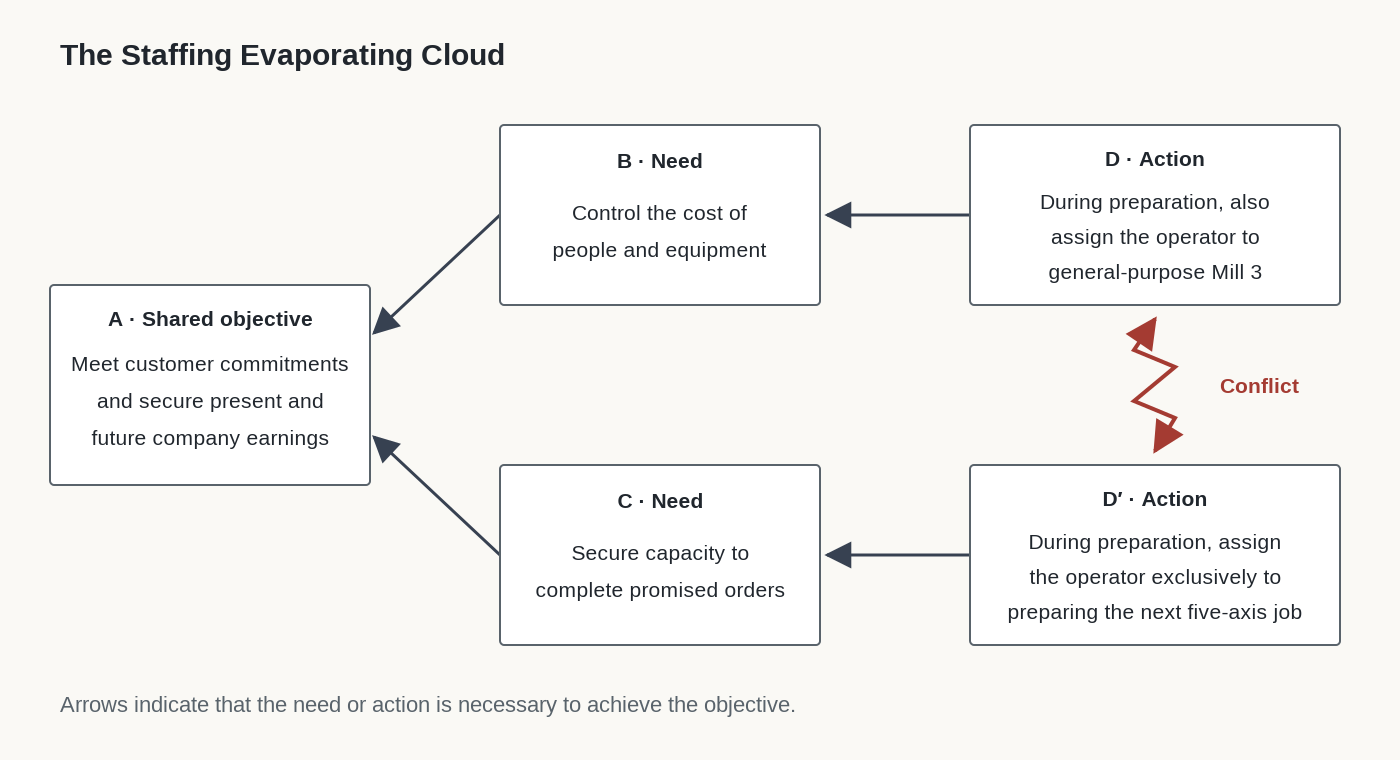
| Element | Content |
|---|---|
| A: Shared objective | Meet commitments to customers while securing the company's present and future earnings. |
| B: Need | Control the cost of people and equipment. |
| C: Need | Secure the production capacity required to complete promised orders. |
| D: Action | Assign the operator to general-purpose Mill 3 during that preparation window as well. |
| D′: Action | During that preparation window, assign the operator exclusively to preparing the next five-axis job. |
The cloud's arrows are read as “In order to achieve this, that is necessary.” B is necessary to achieve the shared objective A, and D is necessary to satisfy B. At the same time, C is also necessary to achieve A, and D′ is necessary to satisfy C. Yet D and D′ cannot be carried out together. Their incompatibility is the core of the conflict. The purpose of the cloud is to develop an injection: a new action or condition that invalidates an assumption sustaining the conflict and thereby resolves it.
D and D′ are two tasks that the same operator would have to perform during the same time window. That physical condition makes the two actions incompatible. The cloud therefore examines not so much the incompatibility itself as the connections that lead people to believe each action is indispensable to its respective need.
Three hidden assumptions underlie the judgment that D is necessary for B. If equipment and people are not working, the company incurs a corresponding loss. If Mill 3 stops, other orders requiring Mill 3 will be late. Assigning the operator exclusively to the five-axis machine will increase the company's costs.
The judgment that D′ is necessary for C rests on the assumptions that five-axis time determines completion of this week's orders, and that no other person or time window is available to do the preparation.
There was another reason the shop floor insisted on D. Idle time on Mill 3 was recorded as a decline in the efficiency of the operator and the machining team. Unlike an assumption about company costs, this was an evaluation rule. As long as it remained in place, choosing D′ meant accepting a penalty on the shop floor.
Resolving the cloud means identifying assumptions beneath the arrows that do not match the facts and developing an injection that invalidates them. The process begins by testing the assumptions connecting B and D against the facts. Before the meeting, Martin had rescheduled confirmed orders at each operation and reported that Operations 3 and 4 had enough spare capacity to prepare the five-axis work. If an examination of orders requiring Mill 3 over the same period shows that they will not be late, the assumption that other orders will be delayed does not hold for this week. The assumption that company costs will rise can be examined in the same way. The operator receives the same wages whether running Mill 3 or preparing the five-axis job. If neither assignment creates additional costs such as overtime, subcontracting, or extra setups, the company's total operating expense is the same under both. Traditional performance and cost evaluation, however, differs from this common-sense view.
Traditional costing allocates labor costs to working time to calculate unit costs. Under this approach, reducing the time required for a task lowers its unit cost, and the difference is reported as a cost saving. An example is an accounting department reporting savings after introducing an IT system because preparing each voucher takes less time. Yet if staffing and salaries remain unchanged, the company's expenditure does not fall. The capacity freed by shorter processing time can be used for other tasks or additional output. The company can then achieve more for the same expenditure, but that does not mean the expenditure itself has decreased. Actual cost savings require a separate check of changes in the costs borne by the company, such as salaries, overtime, and subcontracting. The same reasoning applies when the operator's assignment changes but the wages the company pays remain the same. The Finance Series will discuss this further.
This examination does not abandon need B. What changes is the unit by which cost is measured. If cost control is measured by one operator's efficiency, D′ harms B. If it is measured by the company's total operating expense, D′ contributes to C without harming B. This is where departmental performance and factory performance had diverged.
What remained was the evaluation rule. The plant manager's answer changed that rule for the assignments approved in this trial, enabling the shop floor to carry out D′. The foreman asked that additional setup and overtime hours be included in the same record, and the manager agreed. It was a commitment that the company would jointly record the consequences of the assignment. The decision did not change the fact that one operator cannot perform two tasks at the same time. It changed the basis for deciding which task to choose.
Martin's dedicated assignment and the plant manager's revised evaluation rule were the injection they attempted in order to resolve this cloud's conflict.
The cloud does not remove every problem. If five-axis capacity is genuinely insufficient, changing the assignment leaves that shortage in place. That was the case with the manifolds that week. Even with a dedicated operator and an adjusted measurement sequence, the manifolds could enter the five-axis machine only on Friday morning, after roughing and datum checks were complete. Machining, washing, leak testing, and final measurement could not then be completed within the week for shipment by the original Friday deadline. The cloud exposes assumptions that made the conflict appear inevitable; it does not eliminate capacity limits.
The same structure appears in other scenes. Rejection of the $20,000 plate was a clash between limiting expenditure and shortening setup time. Sales-driven sequence changes were a clash between responding to urgent customers and keeping the five-axis sequence stable. Beneath those arrows, too, lie assumptions: “The less we spend on consumables, the better for the company,” and “Changing the sequence to what the customer wants protects the customer relationship.” Although this article develops only one cloud in full, the same method can examine the remaining conflicts.
5. The Three Numbers of Throughput Accounting
Once the cloud has exposed the assumptions, the remaining question is what should replace them as the basis for evaluating choices. This is why the article uses throughput accounting.
Throughput accounting is an accounting approach proposed by Goldratt. In Korea, its name is translated as “cash generation accounting.” Cost and management accounting textbooks formalize the approach as super-variable costing, which treats only direct material costs as product costs, alongside absorption costing and variable costing. Throughput accounting is management accounting for decision-making: it helps managers compare alternatives and decide, rather than prepare financial statements for external reporting. Defining it simply as revenue minus totally variable costs does not convey its purpose. Its role is to bridge local decisions and company-wide performance by calculating how a department's choices change the company's revenue, inventory, and operating expense.
Throughput accounting interprets company choices through three numbers.
Throughput (T) is sales revenue minus totally variable costs. A totally variable cost is a cost that actually increases with each additional unit sold. A typical example is the cost of materials purchased to replace the quantity sold. T is an amount realized through sales, not production volume. Machining parts and storing them in a warehouse generates no T until those parts are sold. The point when T arises from a sale is also not necessarily the point when the customer pays.
Inventory/Investment (I) is the money the company has tied up in making what it intends to sell. It includes inventory such as materials, work in process, and finished goods. In the broader sense of investment, it also includes purchased assets such as equipment. Throughput accounting values inventory at the purchase cost of its materials, without adding machining labor or overhead to that value. This article uses the narrower meaning when discussing inventory and the broader one when discussing equipment investment.
Operating Expense (OE) is the money the company spends to turn I into T. It includes wages, maintenance, and administrative expenses.
Judgment in throughput accounting always starts by comparing alternatives. For each alternative, one establishes an “if we make this choice” condition and calculates how T, OE, and I would change under it. T minus OE for the same period gives that period's net profit (NP); dividing net profit by I gives return on investment (ROI). The final decision follows calculation and comparison of the alternatives' ROIs. Investment decisions do not calculate these figures solely from past results. They compare projected sales, costs, and investment over a defined period if each alternative is implemented.
Purchasing, production, and investment decisions can all be evaluated in this format. An alternative that raises operating expense can be sound if it raises T by more and improves ROI. An approach that considers only cost increases and decreases cannot distinguish a decision that cuts costs but reduces T by even more from one that raises costs but increases the company's overall profit. This decision framework was systematically presented in works including Thomas Corbett's Throughput Accounting (1998).
Applied to staffing, the framework works as follows. The figures below are assumptions used to explain the principle, not Meriden's prices or costs in the story.
Compare the two assignments over the same week. Assume the same prices, quality, demand from existing orders, and starting conditions for both. The investment I₀ used in the comparison, including inventory and equipment, is also the same positive amount in both alternatives. Assume no additional investment arises from differences in inventory levels or customer payment terms.
- Under assignment D, the operator runs Mill 3 during the preparation window as well.
- Under assignment D′, the operator prepares the next five-axis job during that window. Assume the recovered five-axis time allows 10 additional units to be shipped and sold that week. All conditions required for the materials, downstream processing, inspection, and delivery of those sales are in place.
- The selling price is $100 per unit, and the totally variable cost is $40.
- There is no difference in overtime, subcontracting, additional staff, or new equipment between the assignments. Sales of other orders do not decline either.
- Materials are purchased to replace the quantity sold. Thus each additional unit sold brings a corresponding $40 increase in material costs as a totally variable cost.
Relative to assignment D, the changes under assignment D′ are as follows.
| Item | Change under D′ relative to D |
|---|---|
| Units sold | +10 units |
| Revenue | +$1,000 |
| Totally variable costs | +$400 |
| Throughput (T) | +$600 |
| Operating Expense (OE) | 0 |
| Net Profit (NP) | +$600 |
| Inventory/Investment (I) | 0 |
Consider the calculation in detail.
- 10 is the additional quantity sold that week under assignment D′.
- 100 − 40 is the throughput retained by the company per unit sold.
- ΔOE is zero because we assumed the operator's wages were the same under both assignments and no other costs increased.
- ΔI is zero because we assumed the investment being evaluated, including inventory and equipment, was the same under both alternatives. Replenishing the materials sold does not, by itself, make the investment amounts equal.
Let NP₀ be the projected net profit under assignment D and I₀ the investment under both alternatives. The comparison is then as follows. Both ROIs cover one week.
| Item | Assignment D | Assignment D′ |
|---|---|---|
| Projected net profit | NP₀ | NP₀ + $600 |
| Investment | I₀ | I₀ |
| Projected ROI | NP₀ / I₀ | (NP₀ + $600) / I₀ |
Under these assumptions, assignment D′ increases that week's net profit by $600 relative to D. Because I is the same, D′ also has the higher ROI. This amount is the change in profit generated by sales, not the cash received by the company that week. When payment arrives depends on the terms agreed with the customer. Even if Mill 3 runs longer under D, T does not increase if the parts machined during that time are not sold that week.
The same calculation applies when sales do not increase. If D′ recovers five-axis time but there are no additional orders to sell that week, sales volume is the same under both assignments and ΔT is zero. Recovered time can provide more room to meet deadlines, but does not itself increase sales. If it merely brings next week's sales forward into this week, the comparison must cover a longer period. Throughput accounting asks whether operation leads to sales, rather than merely how long the equipment runs.
6. Machining Materials and the Availability of Cash
The story's preview promised to examine where departmental performance diverges from company cash flow. One point most easily overlooked on the shop floor is the moment materials enter machining.
Paying for materials ties the company's cash up in inventory. Even before payment, the company has an obligation to pay that amount. While purchased materials remain unmachined in the warehouse, several routes remain open for that money to return to the company. The materials can be used for another order requiring the same material and specifications; changed plans can be accommodated by reducing subsequent purchases; and materials with a resale market can be sold. Materials are not cash. They are, however, inventory with several possible routes back to cash.
Once those same materials are machined into the shape of a particular part, the situation changes. Materials that have become work in process recover their full value only when demand exists for that shape. They are difficult to redirect to another order, and selling them as materials is unlikely to recover the original purchase value. If the order's schedule changes or its quantity falls, the remaining work in process waits for future demand or is sold as scrap. Both the amount recoverable and its timing become substantially less favorable than before machining. Machining is an irreversible transformation. Once it starts, the possibility of recovering the full value of the money tied up in materials becomes heavily dependent on demand for that particular shape.
This change does not appear as a monetary change in throughput accounting's I. Unmachined materials merely move into work in process, because throughput accounting does not add machining labor or overhead to inventory value. Unchanged I does not mean nothing has changed. What changes is the flexibility of the tied-up funds. Money available for several uses becomes money waiting for the sale of a particular part. It returns as cash through the sequence of completion, shipment, and customer payment.
In Chapter 3 of the story, the manifold materials were behind boxes of covers ahead of milling at Operation 3. The covers were due two weeks later than Meriden's order, but their release date had been brought forward by the extended standard lead time. Cover materials were occupying Operation 3's time as they were machined early into shapes not needed that week. Martin decided to finish only the batch already in progress and hold the release of covers not yet started. That decision gave Operation 3's time back to the manifolds. It also left the remaining materials unmachined, keeping routes to recovering their value open.
Release timing is a cash issue as well as a scheduling issue. Purchasing materials ties the company's money up in inventory; machining them ties recovery of that inventory's full value to demand for a particular part. Sending materials to the shop floor before they are needed brings this second transformation forward. Five weeks later, the factory released materials from the warehouse only on dates calculated backward from the five-axis schedule. Chapter 11 records what the people in the five-axis area had recognized: parts produced early by keeping other equipment continuously busy occupied the aisles and harmed the factory's delivery performance and cash flow.
How to determine release timing is the subject of Commentary 3. The Finance Series will continue the discussion of how company accounts differ from cash flows.
7. The $20,000 Request and the $1 Million Request
Two purchase requests appear in the story: the $20,000 quick-change plate rejected in the previous quarter and the $1 million five-axis machine requested by the sales director. Martin placed them side by side at the meeting. The expenditures differ both in when their effects would appear and in which numbers they would change. Read through the framework in Section 5, they call for different questions.
The $20,000 plate. This device allows materials for the next job to be clamped outside the machine while the five-axis machine is cutting, reducing the setup time for which the machine must stop. Throughput accounting evaluates the request under the condition “if we buy the plate.” At the moment of purchase, there are no sales yet. The question is how much additional product the recovered five-axis time would allow the factory to ship and sell within the delivery deadline: how much T would increase over the same period. Placing that increase alongside the $20,000 invested in the plate makes it possible to calculate ROI.
Compare buying and not buying the plate as two alternatives over the same period. Accounting for installation and the start of use, let projected revenue without the purchase be R₀, totally variable costs V₀, throughput T₀, operating expense OE₀, and investment I₀. I₀ is positive, and T₀ = R₀ − V₀. Calculate the changes resulting from purchase as follows.
| Item | Not buying | Buying |
|---|---|---|
| Projected revenue | R₀ | R₀ + ΔR |
| Projected totally variable costs | V₀ | V₀ + ΔV |
| Projected throughput | T₀ | T₀ + ΔT, where ΔT = ΔR − ΔV |
| Projected operating expense | OE₀ | OE₀ + ΔOE |
| Investment being evaluated | I₀ | I₀ + $20,000 + ΔI_other |
| Projected net profit | T₀ − OE₀ | T₀ + ΔT − OE₀ − ΔOE |
| Projected ROI | (T₀ − OE₀) / I₀ | (T₀ + ΔT − OE₀ − ΔOE) / (I₀ + $20,000 + ΔI_other) |
This table treats the plate's purchase price as investment and separates other investment changes, such as additional inventory, into ΔI_other. Changes in operating expense over the evaluation period, including maintenance and depreciation, are examined under ΔOE. The full purchase price is not counted again as operating expense for the same period. Both alternatives use the same evaluation period and investment measurement basis.
ΔT is not determined by recovered machining time alone. Projected revenue and totally variable costs must be calculated by considering the orders that can use that time, downstream processing and inspection capacity, and the quantity that can be sold within the deadline. Comparing this projected profit with the investment is the decision required at the purchase-request stage. The story provides neither the order-specific prices nor the additional operating expenses needed to establish those figures, so the plate's actual ROI cannot be asserted as a specific percentage.
The comparison period must be explicit because production time is a resource that cannot be recovered once lost. Even if an order is not canceled and is sold a month later, that does not restore the production opportunity or cash-recovery date of the month in which it could originally have been sold. In a factory whose bottleneck capacity cannot accommodate all orders, however, an order not shipped this month consumes bottleneck time next month, pushing back another order that should have been made in that time. If orders continue to exceed bottleneck capacity and no additional capacity can make up the shortfall, processing the delayed order next month reduces the production opportunities available for other orders. The eventual sale alone does not mean those opportunities have been recovered. Goldratt expressed this as “An hour lost at a bottleneck is an hour lost for the entire system.” If subsequent demand is insufficient, or additional capacity allows the backlog to be caught up, the effect on cumulative sales is different. A period with spare bottleneck capacity and insufficient orders is a different situation. Since a delayed order does not displace other orders, the loss appears as delayed cash collection and diminished customer trust. Meriden's manifolds were shipped the following Wednesday, beyond the original deadline, and accordingly took up five-axis time in the following week.
The story's facts nevertheless need to be read accurately. The plant manager approved the request on Tuesday, but the plate had not arrived for the first shipment. That week's housings shipped through the combined use of a dedicated operator, a spare holder, an agreed measurement slot, and an adjusted release sequence. The plate arrived afterward, and five weeks later setup time had fallen from 90 minutes to 25. That reduction resulted from the plate, dedicated staffing, and a stable sequence working together.
The $1 million five-axis machine. This investment would substantially increase I. How much OE would rise through operating staff, maintenance, and tooling depends on how the equipment would be operated and requires a separate examination. To judge whether the investment would increase T, three things must be compared together: the capacity recoverable from the existing five-axis machines through operating changes; future order loads; and whether upstream operations could supply parts to the expanded five-axis capacity while the metrology room and downstream operations could handle its increased output. Throughput accounting calculates the expansion alternative's ΔT, ΔOE, and ΔI from those three factors, calculates its ROI, and compares it with the ROI of changing operations. At the meeting, Martin reported that expanding equipment while leaving the waits intact would also increase first articles waiting outside the metrology room and time spent waiting for roughing. With installation at least six months away, the new machine could not help that week's Meriden shipment.
The plant manager deferred the expansion request rather than canceling it. Meriden's volumes for the following year might require more capacity. This decision can be understood as an order of evaluation. First, recover the time currently being lost. Then establish the capacity that remains and the future order load. If capacity is still insufficient, decide then to increase I. Five weeks later, the request remained in the plant manager's drawer. Whether additional equipment was necessary would be judged after several more months of records had accumulated. Commentary 4 will examine which records that judgment requires.
8. Decision Criteria and Responsibility for Execution
The factory's results had limits. The housings shipped on the originally promised Friday, but the manifolds missed the original deadline and shipped on the renegotiated date the following Wednesday. Meriden had to reorganize its assembly sequence and recorded the failure to meet the initial schedule in its supplier evaluation. Even five weeks later, the changes were still a trial centered on the five-axis area, while boxes remained stacked in the aisles elsewhere.
What changed during those five weeks was the order in which decisions were made. Not a single machine was added. The bottleneck's schedule came first, followed by the question of how choices elsewhere would affect that schedule. To make that sequence workable on the shop floor, evaluation and responsibility rules had to change with it, just as the plant manager's answer to the foreman showed.
Applied to another factory, the same questions become these.
- If our department's performance against its metrics improves, which orders promised to customers will be completed sooner?
- What is the factory's most capacity-constrained bottleneck now, and who is protecting that resource's time?
- How is idle equipment and labor time recorded, and whose evaluation does that record affect?
- Which of T, I, and OE did the expenditures rejected or approved this quarter change?
- Were the materials now on the shop floor released at the start times required by confirmed orders?
The remaining questions lead to the next commentary. If every department was busy, why did work accumulate ahead of the five-axis machines and the metrology room?
Next: Commentary 2. How Work in Process and Waiting Build Up
A first article stalled outside the metrology room, and manifolds waiting behind covers due two weeks later. Queueing theory and Little's Law explain the structure that prevented a busy factory from producing the parts it actually needed.

Join the discussion