

This is the first installment in EXA's manufacturing Business Science series. The story begins four days before a fictional precision machining company is due to ship its first production parts to Meriden, a North American Tier 1 supplier. Not a single part has reached the shipping area. The report puts utilization of the five-axis machines at 95%, and Sales is demanding another machine at a cost of one million dollars.
Martin, the production control manager, begins by investigating the gap between that number and the machine standing idle. This is a story about how departmental decisions affect deadlines and production flow when different orders share equipment and inspection resources. The epilogue considers the situation depicted in the story and the meaning of its ending, then introduces the four commentaries that follow.
1. Silence on the Shop Floor
8:40 a.m.
What first pierced Martin's ears as he entered the factory was not a roar, but an ominously familiar silence.
Martin was the production control manager at this precision machining company. His job was to schedule which order would go onto which machine and when, and to release work instructions to the shop floor accordingly. From the arrival of raw stock through successive machining operations to the shipping area, the sequence and timing bore his approval.
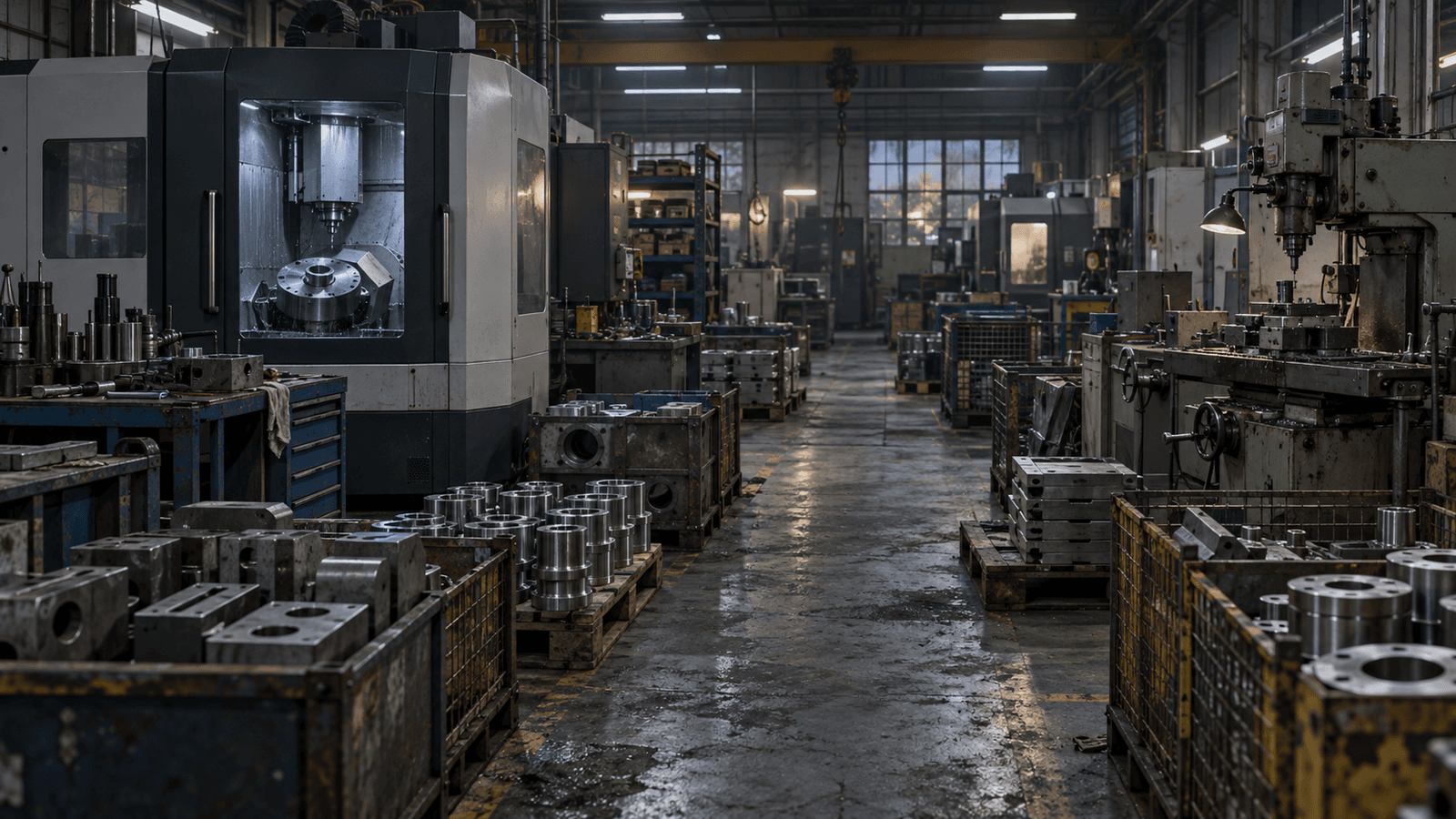
In the central aisle of Machining Building 2, which covered tens of thousands of square feet, a forklift crept through an almost acrobatic maneuver around stacks of pallets jutting beyond the yellow safety line. Titanium manifold blanks were piled on the pallets, each stack carrying a pink traveler marked “Meriden Project — Awaiting Second Operation.” It was not just the aisle. Boxes of work in process (WIP) stood like fortifications in front of the milling machine at Operation 3 and beside the electrical discharge machine at Operation 4. The entire factory floor had become a vast buffer warehouse.
Meriden was a North American Tier 1 supplier the company had spent a year winning as a customer. At 5 p.m. this Friday, the factory was scheduled to make its first production shipment of two parts to Meriden: 120 titanium housings forming the body of a pump module, and 120 manifold blocks that would attach to those housings and divide the fluid passages. This factory would machine, inspect, and ship both parts. Meriden would pair them and assemble the modules at its own plant. Its assembly line could not run with only one of the two.
Martin quickened his pace toward the five-axis machining centers at the heart of the line. A five-axis machine moves the tool and workpiece in five directions, cutting complex curved surfaces and angled holes in a single setup that ordinary milling cannot produce in one go. Both Meriden parts had to pass through these machines.
Of the three German-made Hermle C42 five-axis machines—the company's most expensive equipment—the spindle of Machine 1 was completely still. Inside the machining enclosure, where the coolant mist had cleared, the next piece of titanium stock remained clamped in place. Beyond the safety door, the warning lamp blinked yellow. There was only one dedicated fixture for holding the housing, and it was secured to Machine 1's table.
At the control panel, the machining foreman, a veteran of twenty years, stood frowning with his arms folded. An empty urethane support lay at his feet. It had held the first housing machined before dawn—the first article—before it was taken to the metrology room. Until approval confirmed that its dimensions matched the drawing, the remaining 119 could not be machined.
“Why is Machine 1 stopped? The first 120 parts for Meriden are due this Friday. If we don't have the spindle running production this morning, there's no way we'll meet the shipping schedule.”
The foreman pointed his chin at the empty support.
“You think I wanted to stop it? As soon as setup was finished and we'd checked the first article's dimensions, I ran it over to Quality's metrology room. Have you looked inside the CMM—coordinate measuring machine—room? The probe hasn't stopped. They're inspecting a lot of 300 automotive brackets that came in from Line 3. The inspector asked why I thought we could jump the queue. Said we had to follow the order of receipt, and we wouldn't get this first article's results until after lunch.”
“Couldn't you at least have used the touch probe for on-machine measurement, checked the specified tolerances, and got the next operation ready?”
“Look at the drawing. The concentricity of Orifice 18 and the three-dimensional freeform surface tolerances are on the order of five microns—µm. If we run all 120 on the strength of a quick on-machine check and precision CMM measurement finds the axes out of alignment, all that expensive titanium is wasted. Will Quality take responsibility for the rejects? It'll come back to me, and the company will just take the loss. I'm not pressing Start until that first-article report comes back signed off.”
The foreman was not wrong. The problem was the hourly depreciation and labor cost of this five-axis machine. The line's most expensive, critical machine had been idle for two hours because it lacked a single first-article inspection report for a measurement that took only fifteen minutes.
Martin's phone rang in his pocket. It was the quality manager.
“Martin, where are you? Have you forgotten the emergency roundtable at nine, Conference Room 2 in the main building? The sales director has already barged into the plant manager's office over Meriden's deadline. Get up here!”
Martin pressed a hand to his forehead. The spindle on the line was dead, and it was time for another feast of words in the conference room. He turned to the foreman and gave his instructions quickly.
“Don't just leave the machine standing. I'll get Quality to rearrange a CMM slot before I go into the meeting. Meanwhile, get the tool presetting and fixture-change preparations for the next job on Machine 1 done ahead of time. I'll have that first-article report out within an hour.”
Martin took off his hard hat, ran up the stairs of the main building, and opened the conference room door.
2. The Conference Room Illusion — We Need Another Machine
A heavy stillness hung over the main conference room. On the projector screen was an email from Meriden's head of purchasing.
[Urgent] Meriden Project: Risk of Late Delivery — Deadline in Four Days (Friday, 17:00)
The sales director tapped the table and looked at the plant manager and Martin.
“Plant Manager, we spent a year getting into Meriden, a North American Tier 1 supplier. If we miss the deadline on these first 120 production parts, penalties will be the least of it. We could lose the entire five-million-dollar main contract scheduled for the first quarter of next year alone. Meriden has asked Sales to send a formal assurance this morning that we'll meet Friday's deadline. Didn't Production Control stamp the order confirmed last month, saying we had enough equipment capacity? Then why, four days before shipment, hasn't a single part reached the shipping area?”
The plant manager gave Martin a hard look. Martin sat down and opened his status sheet.
“Setup on five-axis Machine 1 was completed early this morning. But the first-article inspection backlog—”
“There you are!” The sales director cut him off and tossed a thick catalog onto the table. It was a quotation for a Swiss-made five-axis machining center. A machine costing a full million dollars.
“The excuses from Production are always the same. Setup takes too long, inspection's backed up, parts aren't there! You saw last month's production report. Five-axis line utilization was 94.8%. Doesn't that mean the machines are running without a moment to breathe? We simply don't have enough machine capacity. What's the point of Sales bringing in orders if the factory can't handle them? Plant Manager, this million-dollar five-axis machine has to go before the capital investment review. Without another machine, we won't be able to accept orders from major customers like Meriden.”
There was a reason the sales director had raised his voice. Meriden's volume for next year was several times the current level, and he was the one who had quoted it. He had been promising capacity to the customer on the strength of the utilization reports sent by the factory.
The plant manager's eyes wavered. To management, “95% utilization” and “additional machinery” made an intuitive, seductive argument. If the factory was too full to move, buying another machine to widen the passage seemed likely to solve it. The investment review was scheduled for four weeks later.
“Martin,” the plant manager asked quietly. “Are we certain the five-axis line is the bottleneck, as Sales says? At 95% utilization, is there any answer besides adding machine capacity? If a new machine came in, which of these orders would it change first?”
Every eye in the room turned to Martin. Production Engineering and Purchasing were silent too. Everyone seemed to hope that another machine would bring at least a temporary reprieve from the delivery pressure bearing down on them.
Martin could not answer at once. When he had confirmed Meriden's deadline last month, he too had relied on that utilization report and the standard times. He had just come from a machine that had been stopped for two hours. He could not yet explain how 95% utilization and that silence could describe the same machine.
“I don't have grounds to say we're certain. Last month, I checked capacity against standard times and the utilization report. I'll first establish whether those numbers match reality. I'll review it order by order and report back tomorrow afternoon.”
As the sales director began to speak, the quality manager's phone gave a short buzz. He checked the screen.
“That was the metrology room. At nine-thirty, when the bracket currently on the machine is finished, they'll switch the measurement program and load the first housing. We'll have results before ten. The 200 brackets already in the metrology room will be delayed about thirty minutes. But the other 100 still have their final machining operation at Operation 3 on Wednesday, and the plating contractor isn't collecting until Thursday morning. They say shipment won't be affected.”
The plant manager nodded and wrote the investment review date on the first page of the quotation. Below it, he added another line: “Tomorrow (Tuesday), 14:00 — Meriden production control review.”
After the meeting, the sales director sent Meriden an interim reply. Production of the housings would begin that morning, and the shipping schedules for both items would be verified and communicated the following day. The formal assurance was postponed until then.
3. The Release Date Brought Forward
First-article approval for Machine 1 came through at 9:50. When Martin reached the five-axis area, the foreman was installing the tools he had preset. At ten sharp, the yellow warning light went out and the spindle began turning again. The sharp sound of cutting filled the enclosure.
The foreman was about to return to the adjacent machine.
“Where are the manifolds?”
He pointed toward the stacks of pallets in the aisle with the pink travelers.
“Those. They come to five-axis after roughing at Operation 3 milling. They're booked into Machine 2's Tuesday-night slot.”
Martin walked over to the Operation 3 milling machine. Boxes of valve covers stood in rows beside it. Most were repeat orders from the same customer. They could be machined consecutively with the same fixture and program, so the machine did not have to be reset every time the next blank was loaded. The manifold blanks stood behind those boxes of covers.
“When will the covers be finished?”
The foreman, who had followed him, answered in place of the milling operator.
“The batch on now will finish at the end of tonight's shift. If we run the rest straight through, we'll be at it until Wednesday.”
“And their due date?”
The foreman turned over the work order.
“Two weeks after Meriden.”
Martin asked what would happen if they put the manifolds in first. The foreman did not answer immediately. He picked up a finished cover, checked its dimensions, and set it in a box.
“If we split the run now, we'll have to do this setup again later. Last time Sales told us to switch to the urgent work, we changed the sequence three times in three days. If we've already mounted a jig and the order changes, we have to pull it all off again. The late orders were still late, and output went down.”
Martin remembered. He had been at the month-end meeting where the foreman explained the overtime. In that report, the machining team's failure to meet the planned quantity appeared before any mention of the department that had requested the changes. Machining was evaluated each month on equipment utilization and operator efficiency.
“This time I'll include the setup time.”
The foreman pulled out the work order propped against the boxes and handed it over.
“And this is the sequence Production Control issued. We didn't decide to start this work ourselves.”
Martin's approval mark was in the lower-right corner.
He looked again at the sheet he had been about to return. Even after checking the release date and approval box, he could not quite let it go.
Back in the office, he looked up the cover order. Its due date was two weeks later, but the release date had been brought forward. Sales had attached the customer's request for an early photograph showing work under way. The material was in stock, the same item was already on the machine, and they had grouped the work this way before. None of those steps was unusual in itself.
Next he opened the manifold's master data. Master data specified each item's routing, standard times, and standard lead time. Standard lead time was the assumed interval from material release to shipment; the scheduling system worked backward by that interval from the due date to determine the release date. He could see when it had last been changed: just after the Meriden prototypes had been delivered ten days late the previous year.
Martin had been the one who went to Meriden's plant and bowed his head in apology. On the flight back, he had reached a conclusion. The work had started too late. Had the material been released earlier, there would have been time to recover from problems during machining. He extended the standard lead times for Meriden items, and the next several prototype deliveries passed without major trouble. He then extended the same approach to other orders.
The cover release date now on his screen had been calculated on that basis. So had the release dates of the other pallets filling the aisles.
The manifolds were already on the shop floor. They were simply waiting for other orders that had been released first. Those work orders carried Martin's approval too.
He laid the cover work order beside Meriden's order. Looked at individually, neither sheet readily revealed a mistake.
Martin returned to Operation 3. Interrupting the cover batch currently running could bring manifold roughing forward by a few hours, but it would require an extra cover setup. Whether those few hours could recover Friday's commitment would only become clear when the downstream five-axis work and measurement were calculated together. For now, the two agreed to finish the current batch by the end of that night's shift and hold the cover quantities that had not yet started. Manifold roughing would go on at the first shift Tuesday morning. On Wednesday morning, however, the remaining 100 Line 3 brackets needed their final machining at Operation 3. The plating contractor would collect them Thursday morning.
Martin entered that sequence into the schedule. Manifold roughing would finish Wednesday evening. Datum measurement and deburring still had to follow before the parts could go onto five-axis. The Tuesday-night slot reserved on Machine 2 was already out of reach.
4. Idle Time Counted as Running Time
That afternoon, Martin spread out the previous month's records with the foreman and the metrology inspector. There was one question to answer for the plant manager: why could a five-axis line reporting 95% utilization not meet Meriden's Friday deadline?
They first opened the actuals in the production planning system. The 94.8% utilization for the three five-axis machines that the sales director had presented was calculated from the start and finish barcodes scanned by operators.
Next, Martin downloaded the controller records for the same three machines over the same period. The controllers logged, to the minute, when machining programs ran and stopped. He aligned those records with the job sheets and the measurement receipt and approval times the inspector had brought. Referring to the job sheets, the foreman identified test runs and periods when the tools had run without material.
When only the intervals of actual metal cutting remained, they amounted to less than half the day. For much of the time the barcodes said they were working, the machines had been stopped.
“What happened here?”
Martin pointed to a long gap shaded gray.
“Finding tools and changing fixtures,” the foreman said. “The machine has to stop while we take the old fixture off and set up the new one.”
The inspector explained the orange intervals. Those were times when a first article had arrived but could not be measured immediately. Another urgent product had come in first that day too. The remaining gaps were waits for the next blank, which had not arrived from the preceding operation.
They divided the gaps into three categories: setup, waiting for first-article measurement, and waiting for material from the preceding operation. The ERP system was counting much of that waiting as “running.” That was the number Martin had trusted when confirming Meriden's deadline the previous month.
As he followed the records, Martin noticed something else. The times when the spindle stopped often coincided with an operator scanning job completion on general-purpose Mill 3.
“Does this operator also run general-purpose Mill 3?”
“Since last year,” the foreman answered. “To improve labor-cost efficiency per person, they gave the five-axis operator another general-purpose machine. While five-axis is cutting, he's running around clearing chips and changing stock on the machine beside it. So he can't pick up a wrench until five-axis has stopped.”
This was not the first Martin had heard of it. The previous quarter, he had submitted a request for five-axis quick-change plates and an extra set of toolholders. These would let them clamp the next workpiece outside the machine and swap the whole assembly in. The request had come back rejected, with a note: “No reason to spend $20,000 on consumable tooling.”
The inspector pointed again at the measurement waiting intervals.
“The metrology room has its own constraints. We receive dozens of measurement jobs a day. If we don't follow the order they arrive in, the other lines raise hell. We have no way of knowing which first article is keeping a five-axis machine stopped.”
“How many five-axis first articles are there in a day?”
The inspector leafed through the receipt log.
“Five at most.”
Breaking down the records further revealed another fact. The foreman pointed to the Meriden housing prototype records.
“This one really does take longer. Since the geometry changed, we can't run at the old speed. This isn't waiting time.”
When they separated out spindle-running time and compared it with the standards, the cutting time per part for both Meriden items exceeded the master data. Martin had used those shorter standard times when he confirmed sufficient capacity the previous month.
Some records still did not reconcile. Martin marked the intervals he could not verify without inventing reasons for them.
The system already contained each order's routing and equipment calendars. But first-article measurement and waiting for approval were bundled into machining time, and nothing recorded when tools and material would be ready. Martin began by changing the job sheets, which had recorded only machining start times. Beside the same order, the foreman checked when material and tools would be ready, and the inspector checked the time needed for measurement and approval. If a promised time and actual completion diverged, they would use that sheet to reassess how much time remained before the next operation.
On Tuesday morning, Martin recalculated. Each housing took forty-two minutes, including changing and clamping the stock. The 119 remaining when the machine restarted on Monday required about eighty-three hours. Machine stops for tool checks and changes came on top of that. Intermediate measurements took place while the next part was being machined, so they did not stop the machine. If it stood waiting for first-article results and tools as it had the previous month, machining would slip into Friday morning. If they kept other work off Machine 1 and prepared tools and material in advance, it would finish late Thursday night. Passing completed batches onward for post-processing and measurement would allow washing, final measurement, and packing of the last batch to finish on Friday in time for the 5 p.m. shipment. Only a few hours of margin remained. One more long wait for measurement or one more prolonged setup would take them past Friday.
The manifolds were different. Roughing would finish Wednesday evening, and datum measurement and deburring could not be done until Thursday. Machine 2's Wednesday and Thursday were full of confirmed orders for other customers. The earliest it could accept the manifolds was Friday morning. Each manifold took twenty-eight minutes including changing the stock: fifty-six hours for 120. Using the actual machining times, longer than the standards, and leaving other commitments intact, the manifolds would pass through five-axis from Friday morning to the following Tuesday evening, with the weekend off. After washing, leak testing, and final measurement, they could ship on Wednesday. Of the options Martin had found so far, that was the date he could put before the customer.
5. Stripping the Mask from the Numbers
Tuesday, 2 p.m., the main conference room. The same faces had gathered again. The red lettering on the whiteboard now read “D-3.”
Martin drew a deep breath. He had to begin the report he had promised the day before. Everyone in the room was watching. He connected his tablet to the projector. Instead of the monthly utilization bar chart, the screen showed minute-by-minute timelines of the three five-axis machines' operation across twenty-four-hour days during the previous month.
“Director, Plant Manager—you need to see what lies behind the '95% utilization' reported in the ERP system.”
Martin enlarged a section of the screen inside a red box.
“When an operator scans the Start barcode at the beginning of a shift and the End barcode at its close, the ERP system counts everything in between as machine working time. But when we trace pure cutting time—the 'touch time' when the spindle was actually turning and removing chips—through the controller records, the result is entirely different.”
The red bars on the screen—actual machining—accounted for 37.5% of the whole. Gray, orange, and blue filled the rest.
“Of twenty-four hours in a day, only nine were spent cutting metal. What were these machines doing for the other fifteen? Four hours were setup, finding and changing fixtures and tools. Five hours were spent waiting for first-article results from the CMM in the metrology room, just as Machine 1 did yesterday. Six hours were spent waiting for the next blank because roughed parts had not arrived from the preceding operation in time.”
The room fell quiet. The sales director studied the screen for a while, then asked:
“But... surely buying another one—going from three to four—would increase throughput by at least thirty percent?”
“Not if we keep operating this way,” Martin said flatly. “If anything, it will make the factory more congested.”
“What kind of twisted logic is that?”
Martin pointed first to the orange intervals, then to the blue.
“Even now, one CMM can't accept the first articles from our three five-axis machines in time, so the machines stop. They also stop because roughing upstream is late. What happens if we spend a million dollars to bring in another five-axis machine under these conditions? Both the first articles queuing at the metrology room and the time spent waiting for roughing will increase. More WIP pallets will fill the aisles and obstruct material movement. With our current operating practices, we wouldn't be buying more production. We'd be paying a million dollars to incur the cost of another machine standing idle. Besides, even if we ordered it now, it would do nothing for Meriden this week.”
“So you're saying we don't need to expand?” the plant manager asked.
“That's not what I'm saying. With Meriden's volume next year, we may need more capacity. But we have to recover the time we're losing now and establish what shortfall remains before I can tell you how many machines we need.”
The plant manager took off his glasses and rubbed his face. “Then how are you going to meet Friday's deadline, Martin? Is there a way to get a shipment out now without buying a machine?”
Synchronization: Restoring the Rhythm
Martin took a marker and walked to the whiteboard. Above the arrows from order acceptance through purchasing, machining, inspection, and shipping, he drew this week's schedule for the three five-axis machines in a single line.
“I've put this week's confirmed orders back onto the calendar at each operation. Even allowing for the time we can recover by connecting preparation and inspection, five-axis has the greatest shortfall against the time required. Operations 3 and 4 have capacity left to prepare that work. I've separately checked orders that don't use five-axis and the metrology room's schedule too. So this week we'll set the five-axis sequence first, then connect the other schedules so material, approvals, and tools are ready before each job starts. This week, we'll try four things.”
His marker tapped the board.
“First, CMM slots for five-axis first articles. Dozens of measurement jobs arrive each day, but fewer than five first articles are keeping five-axis machines stopped. As soon as those five arrive, please fit them in after the individual measurement in progress finishes. I'm not asking you to abandon an entire lot inspection, such as the brackets. If you insert a first article between individual parts as you did yesterday, the lot slips thirty minutes and five-axis recovers two hours.”
The quality manager unfolded his arms.
“The metrology room has its own constraints. If changing a lot's sequence delays its shipment, who takes responsibility?”
“That's why we'll check that lot's remaining schedule together before inserting anything. Yesterday, thirty minutes didn't matter because the brackets weren't being collected for plating until Thursday. If a lot has no slack, we won't insert the first article.”
The quality manager nodded and picked up his radio. “I'll tell the metrology room.”
“Second, external setup. While five-axis is cutting a part, we need to finish preparing the tools and stock for the next job outside the machine. Mounting and checks that require stopping the machine will remain. But if we move the work now done only after the machine stops—finding a wrench, changing tools—outside the machine, we can reduce the current ninety-minute changeover to twenty minutes.”
The plant manager frowned at Martin.
“Wait. External setup? Getting things ready outside the machine—isn't that basic practice that you and the foreman both know? As the person in charge of Production Control, why haven't you had them doing it?”
Martin slid two documents toward him. One was the five-axis operator's work record printed the day before. The other was the purchase request rejected the previous quarter.
“I couldn't. Three operating rules—our KPIs—had us shackled.”
Structural Shackles
There was an edge to Martin's voice.
“One is staffing. To improve labor-cost efficiency per operator, we assigned the five-axis machinist two machines, including general-purpose Mill 3. While five-axis is cutting, the operator has no time to set up the next tools. He's busy running around, clearing chips and changing material on the other machine. While we filled one operator's utilization to a hundred percent, a million-dollar five-axis machine stood for ninety minutes at a time waiting for the wrench to come back.”
The foreman bit his lip and nodded. Martin continued.
“Another is this. To complete setup outside the machine, we need spare vise plates and toolholder sets on which to prepare the next workpiece. Do you remember my twenty-thousand-dollar request for quick-change plates last quarter? You rejected it, asking why we should spend that much on consumable tooling. Does it make sense to cut twenty thousand dollars of external setup equipment as too expensive, then propose a million-dollar new machine because the existing one keeps stopping?”
A heavy silence settled over the room. The plant manager could not take his eyes off the rejection stamp on the request.
“Finally, Sales keeps changing delivery priorities, so operators don't even know what they'll be machining after the current job. If they mount a jig in advance and the sequence changes, they have to strip it off again. It isn't lazy operators who have made it impossible to pick up a wrench until the machine stops. It's our operating rules.”
The sales director started to speak, then closed his mouth. Many of the calls asking for sequence changes had come from his team.
“Please hold the five-axis sequence fixed at least until this week's Meriden deadline. Approve the quick-change plates, and let the five-axis operator concentrate on external setup for the next job while the machine is cutting. The plates will take two weeks to arrive after we order them. This week we'll reduce the time as far as we can with existing tools and dedicated staffing. I'll report the reduction from the records.”
The foreman looked away from the screen.
“If we keep the operator on five-axis alone, general-purpose Mill 3 will be idle. Who explains that empty machine in the month-end performance report?”
The room was quiet for a moment. The foreman had not brought the overtime report from the last sequence change. The question was enough.
The plant manager pulled the meeting record toward him.
“Idle time caused by the staffing arrangement approved for this trial won't be treated as a decline in an individual operator's efficiency. I'll explain that part.”
The foreman asked that extra setup and overtime hours be entered in the same record. The plant manager nodded.
Martin turned finally to Purchasing and the sales director.
“Third, control of release to the line. Look at the pallets filling the aisles in Machining Building 2. We pushed materials due next week and the week after onto the floor, saying, 'Don't leave machines idle—get working.' Now the Meriden manifolds that actually need to ship this week are trapped behind other orders at Operation 3. I was the one who set and approved those release criteria.”
Martin wrote four points on the whiteboard.
Measure five-axis first articles immediately on receipt
Five-axis operator to prepare the next job only · Approve $20,000 for plates
Fix this week's five-axis sequence · Release materials in line with that schedule
Housing machining cutoff on Machine 1 (allowing a one-day buffer): Thursday, 24:00
The plant manager pointed to the fourth item.
“Thursday midnight? Shipment is at five on Friday. Why leave nearly a day clear?”
“Because of last year's Meriden prototypes. We kept five-axis running into the afternoon of shipment day. The last batch was held up at final measurement, and the truck left while we were remachining it. We ended up ten days late.”
Martin paused to choose his words.
“At the time, I decided we'd started too late. So I extended the standard lead times for Meriden items and then applied the same approach to other orders. I put the recovery time at the very beginning. That time has turned into the pallets filling our aisles. Material released early simply waited its turn in front of five-axis. It didn't protect shipment day.”
“This time, I'll put the same time at the very end—as a buffer. If we reduce Machine 1's stoppages through the first-article measurements and tool preparation we've agreed on today, housing machining will finish by midnight Thursday. That's the cutoff if we're to ship at 17:00 Friday. In the seventeen hours after that, we'll complete washing, final measurement, and packing, using the few hours left to absorb tool wear or inspection delays. We'll first try this cutoff on one machine, Machine 1, and one item, the housing, this week. We'll continue checking the manifolds, covers, brackets, and Machine 2's commitments to other customers against their current schedules. I'll plot the remaining 119 parts hour by hour and report every evening on whether we're holding that cutoff.”
“A new machine would take at least six months from order to installation. It won't help this Friday. We can start these four measures this afternoon.”
The sales director looked up. The plant manager was watching Martin too.
“I'll change the release criteria as well. For orders that pass through five-axis, we'll work backward from the five-axis schedule to allow the time and margin needed upstream, and release material only in time for that. We'll resequence WIP already released against confirmed operation schedules and delay release of quantities not yet started. Our principle will be that not a single kilogram of material leaves the warehouse if five-axis cannot absorb it. For orders like the brackets that don't use five-axis, we'll determine release separately from their own routings and due dates.”
“What about the cover customer?” the plant manager asked.
“We finished only the batch already under way last night. The rest is on hold. We'll release it again in time for the deadline two weeks from now. Restarting will require one extra setup, and we'll record that time too.” Martin turned to the sales director. “Could you confirm when the cover customer actually needs the parts?”
The sales director nodded as he made a note.
Then Martin brought up the final screen.
“Even with all this, the Meriden manifolds won't be ready for Friday.”
The housing shipment date on the screen was Friday. Beneath it, the manifold shipment date was the following Wednesday.
“Manifold roughing has been running at Operation 3 since this morning, but it won't finish until tomorrow evening. Once we check the datums on Thursday, the earliest five-axis can take them is Friday morning. And the actual cutting times for both Meriden parts are longer than the standard times I used when I confirmed the deadline last month.”
The sales director pointed to the screen.
“Can't we push back the jobs on Machine 2 for Wednesday and Thursday?”
Martin entered that option. Clearing Wednesday and Thursday on Machine 2 would push orders for two other customers into the following week. One had already booked transport; the other had fixed the date its assembly line would use those parts. Yet even with Machine 2 cleared, manifold roughing would not finish until Wednesday evening. Of the time freed up, only Thursday could actually be used for the manifolds.
“We'd be changing dates for two other customers to keep Meriden's date, and Friday would still be out of reach,” Martin said.
The production engineering manager proposed another option: split the manifolds among gaps in the schedules of five-axis Machines 1 and 3. Martin put that option on the screen too. Machine 1 was full of housings through Friday. Machine 3's gaps were only two or three hours at a time. Each would require mounting and removing the manifold fixture and repeating first-article measurement. That preparation consumed most of the available time. The manifold shipment date did not move forward by even a day.
The foreman checked who could work additional hours, and when. Overtime could bring roughing at Operation 3 forward by a few hours. But the extra five-axis time available that week was not enough to complete all the remaining manifold machining and subsequent measurements.
The purchasing manager suggested subcontracting. An existing supplier also had five-axis equipment. But having the equipment was not enough to send the work over immediately. Fixtures and programs for that geometry had to be prepared, and the supplier's quality conditions had to be approved against Meriden's inspection plan. There was not enough time to use it as a response for this Friday.
“Of the options we've reviewed, there's one schedule we can offer Meriden while keeping our other commitments. Machine 2 will machine all 120 from Friday morning through next Tuesday evening, with the weekend off. We'll wash and leak-test them that night, complete final measurement Wednesday morning, and ship next Wednesday afternoon. That depends on manifold roughing finishing by Wednesday evening and the datum checks being completed within Thursday.”
The sales director's face tightened. He stopped writing and set down his pen.
“Meriden can't assemble anything with housings alone.”
“I know. That's why we need to call them today. I'll join the call.”
The plant manager stood.
“Director, we'll put the million-dollar machine request on hold. Once Martin has established the actual capacity remaining after these improvements and next year's volume, we'll decide again. Quality Manager, start the five-axis first-article slots today. Foreman, assign the five-axis operator exclusively to external setup. I'll approve the plates today. And this week, we set our factory's clock by the five-axis spindle.”
The conference room door opened and people hurried away. Only the sales director and Martin remained. There was still a call to make before the new manifold schedule could be confirmed.
6. The Call to Meriden
The sales director called Meriden and switched on the speaker.
After the greetings, Meriden's buyer immediately asked about the shipment confirmation.
The sales director said shipping the manifolds on Friday would be difficult. The sound of typing stopped at the other end.
“As of yesterday, you were still saying Friday.”
“Yes. Today we checked the job status and remaining capacity again. The housings will leave Friday. We can ship the manifolds next Wednesday.”
“Didn't you say you'd started early this time?”
The sales director looked at Martin.
Martin looked down at the manifold routing on his screen. There was a record of material released to the floor. There was also the time it had spent waiting behind other orders at Operation 3.
“This is Martin, Production Control. I visited you over last year's prototypes.”
“I remember.”
“After last year, we brought releases forward. These manifolds were released early on that basis too. But they waited their turn behind other jobs already assigned to the same equipment. The machining times we used when confirming the deadline last month were also shorter than the actual times. My judgment was wrong.”
The buyer was silent for a moment, then asked:
“What is Wednesday based on?”
Martin explained each step: when manifold roughing would finish at Operation 3, Thursday's datum checks, five-axis machining on Machine 2 from Friday morning through the following Tuesday evening, then washing, leak testing, final measurement, and shipping preparation. He said the parts would be placed ahead of five-axis once roughing was finished, and that they had also fixed a point before five-axis machining began at which readiness would be checked.
“You had a plan last time too.”
Martin paused.
“Yes, we did. This time, we'll tell you on Thursday whether preparation for five-axis machining is complete. If anything changes, we'll contact you before then.”
The buyer said they would check with Assembly, then added:
“When we receive Friday's housings, we'll get their incoming inspection done first. But we can't start module assembly without the manifolds. We'll have to change next week's line sequence.”
Even after the call ended, the sales director held on to the phone for a while.
“Them accepting a new date doesn't make this go away.”
Martin opened the manifold order screen. In the field for the reason for the change, he entered his own name.
Meriden's reply arrived that evening. They would change the assembly line sequence and accept Wednesday shipment of the manifolds. An amended assembly schedule was attached. Meriden too had to move the assembly of other modules.
That same evening, the sales director brought the cover customer's answer. The photograph showing work under way did not have to be sent that week; receiving the parts on the promised due date two weeks later would be fine. Martin worked backward from that date to enter the release of the remaining covers into the schedule.
Only then did he confirm the manifold and cover shipment schedules and put them on the job sheets. Instructions for the housings and five-axis work had already gone to the floor that afternoon.
7. A Schedule Worked Backward from the Deadline
The call had ended at three-thirty on Tuesday afternoon. Martin returned to his desk and reopened the Meriden order. He wanted to transfer the Thursday-midnight cutoff discussed in the meeting to the actual process schedule. One hundred and twenty housings and one hundred and twenty manifolds. Pairs belonging to the same product.
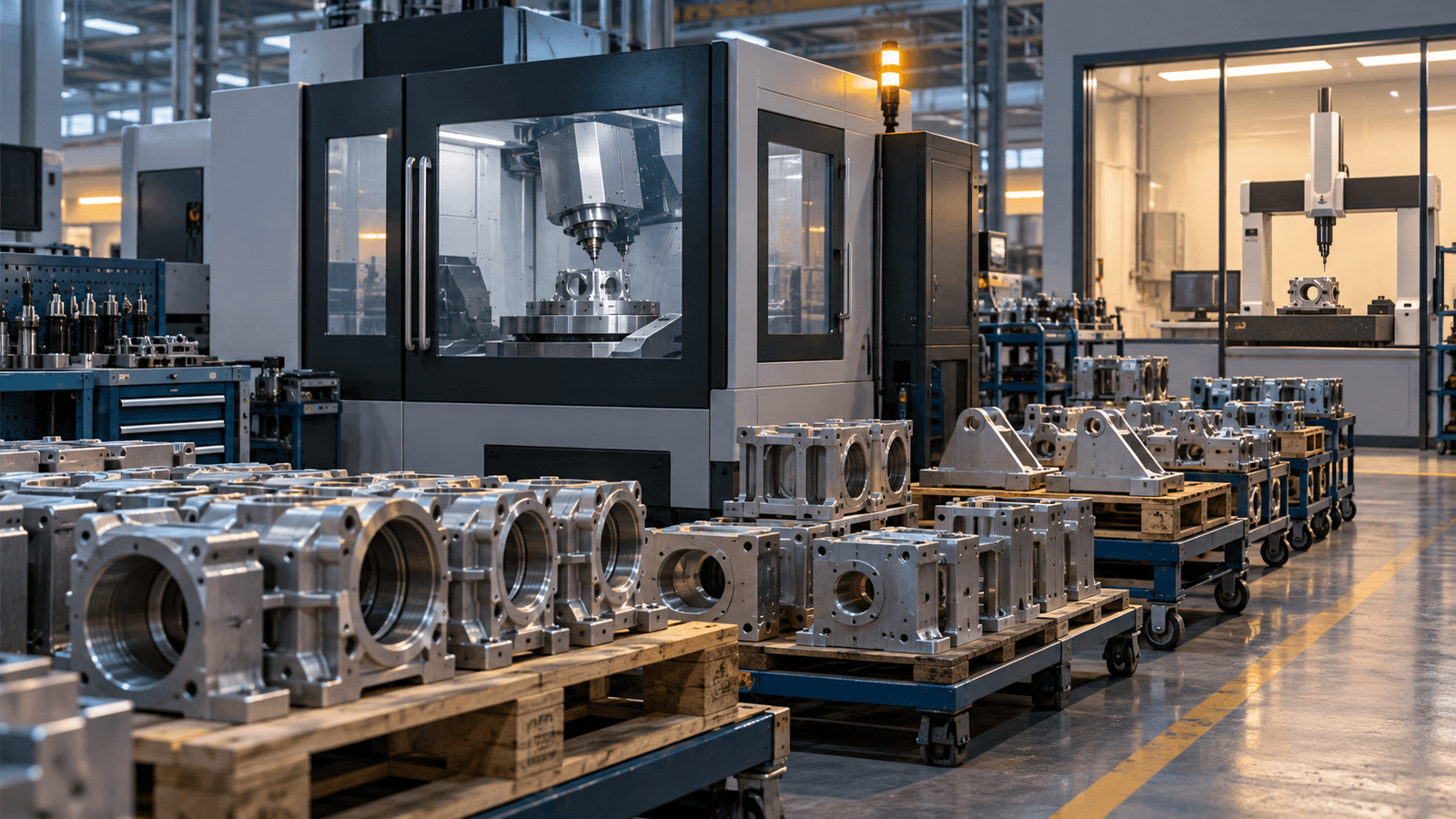
He placed the routings side by side. After material receipt, the housings had their bottom faces machined at Operation 1 milling, then their curved bodies and fluid passages cut on five-axis Machine 1. Washing and deburring followed before they went to the metrology room. The manifolds underwent roughing at Operation 3 milling, had their complex holes machined on five-axis Machine 2, and then had to pass washing, leak testing, and final measurement.
The factory-wide schedule for the week filled the bottom of the screen. Martin moved the mouse through each machine's time slots. Setup time, machining time, transfer time between operations. Rows of numbers.
Three things stood out.
First, the two parts would finish at different times. A housing took forty-two minutes on five-axis; a manifold, twenty-eight. Machine 1 had to keep running for the housings to finish machining Thursday night. Machine 2 could machine the manifolds in fifty-six hours, but it could not accept them until Friday morning. Housings this Friday, manifolds next Wednesday. Those were the two dates just recommitted to Meriden. Both now had to be kept separately.
Second, the connections before five-axis. The first batch of housing stock was clamped on Machine 1, but half the remaining housing blanks had not yet had their bottom faces machined at Operation 1. That milling machine was running 500 other automotive parts. Left as it was, Machine 1 would start waiting for stock Wednesday afternoon. After checking the automotive parts' due date, Martin agreed with the Operation 1 foreman to insert the housing face machining between shifts that night.
Third, the metrology room schedule. Housing inspection did not end with the first article. There were intermediate inspections every thirty parts, followed by precision measurement of ten randomly selected parts after all 120 had been machined. None of those times appeared anywhere in the schedule. If the inspector was occupied elsewhere and could not take the housings in time, the inspection report would be held over the weekend even if machining finished on schedule.
Martin drew a red reference line across the schedule.
[Housing shipment: Friday, 17:00] [17 hours before shipment: washing, final measurement, packing + remaining margin] [Machine 1 machining completion target: Thursday, 24:00]
The seventeen hours from Thursday midnight to five Friday afternoon were not all time they could afford to waste. Washing, final measurement, and packing of the last batch would take close to half a day. The few hours left were the actual margin available to absorb tool wear or inspection delays. If machining did not finish by Thursday midnight, that margin would be the first thing consumed.
Martin wrote three points on paper.
Finish housing machining by Thursday midnight to protect Friday's shipment, and load the manifolds on Machine 2 without disruption Friday morning.
Keep parts supplied to five-axis without interruption.
Secure post-machining inspection time as part of the schedule to protect the seventeen hours before shipment—the buffer.
Taken separately, the problems were simple. On the schedule, however, all three were interlocked. Pull one forward, and another was pushed back.
8. The Metrology Room's Timetable
At four-thirty, Martin opened the metrology room door.
The room was held at a constant twenty degrees Celsius. A single CMM moved its probe quietly. Several brackets were clamped side by side in fixtures on the surface plate. On a shelf beside them, the first housing approved the day before was stored with its inspection report. The technician was checking coordinates on the control monitor.
The quality manager saw Martin and approached.
“We've had complaints from another line since we inserted the first housing yesterday. The bracket machining team wanted to know why their inspection was pushed back.”
He pointed to the schedule board on the wall. The 300 brackets had to go to the plating contractor Thursday morning.
“The 200 already here can be measured across today and tomorrow. The other 100 will arrive after their final machining at Operation 3 tomorrow. It won't affect the Thursday-morning handover to the plating contractor. I'll explain it to the bracket foreman.”
The quality manager nodded and moved a few magnets on the board.
“Martin, how much inspection will Meriden bring us?”
Martin handed him a note listing inspection times by item.
“The intermediate inspection of the first thirty housings was finished this morning. Two intermediate inspections remain, at sixty and ninety parts, then one final dimensional inspection of ten selected parts. For the manifolds, there's the roughed datum check Thursday, first-article inspection Friday morning, and final inspection next Wednesday morning. Please allow fifteen minutes for each intermediate inspection and an hour for each final inspection.”
The quality manager read down the times on the note.
“Will they arrive at exactly these times?”
“I'll hold the machining sequence fixed. No other order goes onto Machine 1 until the housings are finished. Machine 2 will complete the other customers' work booked through Thursday, then machine the manifolds from Friday morning. Unless a machine stops, the parts will be at your door at these times.”
“Then I'll reserve the slots,” the quality manager said. “But Martin, if you're off schedule even once, other work will go in. We can't leave the measuring machine empty and wait indefinitely.”
“I understand. For delays we can foresee, I'll give you an hour's notice. If something happens unexpectedly, I'll tell you as soon as I know. Then we'll look at the remaining margin and agree on the sequence again.”
They shook hands. As Martin left the metrology room, he checked his watch. Five o'clock.
9. Execution and Adjustment
At five-thirty Tuesday afternoon, Martin returned to the five-axis area.
Machine 1 emitted a steady-pitched cutting sound and the smell of coolant. Its green operating light was on. Housings were being cut to the drawing. On the urethane supports on the floor, forty-five housings machined since the previous morning had been wiped clean and arranged in plastic trays. Green tags marked the first thirty as having passed intermediate inspection.
At the bench beside Machine 1, the operator was mounting the next tool in a spare holder brought from the toolroom. Immediately after the meeting, the foreman had assigned him exclusively to five-axis. The new quick-change plates existed only as a purchase order for now. They had to get through the week with the tools they had.
The machining foreman approached Martin and handed him a sheet of paper.
“Tool life is shorter than expected. The end mill for roughing the housing bore was supposed to be changed after thirty parts, but we got the wear-limit alarm on the twenty-second. It looks as though this titanium lot has slightly higher tensile strength than the last.”
Martin checked tool inventory on his tablet.
“There are four sets of inserts of the same specification left in the toolroom. Can we absorb the changes within the margin before shipment?”
“External setup has cut the time spent stopping the machine and looking for tools. We've already fitted fresh inserts in spare holders. Opening the machine interlock and swapping them at the tool changer takes five minutes. But we'll need to lower cutting speed by about eight percent for the tools to last through Friday.”
Martin tapped his calculator. An eight-percent speed reduction would increase machining time per part from forty-two to nearly forty-six minutes. Four extra minutes on each of the remaining seventy-five parts meant a five-hour delay.
“Five hours takes us past the Thursday-midnight completion target. Once washing, final measurement, and packing are deducted from the seventeen hours before shipment, only a few hours of margin remain. We'd use nearly all of that in machining. Any small problem in the washing or final inspection afterward, and we miss the deadline.”
“There's one way.” The foreman pointed at the tool list.
“I'll reduce speed only for bore roughing. Finishing stays at the original speed. And instead of waiting for the alarm, we'll change inserts proactively every twenty parts. With fresh inserts fitted in spare holders, each change takes five minutes. That brings the extra time down to under three hours.”
Martin entered those figures into the schedule. Housing machining would now finish around three Friday morning rather than midnight Thursday. They would be using three hours of the margin before shipment. The time required for washing, final measurement, and packing remained intact.
“All right. Let's do that. In exchange for using three hours of margin, I'll reconfirm the Friday-morning final measurement slot with the metrology room. I'll have packing staff assigned from Friday morning too.”
He called the quality manager on the spot and asked to move final housing measurement to nine Friday morning. After checking the bracket schedule, the quality manager agreed to reserve that time.
The shop floor did not simply follow the plan Martin had drawn up alone. Tools wore, material hardness varied, and cutting sounds changed. But something was different from before. In the past, a broken tool meant stopping the machine and running to the toolroom to find a replacement, while another urgent order seized the machine in the meantime. Now the foreman and Martin were looking at machine load and remaining margin on the same screen. When a delay arose, they could decide together, then and there, how much of that margin to use.
10. Where the Investment Request Went
At four Thursday afternoon, the plant manager's office door opened.
As Martin entered, the plant manager tidied the papers on his desk. The million-dollar five-axis quotation that had sat at the end of the table Monday morning was nowhere to be seen. Instead, his monitor displayed the five-axis progress sheet Martin had submitted every evening.
“How is Meriden coming along?”
“The housings passed the hundred mark by three this afternoon. The remaining fifteen will finish around three tomorrow morning, after one more tool change. We're using three hours of the margin before shipment, but the time for washing, final measurement, and packing remains. Final measurement is at nine tomorrow morning. We'll pack in the afternoon and load Meriden's nominated carrier's truck at four-thirty. Manifold roughing finished yesterday evening. Today we're checking datums and cleaning up the edges. They go on Machine 2 at six tomorrow morning. Two risks remain: whether the housing tools last to the end, and whether the manifold first article passes first time tomorrow morning.”
“There was one disruption Wednesday afternoon. Sales asked us to slip a few urgent parts for another customer onto Machine 1. Taking off the housing fixture and putting it back would have meant three hours of setup alone, pushing the Thursday-midnight cutoff back by as much. We put those parts into a gap on Machine 3.”
“The sales director brought that one to me yesterday too. I sent him back and told him we're sticking to Machine 1's schedule this week.”
The plant manager leaned back in his chair.
“He was just here again. Apparently Meriden said they won't forget the late manifolds. But they've been getting daily progress updates since Tuesday, and they said that has helped them rearrange their assembly line sequence.”
He took a document from a drawer. It was the request for additional equipment put on hold at Tuesday's meeting. The quotation the sales director had thrown onto the table Monday morning was attached behind it.
“About this request. It was going before the investment review in four weeks. I spoke with the sales director this morning, and we've taken it off the agenda for now. Once you establish the capacity actually remaining and next year's volume, we'll decide whether to put it back.”
Martin looked at him. The plant manager gave a faint smile.
“The original request contained just one number: 95% utilization of the five-axis machines. Seeing your records and watching the floor over these past four days has changed my mind. If we'd bought another machine and kept operating the same way, we'd have spent a million dollars and waited six months, only to find the same queues at the metrology room and in front of the machines. I understand that now.”
He picked up his pen and wrote a bold note at the top of the request, putting it on hold.
“The twenty-thousand-dollar plates haven't even arrived. This week we've managed with spare holders, agreed times with the metrology room, and the release sequence. Even so, the housings will leave tomorrow, and the manifolds are on their way toward the date we recommitted to. Let's talk about more machines after we've kept all those promises, with the numbers you bring back.”
11. Two Shipments and the Yellow Line on the Floor
Friday, 4:30 p.m.
A heavy air-suspension truck designed to minimize vibration reversed into the finished-goods shipping dock outside Machining Building 2.
A forklift carried a wooden pallet bearing a shipping inspection clearance into the truck. On it were 120 precisely machined, silver titanium housings. Final measurement, begun at nine that morning, had finished at eleven; the report was issued at noon. The other side of the cargo bay, where the manifolds should have been, was empty.
The doors closed with a thud, and the driver handed Martin a receipt. The departure time entered on it was 4:40 p.m.
At that moment, Machine 2 was machining manifolds following the first article that had passed through the metrology room that morning.
Watching the truck leave through the factory gate, the sales director let his tense shoulders ease a little. There was no weekend overtime application, nor an emergency airfreight invoice costing tens of thousands of dollars per shipment as there had been the previous month. But only one of the two parts had been sent to Meriden.
At two the following Wednesday afternoon, a truck from the same carrier returned to the same dock.
The 120 manifolds had been machined on Machine 2 from Friday morning to Tuesday evening, with the weekend off. They were washed and leak-tested that night and passed final measurement Wednesday morning. As promised on the call, Martin had notified Meriden the previous Thursday evening that the manifolds were ready to go onto Machine 2. He had continued sending each day's machining quantity afterward. The shipment date did not change again.
That Friday, a reply arrived from Meriden's head of purchasing.
“We have completed incoming inspection of the 120 housing-and-manifold sets and will resume module assembly next week. The failure to meet the original schedule and the resulting need to change our assembly sequence will be reflected in your supplier evaluation. We will also record that the revised schedule was fulfilled as agreed and that progress was shared daily. We will decide whether to place the follow-on order for 300 sets next quarter after reviewing the production schedule and supporting capacity evidence you submit.”
The sales director read the reply twice. Then he asked Martin for a draft production schedule for 300 sets. This time, he said, he would send the schedule before the quotation.
Monday, 8:40 a.m., five weeks after the Monday when the Meriden problem first erupted.
Martin walked down the central aisle of Machining Building 2 again.
In the aisle before the five-axis area, where the forklift had needed to weave around piles of pallets five weeks earlier, the yellow safety line was visible again. The boxes of unmachined WIP that had blocked passage in front of each machine had diminished too. Materials were no longer released indiscriminately onto the factory floor. They left the warehouse for the first operation only on a release date calculated backward from the five-axis schedule, allowing the time needed upstream. Once the preceding operations were finished, the material waited its turn on the preparation racks at the entrance to the five-axis area before moving to the machine. Boxes still filled the aisles in other areas.
The five-axis machining center area looked different too. On Machine 1, the first batch of the follow-on volume Meriden had ordered after reviewing the schedule was being cut at a brisk pitch. Without hurrying, the operator at the control panel was clamping the next blank onto a quick-change plate on the external workbench. The plates had arrived three weeks earlier. Setup time had fallen from ninety minutes to twenty-five, and five-axis first articles rarely piled up outside the metrology room.
Farther away, a general-purpose milling machine at Operation 3 stood quietly without cutting. Its operator was checking the specifications of the next material beside it. Yet no one approached to demand why such an expensive machine was idle. Over the past five weeks, people in the five-axis area had seen for themselves how parts machined by forcing non-five-axis equipment to run at a hundred percent blocked aisles and eroded delivery performance and cash.
Martin switched on his tablet and opened the five-axis records for those five weeks. The figure of 95% utilization no longer headed the report. In its place were entries showing how long the spindles had actually cut and what the machines had been waiting for when they stopped. First articles, tools, material. The list was still long. But each entry now had a person and an action attached to it.
The final column recorded, for every order that had passed through five-axis, the interval between completion of machining and shipment. Martin now called the cutoff first drawn for the housings five weeks earlier a “shipping buffer.” Most orders had absorbed tool wear or inspection delays within that interval. Once, even that time had not been enough, and shipment was half a day late. No one outside the five-axis area was using the term yet.
The million-dollar request remained in the plant manager's drawer, never having gone before the investment review. Whether more machinery was needed would be judged after several more months of records had accumulated.
The plant manager came over and stood beside Martin, looking down the aisle in front of the five-axis area.
“Martin, for twenty years I thought a good factory was one where the machines never stopped.”
He pointed first to the idle Operation 3 milling machine, then to the five-axis machine running without pause, and spoke quietly.
“But I was wrong. We've barely begun, but I know this much now. What we needed to build wasn't a factory where the machines never stopped. It was a factory where products kept flowing without stopping.”
Behind them, a five-axis spindle increased its speed with a smooth metallic sound. It was no longer the indiscriminate roar of a factory driven by its machines' appetite. In this area, where materials, measurement, and shipping had begun moving to the beat of five-axis, the factory's heart was at last finding its own rhythm.
Epilogue: Why Orders Were Late in a Busy Factory
At this factory, high reported utilization and late deliveries appeared together. Five-axis utilization was reported as 95%, and everyone on the floor was busy. Yet not a single part from the first production order had reached the shipping area four days before shipment.
The delay did not arise from one person's negligence. Machining was evaluated on equipment utilization and operator efficiency, and grouped the same items together to reduce setups. To improve labor-cost efficiency, the company assigned the five-axis operator an additional general-purpose mill and rejected twenty thousand dollars of preparation equipment as consumable expenditure. Sales requested sequence changes whenever an urgent customer need arose. The metrology room followed the order of receipt. Production Control released material early to avoid repeating the previous year's delay. Each department made choices it considered reasonable. On top of this, the actual machining times for the two Meriden parts were longer than the standard times in the master data. Work sequences and readiness conditions were not coordinated across departments. As a result, the very orders that were needed waited their turn at the shared five-axis machines and metrology room. Standard times shorter than reality also understated the time needed to finish the remaining work.
One: Reported Utilization Was Not Actual Production Capacity
Reported utilization totaled the time between job-start and job-completion barcode scans. It included setup, waiting for first-article approval, and waiting for material from the preceding operation, without distinguishing those from actual machining time. Comparison with controller records showed that less than half the day was spent cutting metal.
That method of aggregation influenced two decisions. Martin confirmed Meriden's due date using this figure and short standard times, while the sales director used the same figure to demand more equipment. Without addressing the existing causes of waiting, it was difficult to judge how much an additional machine would improve delivery performance. Given the time needed for installation, it could not help that Friday's shipment at all. The plant manager put the expansion request on hold rather than canceling it. He would reassess it after examining both the capacity gained through changes in operations and the load from future orders.
Two: Earlier Release Alone Did Not Protect Shipment
After the prototypes were ten days late the previous year, Martin concluded that work had started too late. He extended standard lead times and released material earlier. But the early-released material competed for position with other orders already waiting before Operation 3 and five-axis. The manifolds waited behind boxes of covers due two weeks later.
Martin established that bringing release forward alone did not protect shipment. At the meeting, he described his own judgment as having “put recovery time at the very beginning,” and said he would now place that time before shipment. He then considered three things: preparation and release aligned with the five-axis schedule, the work that must be done after machining, and the margin needed to protect completion of that work. Housing machining was to finish by Thursday midnight, with washing, final measurement, and packing completed within the seventeen hours before five Friday afternoon. The few hours remaining would absorb unexpected events. When tools wore earlier than expected, three of those hours were used, and the housings shipped on the Friday originally promised. Five weeks later, the five-axis area was managing the time secured between target machining completion and shipment as a “shipping buffer,” checking how much margin remained to finish subsequent work when delays arose.
Three: A Promise Kept and a Promise Made Again
The housings shipped on the Friday originally promised. The manifolds did not, and Martin told the customer that his judgment had been wrong. Meriden bore the burden of changing its assembly sequence and accepted shipment the following Wednesday. The manifolds shipped that Wednesday. Meriden recorded both the failure to meet the original schedule and fulfillment of the revised schedule in its supplier evaluation.
The improvements observed five weeks later were centered on the five-axis area. Material left the warehouse on dates worked backward from the five-axis schedule, and the operator prepared the next job while the machine was cutting. There had still been one shipment half a day late, and boxes remained piled in the aisles elsewhere. What had changed was the sequence of decisions: first set the schedule for the equipment with the greatest capacity shortfall, then connect material, measurement, and shipment to it. That is why the plant manager, speaking of “a factory where products kept flowing without stopping,” added that they had “barely begun.”
From Story to Commentary
This story has not artificially forced a workplace into the diagram of any one theory. Yet the painful judgments its characters make at every turn contain the fundamental contradictions that theories of manufacturing operations have wrestled with for decades.
The standard times and utilization figures in the factory's plans did not reflect the living reality of the shop floor. Tools wore earlier than expected, actual machining times diverged from the master data, and the metrology room's sequence was buffeted by unexpected circumstances on other lines. In real manufacturing, standard time cannot be treated as a single fixed number. In a world governed by statistical variation and Murphy's Law, the real challenge for a production system is how to absorb and manage this unavoidable uncertainty.
The four commentaries that follow reread the judgments of Martin and the shop-floor managers through the lens of Business Science. Step by step, they examine what else is needed to extend the small operational changes begun in the five-axis area into a company-wide system.
Commentary 1. Departmental Performance and Factory Performance — Why are orders late when every department does its best by its own standards? We examine individual evaluation centered on utilization and efficiency, the rejection of twenty-thousand-dollar fixtures, and the demand for a million-dollar expansion through the perspectives of company-wide performance and interdependence. Throughput accounting, which serves as accounting for shop-floor decisions, and the Evaporating Cloud, which exposes assumptions beneath conflicting demands, reveal where departmental evaluation criteria and operating rules cease to connect to the company's goal.
Commentary 2. How Work in Process and Waiting Build Up — Why do the parts actually needed fail to emerge from a factory where everyone is busy? Queueing theory and Little's Law provide a mathematical explanation for first articles stalled outside the metrology room and manifold blocks trapped behind covers due two weeks later.
Commentary 3. Synchronizing Production Planning and Execution — When should material be released, and where should margin be placed? We use the principles of finite-capacity scheduling and time-buffer management to explain schedule control paced to the bottleneck resource, external setup that prepares the next job while the machine is cutting, and buffer design that absorbs unexpected variation on the shop floor.
Commentary 4. Work Records and Updating Estimates — Why do standard times keep missing the mark? We consider tools expected to last thirty parts that wore out at the twenty-second, actual cutting times longer than the standards, and the timing of equipment investments that can only be judged once data accumulates. We examine the practical application of Bayesian inference: using comparisons of shop-floor records to learn uncertainty in processing times as probability distributions and incorporate that learning into the next plan.
Next: Commentary 1. Departmental Performance and Factory Performance
“If we keep the operator on five-axis alone, general-purpose Mill 3 will be idle. Who explains that empty machine in the month-end performance report?”
We begin with the plant manager's decision in response to this question from the foreman. We examine the actual point at which departmental performance and company-wide cash flow diverge.

Join the discussion