
Important work survives even the busiest day
The work that gets pushed aside between plans and reality
Everyone hopes to succeed. One person wants financial freedom; another wants recognition in a chosen field. Starting a business long held in the imagination, acquiring a new skill, regaining physical health, or keeping a promise to oneself and finding inner peace can all be forms of success. Its shape and name differ from person to person, but the desire to live the life one truly wants is deep and urgent in all of us.
We make plans with that desire in mind. We buy the books we need, open a notebook, write down our ideas, and organize what must be done. At first, everything seems possible. A few days later, however, urgent demands force their way into the plan. We answer an endless stream of messages, solve the problem directly in front of us, and clear requests that cannot be postponed. The day ends. We have worked hard from morning to night, yet the essential thing we most wanted to change in our life remains exactly where it was yesterday.
The weight of unfinished work
Unfinished work begins to accumulate in the mind: the business proposal that was supposed to reach the market one day, the serious course of study we meant to begin, the exercise routine we promised to resume. At first, we tell ourselves that tomorrow will be fine. After breaking the same promise to ourselves several times, the task grows heavier and our trust in ourselves begins to fade. We know exactly what we want, but the path that could turn it into a concrete result refuses to open.
Many people blame this state on weak willpower or laziness. Yet unfinished work does not remain only on the desk. It returns unexpectedly while we rest and holds part of our attention even while we do something else. The Zeigarnik effect—the tendency for interrupted or incomplete work to remain mentally active—echoes this experience. The body may have finished the day's work, but the mind is still caught in several places. The more things we believe we ought to do but fail to close, the harder it becomes to end the day with a sense of release.
Turning a large goal into an action you can complete today
The point where thought begins to change reality
To stop this interference and move thought into reality, we must cross one decisive threshold: the point where thought becomes physical action and acts directly upon the world.
No matter how precisely we design and imagine a wheel in our head, it will not turn by itself. We must obtain the material, cut it into shape, fasten it securely to an axle, and apply physical force. Choosing the direction matters, but reality changes only when that decision reaches our hands, becomes an object, and sets the wheel in motion.
Every change a person wants follows the same rule. To earn a customer's trust, we must see the customer's unmet need and place a tangible result that answers it in the customer's hands. To build exceptional expertise, we must go beyond reading: apply what we know, encounter failure, and repair what breaks. If the concrete action that success requires is never performed in the real world, the door to the next stage never opens. The only bridge between an intention in the mind and a substantial change in reality is physical action.
From winning a new customer to completing the first proposal draft
Grand declarations such as “grow the business” or “become an expert” do not tell us what to begin when we sit at the desk this morning.
There is distance between looking toward a remote goal and moving our hands now. To cross it, we must reduce the scale of the work and untangle its layers of requirements until it becomes small enough to handle today. Albert Bandura's work on proximal goals points to the value of bringing a goal closer in this way. Instead of looking only at what we must eventually become, we begin to see what must be done first.
Consider the process of winning a contract with a new customer. To make a final decision, the customer must be able to judge clearly what will actually change on the ground after adopting our solution. That requires a comparative analysis that places the current process beside the improved future state. To prepare it, we must first examine the customer's operating data, organize the key numbers that will change, and produce a first proposal draft that others can review.
Now today's action finally comes into focus. From the distant goal of “winning a new customer,” we can extract one concrete unit: “Complete one first draft comparing Company A's current workflow with its post-adoption process.” If even that is too large for a day, divide it again into checking the current data, organizing the comparison, and writing the draft. Each smaller result becomes firm ground on which the next action can stand.
From a large goal to one unit you can put your hands on today
- I want to win a new customer
What must the customer be able to confirm before deciding to sign? - Show the change before and after adoption
Prepare material that compares the current process with the improved state. - Build the evidence for the comparison
Examine the current operating data and organize the key numbers that will change. - Complete today's deliverable
One first draft comparing Company A's current workflow with its post-adoption process.
Even small work needs an end and a priority
What must be true before we can call it finished?
This is the real reason to divide work into smaller units. Making work smaller is more than a technique for reducing psychological pressure. It creates a physical boundary within which we can begin and finish. Ideally, the unit can be completed within a day; if not, within a few days. Only at that scale can we observe our action and the result it produces at close range.
When we hold a large undertaking as a single unit, we must endure a long interval before reaching its end. We may work on it for days and still be nowhere near finished, while other demands keep arriving. Although we are exerting ourselves, we begin to wonder how far remains and whether we will ever complete it. The more deeply we want to succeed, the more oppressive and uncertain time feels when it passes without completion.
Now imagine dividing that work into a unit you can finish today and actually carrying one piece through to the end. The larger goal may still be distant, but one fact is unmistakable: you completed the unit you chose. Something you intended to do passed through your hands and reached an end. The relief and quiet pride of that moment provide the strength to reach for the next task. A day once spent merely enduring the distance to success now contains a moment in which you bring something to completion and begin again.
A clear ending also makes measurement possible. We can see whether the proposal draft is truly on the desk or whether the comparative evidence is still missing. We can count honestly which of today's chosen actions were completed and which remain open. The vague conclusion—“I worked hard and ended the day exhausted”—gives way to precise data from which we can review our own behavior.
Finishing many things and finishing what matters
Completing many tasks in a day does not necessarily mean that we moved closer to the success we want. We can spend all day on easy administrative work and email while the proposal that could determine the future of the business remains untouched.
Every unit of execution therefore needs a priority. We must look directly at which completion will open the next stage and which delay will stop the whole flow, then put the work in order.
According to that priority, we select the important work, begin it, and carry it through without abandoning it halfway. We open and compare the necessary material, fill in what is missing, and leave a draft that is ready for the next review. A result that did not exist this morning has become a real object by evening. An intention that once circled in the mind has passed through action and settled in the physical world as evidence.
EXA calls this unit of execution a Ring
What a Ring means
A unit of execution created by dividing the actions success requires into the smallest units that can be started and finished, defining clear boundaries for completion, and assigning priority in the order of greatest importance.
EXA calls this a Ring. Carrying that action through to completion in the real world is called closing the Ring (Ring Closure).
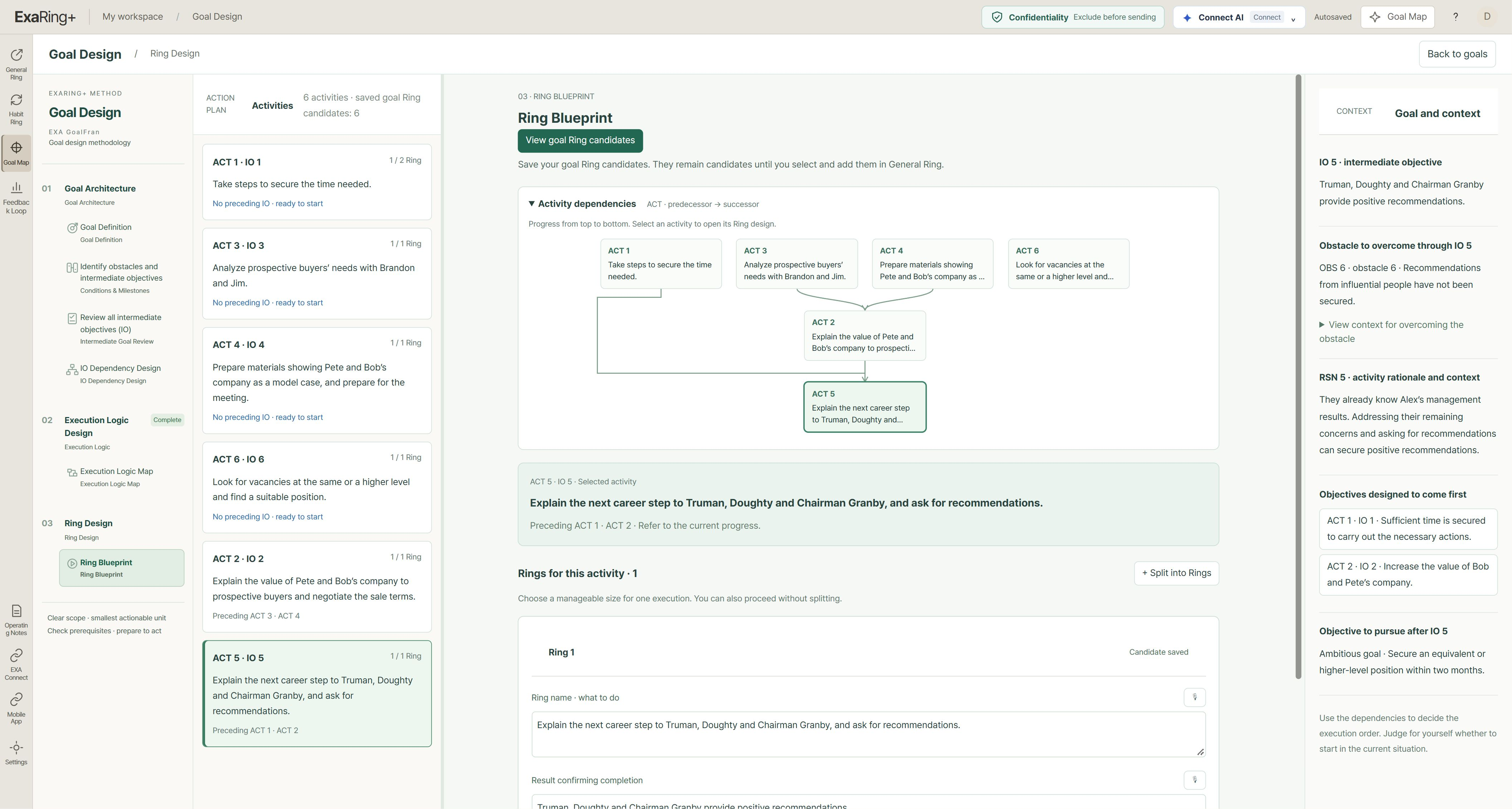
ExaRing+ goal-design methodology: A systematic process that brings an ambitious, distant goal down to the smallest unit of execution that can be completed by your own hands today. It identifies the obstacles blocking the goal, establishes the dependencies among the intermediate objectives needed to overcome them, and derives the Ring. By preserving the context and order of relationships beneath the goal, it aligns a large vision into one concrete knot that can be acted upon now. (Select the image to open the full-size original.)
What it means to close a Ring
Closing a Ring does not mean clearing many checkboxes. It means understanding precisely what the success you want requires, choosing the most important action, and carrying it through to a completed result in reality.
For people who have already achieved success, this is a truth demonstrated by experience. In their own fields, they are people who have quietly closed the many Rings required of them each day rather than relying on grand declarations.
For someone who has not yet reached that success, it remains a hypothesis. They may not yet have accumulated enough experience defining a small unit of execution and carrying it through to the end—or may not yet have tried.
How one completion creates the next action
Evidence that you finished builds self-trust
The moment a person closes one Ring, however, something decisive changes within. The grounds for trusting oneself move from intention in the mind to action in plain sight. Daryl Bem's self-perception theory describes how people also come to understand themselves by observing their own behavior. When night after night we postpone the plan and go to sleep with the Ring still open, the mind begins to accept the hypothesis “I am someone who intends to act but does not finish” as truth. When we close one essential Ring all the way to the end, we acquire self-trust grounded in evidence: “I am someone who turns what I declare into reality.” Ultimate success may still be distant, but no one can deny the fact that today we completed the most essential unit required of us.
The experience of completion does more than restore self-trust. It creates momentum toward the next action. We feel that we have taken one real step in work that seemed impossible yesterday, that something moved forward through our own hands. Teresa Amabile's research on meaningful progress in work—the Progress Principle—speaks to this experience. There is still distance to travel, but now we know that we are moving along the path.
Learning by doing, and finding the strength to begin again
Only after closing a Ring do we learn how reality actually works. We must finish the first proposal draft before we can see what else to ask the customer. We must deploy the small system module before discovering what was wrong in the original design and what must be strengthened. Knowledge appears along the road; understanding emerges through action. Sharp ideas and business insight that could never arise from thought at a desk alone emerge in the demanding work of closing Rings.
A closed Ring leaves more than a deliverable. It leaves the release of finishing, grounds for trusting oneself, and practical knowledge that could only come from doing. These become resources we can draw on when we face the next task. After closing one Ring, the next action becomes clearer, and the willingness to begin it changes. Completion calls forth the next action; that action leads to another completion. This is how a virtuous cycle grows within everyday life.
Recall a moment when you finished something difficult and felt your chest fill with pride. After such a completion, the next task looks different. The strength gained from one completion flows into the next action; when that action is completed, one more piece of evidence for self-trust is added. What would happen if we continued creating these moments in ordinary life? If the Ring closed today initiated tomorrow's action, and tomorrow's completion moved the following day in turn, the accumulated effect would change us from within.
When difficult work appears, we remember the things we have already carried through. Even before an intimidating goal, we can find one unit we can touch now and draw from ourselves the strength to finish it first. Confidence and self-esteem take root in the actions we complete each day. Our stance toward the life we want changes as well. The desire for success becomes the action required today, and day after day we carry that action through. By continuing to close Rings, we develop the power to move our own lives.
The most important Ring to close tomorrow
ExaRing+ is the execution operating system designed to make this powerful cycle work in everyday life.
It translates the actions your desired success requires into clear Rings, helps you set priorities and carry them through to closure, and feeds the energy and evidence accumulated in the process back into the next action. ExaRing+ gives people whose success still remains a hypothesis a direct path to test and verify the act of closing a Ring in daily life—until it becomes a firm truth about their own lives.
Success never arrives through imagination alone. The action required by the success you want must be completed by your hands, in your physical reality.
Think of the single most important Ring you must close tomorrow for your life and work. Define what it concerns, what must be true for it to count as closed, and why it comes first. Then carry it through to the end.
The physical result left by one closed Ring—and the energy released from within it—will place your tomorrow on an entirely different trajectory.
In the next essay, we will examine the practical conditions for designing and sustaining Rings in daily life: the conditions of a Ring, and the principles of recovery that connect one day to the next.



Join the discussion