


In Part 1, Bayesian reasoning worked in the deep sea and in wartime. This article follows its expansion into courts, historical research, insurance, email, traffic, medicine, and forecasting. In most of these cases, what changed the judgment was evidence that looked insignificant. Bayesian inference measured its weight accurately.
1. The Probability That Made a Traitor — The Dreyfus Affair
September 1894. The German embassy in Paris.
A woman who cleaned the embassy and worked with French intelligence emptied the military attaché’s wastebasket. Inside was a torn letter offering to hand over confidential French military documents. It had no signature.
The French Army’s General Staff was shaken. It meant that someone within the military was communicating with the enemy.
Suspicion quickly settled on one man: Captain Alfred Dreyfus, an artillery officer and one of the few Jewish officers serving on the General Staff. The basis was a resemblance between the letter’s handwriting and his own. Yet there were as many differences as similarities. The handwriting fell far short of establishing guilt.
Then Alphonse Bertillon entered the case. He had won fame among European police forces for devising a method of identifying criminals through bodily measurements. He was not a handwriting expert. Instead, he invoked the authority of science and mathematics.
His claim was peculiar. The letter differed slightly from Dreyfus’s handwriting because Dreyfus had deliberately disguised his own writing to avoid discovery. Bertillon also claimed that the positions of words in the letter coincided too regularly to be accidental, and supplied calculations of the probability of such coincidences arising by chance.
The numbers were exceedingly small. The courtroom held its breath.
“With a probability that small, it cannot be coincidence.”
If the handwriting resembled Dreyfus’s, he was guilty because it was his. If it differed, he was guilty because he had disguised it. Whatever evidence appeared, only one conclusion was possible.
January 1895. The parade ground of the École Militaire in Paris. Before a crowd, Dreyfus’s insignia were torn off and his sword broken. He cried, “I am innocent! Long live France!” He was then sent to Devil’s Island, the penal colony off the coast of South America.
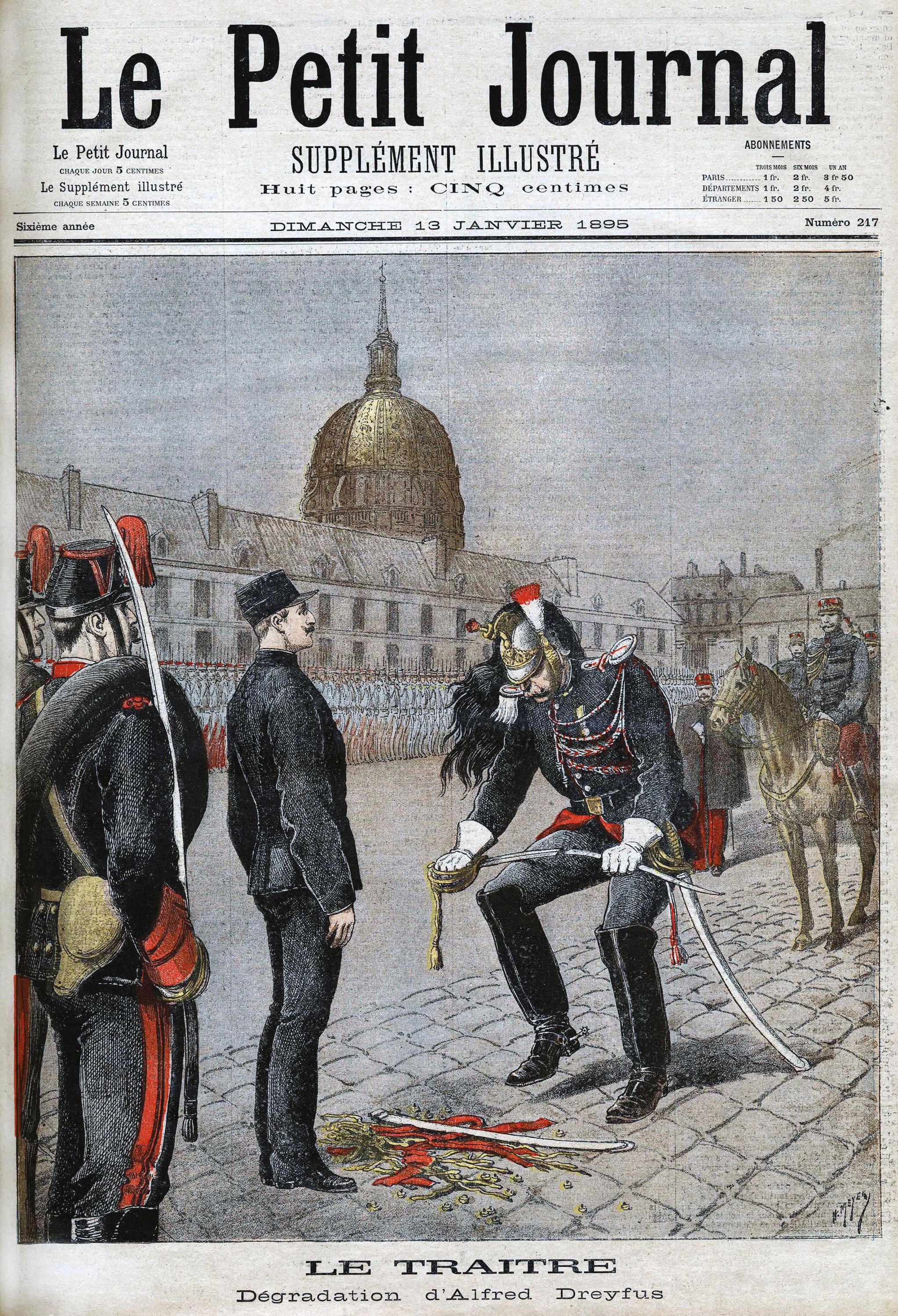
Dreyfus’s military degradation on the cover of Le Petit Journal, January 13, 1895.
Several years later, evidence emerged that someone else was the real culprit. The military leadership concealed it. French society split in two. In January 1898, Émile Zola published “J’Accuse…!” on a newspaper’s front page, directly challenging the military and government. A retrial followed in 1899. Henri Poincaré, one of France’s foremost mathematicians, submitted an opinion explaining that Bertillon’s calculations had no foundation. The military court convicted Dreyfus again.
The turning point came in 1904. The Court of Cassation asked Poincaré and his fellow mathematicians Gaston Darboux and Paul Appell to review Bertillon’s method formally. The three placed the “probability of causes”—the reasoning of Bayes and Laplace—at the beginning of their report.
Their argument was straightforward. However unlikely a coincidence might be under chance, that probability alone cannot tell us the probability of guilt. Three questions must be considered together.
- If Dreyfus wrote the letter, how naturally would these coincidences arise?
- If someone else wrote it, how often would they arise?
- What did we already know before looking for the coincidences?
Concrete numbers reveal the illusion. Suppose a handwriting match has a one-in-a-thousand probability of occurring by chance. That is small. But if several thousand people could have written the letter, some would show the same match by chance alone. One in a thousand is not the probability that Dreyfus is the culprit. It is only the probability that a randomly selected person’s handwriting would resemble the letter to that degree. Confuse the two, and probability becomes a weapon rather than evidence.
The report concluded that Bertillon’s system had no scientific value. In 1906, Dreyfus was exonerated and reinstated in the Army, twelve years after his arrest.
The principle of likelihood discussed in Part 1 underlay this judgment. Evidence is weighed by comparing competing hypotheses. A number calculated under one hypothesis alone cannot establish that hypothesis, however sophisticated the calculation appears.
Across the Atlantic, another case in which handwriting and language became evidence reached a very different ending.
2. A List Before a Duel — Identifying the Authors of The Federalist
July 1804. New York.
Alexander Hamilton was days away from a pistol duel with his political rival Aaron Burr. The first U.S. Treasury secretary and a central figure in the nation’s founding reportedly left a note at the office of his friend and lawyer Egbert Benson shortly before the duel. It listed the numbers of essays Hamilton said he had written.
At dawn on July 11, a shot rang out below the cliffs of Weehawken, across the Hudson River. Hamilton died the following day.
The note concerned The Federalist Papers. Published in New York newspapers in 1787 and 1788 under the pen name “Publius,” the essays urged citizens to ratify the new Constitution. Hamilton, James Madison, and John Jay shared the pseudonym. Collected as 85 essays, the papers became one of the most important classics for interpreting the U.S. Constitution.
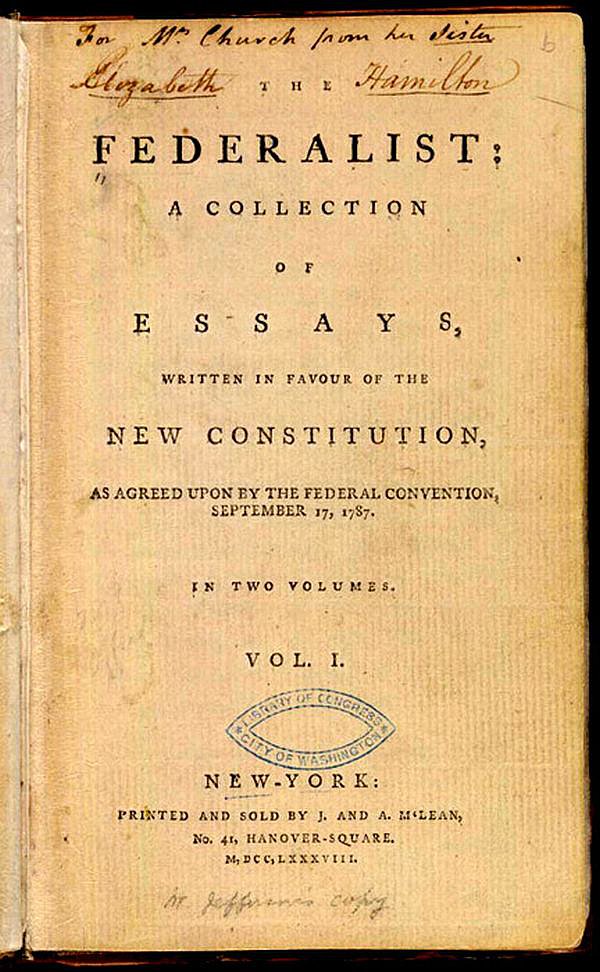
Title page of The Federalist, first edition, volume I, 1788. Library of Congress.
The problem was that Hamilton’s list conflicted with Madison’s account. Madison, later the fourth U.S. president, claimed some of the essays Hamilton had listed as his own: Nos. 49 through 58, and Nos. 62 and 63. Twelve in all.
Both men were among the finest writers of their generation. They wrote for the same purpose, to the same audience, under the same name. Their political philosophy and argumentative methods were similar. Historians examined documents and circumstances for more than a century and a half without reaching a decisive conclusion.
In the 1940s, a young Harvard statistician, Frederick Mosteller, took up the problem. He began by measuring sentence lengths.
The result was disheartening. Their average sentence lengths were so close that the difference appeared only after the decimal point.
“Style cannot distinguish them.”
Mosteller returned to the problem in the late 1950s with David Wallace of the University of Chicago. This time, they looked at something entirely different. Anyone writing on the subject would use words such as “constitution,” “liberty,” and “government.” They examined function words that writers scarcely notice using.
by, to, while, whilst, upon.
Prepositions and conjunctions support an argument without drawing attention to themselves. A pen name can conceal identity, and style can be imitated to a degree. But controlling one’s habits of using function words across tens of thousands of words is difficult.
Essays of known authorship revealed a difference. Hamilton habitually used “upon,” roughly three times per thousand words. Madison used it less than once per thousand, and many of his essays did not contain it at all. Where Hamilton used “while,” Madison used the old-fashioned “whilst.”
Mosteller and Wallace combined these function words using Bayes’ method. Finding no instance of “upon” in a disputed essay would be unusual if Hamilton wrote it and common if Madison did. The ratio shifted the judgment toward Madison. One occurrence of “whilst” shifted it further in the same direction. Each word was weak evidence. When dozens of function words pointed the same way, their combined weight became decisive.
Another element made the study a landmark in the history of statistics. Critics of Bayesian methods had always targeted the same point: researchers chose their priors subjectively. Mosteller and Wallace confronted that criticism directly. They repeated the calculations with priors favoring Hamilton, priors favoring Madison, and a range of starting points between them.
The conclusion did not change.
Strong enough evidence could lead different starting points to the same conclusion. They answered the oldest criticism of priors with calculations.
Their conclusion, published in 1963, was clear. All twelve essays were Madison’s. Even the essay with the weakest evidence favored him. A suspicion historians had long held gained strong statistical support for the first time, effectively ending a dispute of some 170 years. The study, using early computers and extensive hand calculation, demonstrated that Bayesian methods could solve consequential real-world problems.
The implication for business is clear too. The most conspicuous signal is not necessarily the one that best distinguishes hypotheses. In sales, customers’ favorable reactions are often the loudest signals. Whether a contract will be signed may depend on quieter ones: budget approval or the involvement of the department that will actually use the product. Bayesian inference asks how clearly each signal distinguishes the competing explanations.
3. Two Meanings of Zero Accidents — Credibility Theory in Insurance
Monday, 10 a.m. An insurance office.
Two people sit side by side. One is twenty and received a driving license last week. The other has commuted along the same route for fifteen years. Their forms show the same number.
Zero accidents.
The number is identical; the meaning is fundamentally different. The young driver has scarcely had an opportunity to have an accident. The commuter has avoided accidents across many opportunities. The first zero means there is no record from which to judge. The second is supported by fifteen years of observations.
The insurance clerk must decide. “How should I assess this young driver?” Having no record cannot make someone an exemplary driver with zero accident probability. Nor can the insurer postpone pricing until the first accident occurs.
Since the early twentieth century, American actuaries had handled this problem in their own way. For customers with little history, start from the average of similar customers. As an individual’s record accumulates, give it more weight. The practice had been refined over many years in the field. Few, however, could explain its mathematical basis.
Arthur Bailey was an actuary trained in orthodox statistics. When he first encountered this practice, he saw it as an empirical rule of thumb rather than a scientific method.
“Mix the group average with the individual’s record? Where, exactly, does that proportion come from?”
The more he examined it, the more clearly he saw something unexpected. Beneath the actuaries’ experience-based method lay the reasoning of Bayes and Laplace.
In 1950, Bailey formally presented this finding to the Casualty Actuarial Society. The industry’s decades-old method was not merely a rule of thumb, but an application of Bayes’ theorem. Insurers had long been making Bayesian judgments without using the name.
A form widely used in credibility theory today expresses the idea as follows.
Let us unpack the equation.
- : the length or number of observations for that person—the amount of accumulated evidence.
- : a value determining the strength assigned to the group’s experience, corresponding to the strength of the prior.
- : the weight given to the individual’s record. It starts at 0 and approaches 1 as evidence accumulates.
Set to 4, and a driver with one year of experience has a of 0.2. Eighty percent of the judgment still rests on group experience. After four years, is 0.5, giving the two sources equal weight. After twelve years, it is 0.75: the center of judgment has shifted toward the person’s own record.
Credibility theory neither abandons judgment for lack of a record nor freezes a person in an initial category. It starts from broad experience and moves closer to the individual’s actual behavior as that behavior accumulates. This has the same structure as the infant learning discussed in Part 1.
The principle applies directly to assessing people in an organization. A new colleague who completes a first assignment superbly has made a positive start. One performance does not establish proficiency in every kind of work. Equally, a difficult first assignment is insufficient grounds for declaring the person’s potential limited. The accuracy of the assessment grows with the amount of observed evidence.
4. The Inbox Gatekeeper — Bayesian Spam Filtering
As email became part of everyday life in the late 1990s, inboxes filled with loan offers, pharmaceutical advertisements, and fraudulent prize announcements. Every morning, users had to sift through unwanted messages to find the ones they needed.
Programmers added prohibited words such as “Viagra” to lists. Spammers responded with spellings such as “V!agra.” As the lists grew, legitimate messages were increasingly blocked too. The contest between new rules and new evasions had no end in sight.
In 1998, Microsoft Research scientists published a paper on using Bayes’ method to classify spam. In 2002, the programmer and essayist Paul Graham posted “A Plan for Spam” online. It spread quickly, and developers around the world began building Bayesian spam filters.
Graham’s idea was simple. Do not declare a particular word guilty in advance. Collect actual legitimate messages and spam, then count how often each word appears in each class. When a new message arrives, choose the words sending the clearest signals and combine their evidence.
Here is a numerical example. Suppose half of incoming messages are spam. The prior odds are 1 to 1. A new message contains “free.” In the records, this word occurs three times as often in spam as in legitimate mail. The odds become 3 to 1, and the probability of spam rises to 75 percent.
“Spam, just as expected.”
But the same message also contains “meeting minutes.” That expression occurs ten times as often in legitimate mail as in spam.
The odds are 0.3, corresponding to a probability of about 23 percent. The judgment moves in the opposite direction. The message is more likely to be meeting material sent by a colleague.
Each word is weak evidence. As with “upon” in The Federalist, a judgment emerges when the pieces are combined. Each evidence ratio moves the judgment one way or the other, just as Turing added decibans in Part 1.
Graham’s own example is revealing. The programming language “Lisp” appeared frequently in his legitimate mail and scarcely ever in his spam. A word that might mean nothing in another person’s inbox became strong evidence of legitimate mail in his. He reported filtering more than 99 percent of spam while misclassifying almost no legitimate messages.
The same word can mean different things for different users. This is the strength of a system that learns from individual records. Rather than applying the same rules to every message, it learns what counts as normal from the messages that person actually sends and receives. When a user corrects a misclassification, the correction informs the next judgment. When senders change their tactics, the filter learns again from incoming evidence.
Such filters are commonly called “naive Bayes.” “Naive” refers to a simplifying assumption: words are treated as conditionally independent. In real language, words are deeply related. Even so, the simple model worked remarkably well. Its value lay not in reproducing reality perfectly, but in knowing what had been simplified and using the model accordingly.

Even the meaning of the same word depends on the messages a person has actually exchanged.
5. Traffic When You Arrive — JamBayes
5:40 p.m. The journey home.
Open a map on a smartphone, and the road appears red. Yet the driver already knows it is congested. The useful question is what it will be like thirty minutes later, when the driver reaches that stretch after leaving now. Will the congestion have cleared? Would waiting help? Is a different route better?
In the early 2000s, Eric Horvitz’s team at Microsoft Research took on this problem on Seattle’s freeways. Horvitz had also contributed to the 1998 spam-filter paper. Their system, JamBayes, brought different kinds of information into a Bayesian network: current traffic flows from road sensors, years of congestion patterns by day and time, weather, holidays, accidents, and major events. It predicted when congestion would begin and clear, then sent the forecasts to employees’ phones.
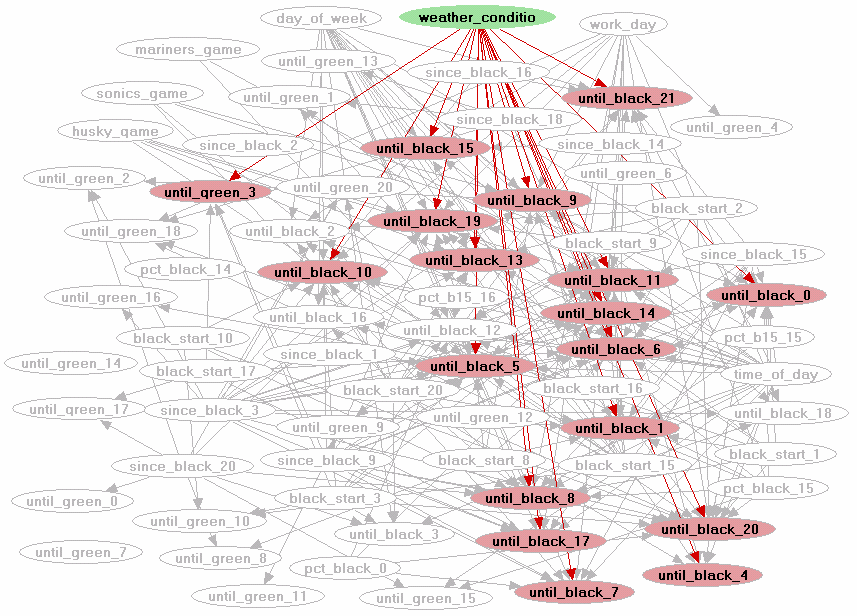
JamBayes’ Bayesian network showing relationships between weather and the onset and clearance of congestion on different roads. Horvitz et al., UAI 2005, Figure 4.
JamBayes paid particular attention to “surprise.” Drivers can anticipate congestion at the usual congested times. The real value was in warning them when traffic would depart from its normal pattern. The Bayesian network assessed how far incoming information deviated from that pattern and probabilistically estimated how the difference would propagate.
The forecast did not show a fixed future. It estimated possible changes from current information and was updated as observations arrived. This is the same principle by which Apollo in Part 1 corrected each prediction with a measurement. A change in guidance between departure and the journey does not itself mean the prediction failed. If circumstances change, the forecast should change. Holding the original number despite changed circumstances is rigidity of judgment rather than consistency.
6. Galton’s Ox and Uncertainty About Models — Bayesian Model Averaging
As forecasting becomes more sophisticated, a more fundamental question emerges. What if the method producing the forecast is itself wrong? The starting point for this question is a livestock show a century earlier.
Late autumn, 1906. Plymouth, a port city in southwest England. Amid muddy boots and the smell of straw, a fat ox stood tethered beside a pen at a livestock show. For sixpence, anyone could write on a card an estimate of the animal’s weight after slaughter, with its hide and internal organs removed. A butcher who had handled a knife all his life and a clerk visiting the fair received the same card.
Watching was an eighty-four-year-old scholar: Francis Galton, Charles Darwin’s cousin and the founder of eugenics. He had spent his life distrusting the judgment of ordinary people.
“What better material could there be to show just how absurd the numbers supplied by this ignorant crowd are?”
After the contest, Galton obtained 787 cards. The numbers were widely scattered. Bringing them together produced something unexpected. Their arithmetic mean was 1,197 pounds, almost identical to the actual weight. The following year, in Nature, the lifelong skeptic of the public wrote that the result gave reason to assess the trustworthiness of democratic judgment more highly than he had expected.
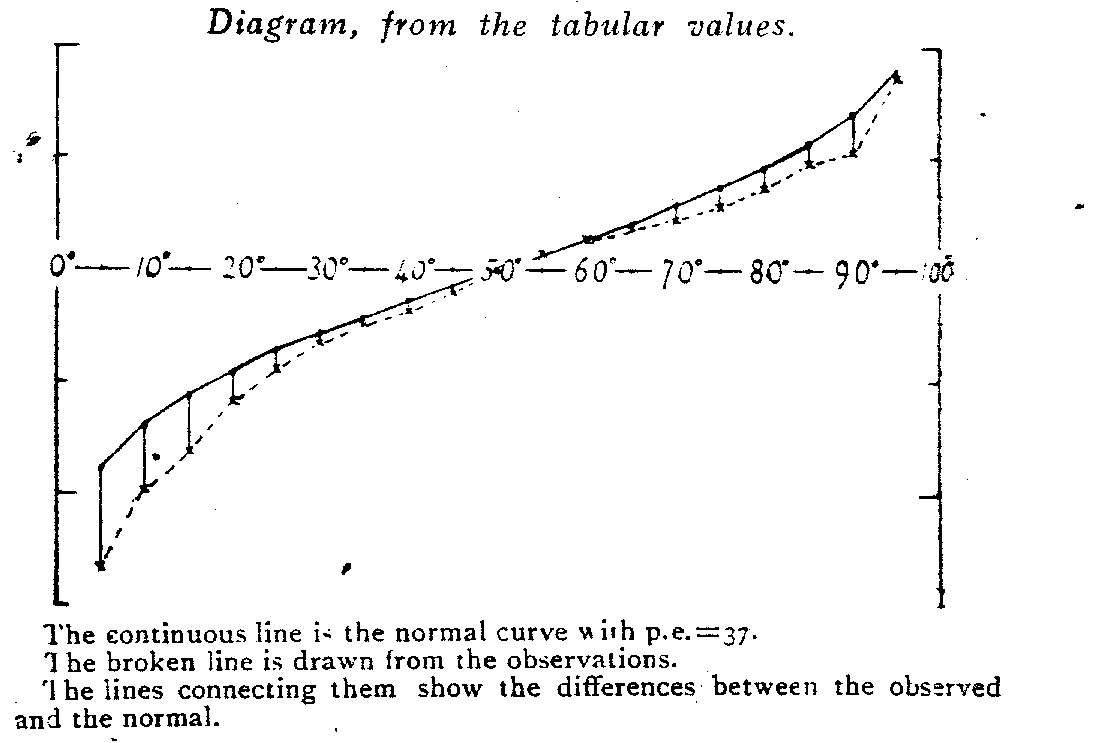
Galton’s chart comparing the distribution of 787 estimates of an ox’s weight. “Vox Populi,” Nature, March 7, 1907.
A century later came a twist. Reexamining Galton’s original material, the econometrician Kenneth Wallis found that the actual weight had been 1,197 pounds, rather than the 1,198 Galton published.
Mean estimate: 1,197 pounds. Actual weight: 1,197 pounds. Error: zero.
Each individual estimate carried its own bias and error. When errors from different perspectives were combined, they offset one another and converged on the actual value. There was a condition: estimates had to come from different grounds, rather than all being influenced by the same rumor.
Ninety years later, the principle reappeared in much more sophisticated mathematics.
In 1997, statistician Chris Volinsky and his colleagues were predicting stroke risk from the Cardiovascular Health Study, which followed thousands of older Americans over many years. There were dozens of variables: age, blood pressure, cholesterol, smoking, electrocardiogram results, and more. Different choices of which variables to include or exclude could generate many models.
The conventional approach was to choose the model that seemed best and discard the rest. Subsequent predictions proceeded as if that model had been the correct one from the outset.
Volinsky questioned the practice. “Where does the certainty that this is the right model come from?” Slightly different data might have led to a different choice. Model-selection uncertainty seemed to disappear once the calculations ended. In reality, it remained.
The researchers kept all the plausible models. They assigned each a weight based on its posterior probability given the observed data, then combined their predictions using those weights. This is Bayesian model averaging. Suppose model A has a weight of 70 percent and model B 30 percent. A predicts a patient’s risk at 20 percent; B predicts 40 percent.
The combined forecast is 26 percent. The possibility identified by B was not excluded merely because B was not the single best model. The researchers reported better predictive performance than the standard approach of selecting one model.
A decade later, the principle was demonstrated in an entirely different field.
In 2006, Netflix announced a million-dollar prize for the team that improved the accuracy of its movie recommendations by 10 percent. Tens of thousands of people entered worldwide. In the final stage of a competition lasting nearly three years, two teams reached virtually the same score. Submission time decided the winner. BellKor’s Pragmatic Chaos submitted its answer twenty minutes before its rival.
Their solutions were very similar. Both combined hundreds of different prediction models. The winning team included Chris Volinsky, who had led the stroke-risk research a decade earlier. Strictly speaking, the Netflix ensembles were not Bayesian model averaging. The shared principle was to acknowledge the limits of a single model and combine the judgments of several. When uncertainty about the analytical method itself enters the calculation, forecasts rest on firmer ground.

7. Dart-Throwing Chimpanzees and Superforecasters
What about human prediction? Who forecasts real events most accurately?
Philip Tetlock, a psychologist at the University of Pennsylvania, spent nearly twenty years collecting experts’ forecasts: tens of thousands of predictions from hundreds of political scientists, economists, and government analysts. The result was startling. The average expert did not perform much better than random guessing. Tetlock compared the performance to a chimpanzee throwing darts. Prominent experts who appeared frequently in the media tended to perform worse still.
In 2011, IARPA, the U.S. intelligence community’s research organization, launched a large forecasting tournament. Would Greece leave the eurozone by a specified date? Would a country’s leader still be in office at year-end? The questions had explicit deadlines and conditions, so outcomes could be judged clearly. The Good Judgment Project, led by Tetlock and Barbara Mellers, recruited thousands of ordinary volunteers and entered the tournament. It outperformed rival teams by large margins year after year.
Among the volunteers were people in the top 2 percent: retired civil servants, computer programmers, graduate students, and others with ordinary occupations. They reportedly forecast more accurately even than intelligence analysts with access to classified information. They became known as “superforecasters.”
They had no special powers. What Tetlock found in common was a way of thinking remarkably close to Bayesian inference.
First, they did not divide judgments into 0 and 100. Where people ordinarily sorted the world into “will happen” and “will not happen,” these forecasters expressed probabilities in fine increments: “38 percent, as things stand.”
Second, they revised their judgments frequently, but incrementally. Each new article or field report might move 38 percent to 41 percent, then 41 to 35. They did not cling to a public forecast to save face. Nor did one news item overturn the entire judgment. They moved it only as far as the evidence justified.
Third, training improved their performance. Even brief instruction in probabilistic thinking produced clear gains in accuracy. Working in teams that shared and examined their reasoning improved it further. Every forecast was recorded and scored when the outcome became known. People remember their successful predictions and readily forget their misses. Recording and scoring both predictions and outcomes kept selective memory from distorting self-assessment.
The same principle applies to organizational decisions. Suppose you put the probability of project approval by next month at 70 percent, then learn that the budget review has been postponed. Approval has not been refused, but the probability of approval within the deadline has clearly fallen. Revising the judgment is not a reversal of position; it is a more faithful answer to the original question. Maintain 70 percent to save face despite knowing the circumstances have changed, and the number ceases to function as a forecast.
What distinguished the superforecasters’ results was less the accuracy of their first prediction than the discipline of reassessing and revising it against the evidence whenever new facts emerged or conditions changed.
8. From Evidence About the World to Evidence About Yourself
The principle that corrected the error in the Dreyfus affair, restored a missing signature to its author, assessed a driver without a record fairly, guarded the inbox, and guided the superforecasters was the same. Start with existing beliefs and revise them according to evidence that actually occurs.
So far, however, the principle has always faced outward. Its subjects have been a submarine on the seabed, an author from some 170 years ago, a driver at the counter, and the future of international affairs.
One subject remains, closer than any other and rarely examined in this way: yourself.
People do not know precisely how much of what they plan they actually complete, under which conditions they postpone work, or under which conditions they finish it. They seldom get to check whether the person they believe themselves to be matches the person their records reveal.
The third and final part applies this principle to an individual’s day and execution.
The Core Ideas
- Evidence is weighed by comparing competing hypotheses. The probabilities that convicted Dreyfus were calculated under one hypothesis alone.
- Weak pieces of evidence can become decisive when combined. The function word “upon” and the expression “meeting minutes” helped identify an author and the nature of an email.
- As records accumulate, the basis of judgment moves toward the actual individual. Credibility theory does not freeze a person in the initial category.
- Predictions must include uncertainty about model selection. Bayesian model averaging acknowledges the limits of a single model and combines several models’ judgments.
- Accurate forecasting comes from the discipline of updating often, but incrementally. Superforecasters moved their judgments only as far as the evidence justified.
Sources
- Poincaré, Darboux, and Appell, report reviewing handwriting evidence in the Dreyfus affair, 1904 (English translation and original materials); Poincaré’s Odds.
- Frederick Mosteller and David L. Wallace, Inference in an Authorship Problem, JASA 58(302), 1963; Inference and Disputed Authorship: The Federalist, 1964.
- Arthur L. Bailey, Credibility Procedures: Laplace’s Generalization of Bayes’ Rule and the Combination of Collateral Knowledge with Observed Data, Proceedings of the Casualty Actuarial Society 37, 1950.
- Mehran Sahami et al., “A Bayesian Approach to Filtering Junk E-Mail,” AAAI Workshop, 1998; Paul Graham, A Plan for Spam, 2002.
- Eric Horvitz et al., Prediction, Expectation, and Surprise: Methods, Designs, and Study of a Deployed Traffic Forecasting Service, UAI 2005.
- Francis Galton, “Vox Populi,” Nature 75, 1907; Kenneth F. Wallis, Revisiting Francis Galton’s Forecasting Competition, Statistical Science 29(3), 2014.
- Chris T. Volinsky et al., Bayesian Model Averaging in Proportional Hazard Models: Assessing the Risk of a Stroke, Applied Statistics 46(4), 1997; Yehuda Koren, The BellKor Solution to the Netflix Grand Prize, 2009.
- Philip E. Tetlock, Expert Political Judgment, 2005; Barbara Mellers et al., Identifying and Cultivating Superforecasters, Perspectives on Psychological Science 10(3), 2015; Philip E. Tetlock and Dan Gardner, Superforecasting, 2015.
- Sharon Bertsch McGrayne, The Theory That Would Not Die, 2011.




Join the discussion